Many custom options...


And formats...



Possible in Chinese / Japanese...
Buy a Possible calligraphy wall scroll here!
To a Willing Heart, All Things Are Possible
Where there is a will, there is a way
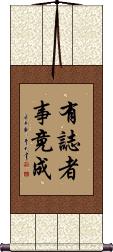
有志者事竟成 is an old Chinese proverb that has been translated many different ways into English. As you read the translations below, keep in mind that in Chinese, heart=mind.
Nothing is impossible to a willing heart.
Nothing is impossible to a willing mind.
Nothing is difficult to a willing heart.
Where there is a will, there is a way.
Nothing in the world is impossible if you set your mind to doing it.
A willful man will have his way.
If you wish it, you will do it.
A determined heart can accomplish anything.
All things are possible with a strong mind.
These search terms might be related to Possible:
Bright and Promising Future
Light / Bright and Promising Future
Potential / Momentum
Not the results for possible that you were looking for?
Below are some entries from our dictionary that may match your possible search...
| Characters If shown, 2nd row is Simp. Chinese |
Pronunciation Romanization |
Simple Dictionary Definition |
空 see styles |
kòng kong4 k`ung kung ron ろん |
More info & calligraphy: Sky / Ether / Void / Emptiness / Unreality(1) empty air; sky; (2) {Buddh} shunyata (the lack of an immutable intrinsic nature within any phenomenon); emptiness; (3) (abbreviation) (See 空軍) air force; (noun or adjectival noun) (4) fruitlessness; meaninglessness; (noun or adjectival noun) (5) (See 五大・1) void (one of the five elements); (can be adjective with の) (6) {math} empty (e.g. set); (female given name) Ron śūnya, empty, void, hollow, vacant, nonexistent. śūnyatā, 舜若多, vacuity, voidness, emptiness, non-existence, immateriality, perhaps spirituality, unreality, the false or illusory nature of all existence, the seeming 假 being unreal. The doctrine that all phenomena and the ego have no reality, but are composed of a certain number of skandhas or elements, which disintegrate. The void, the sky, space. The universal, the absolute, complete abstraction without relativity. There are classifications into 2, 3, 4, 6, 7, 11, 13, 16, and 18 categories. The doctrine is that all things are compounds, or unstable organisms, possessing no self-essence, i.e. are dependent, or caused, come into existence only to perish. The underlying reality, the principle of eternal relativity, or non-infinity, i.e. śūnya, permeates all phenomena making possible their evolution. From this doctrine the Yogācārya school developed the idea of the permanent reality, which is Essence of Mind, the unknowable noumenon behind all phenomena, the entity void of ideas and phenomena, neither matter nor mind, but the root of both. |
四諦 四谛 see styles |
sì dì si4 di4 ssu ti shitai したい |
More info & calligraphy: Four Noble Truths (Buddhism){Buddh} (See 苦集滅道) The Four Noble Truths catvāri-ārya-satyāni; 四聖諦; 四眞諦. The four dogmas, or noble truths, the primary and fundamental doctrines of Śākyamuni, said to approximate to the form of medical diagnosis. They are pain or 'suffering, its cause, its ending, the way thereto; that existence is suffering, that human passion (taṇhā, 欲 desire) is the cause of continued suffering, that by the destruction of human passion existence may be brought to an end; that by a life of holiness the destruction of human passion may be attained'. Childers. The four are 苦, 聚 (or 集), 滅, and 道諦, i. e. duḥkha 豆佉, samudaya 三牟提耶, nirodha 尼棲陀, and mārga 末加. Eitel interprets them (1) 'that 'misery' is a necessary attribute of sentient existence'; (2) that 'the 'accumulation' of misery is caused by the passions'; (3) that 'the 'extinction' of passion is possible; (4) mārga is 'the doctrine of the 'path' that leads to the extinction of passion'. (1) 苦 suffering is the lot of the 六趣 six states of existence; (2) 集 is the aggregation (or exacerbation) of suffering by reason of the passions; (3) 滅 is nirvana, the extinction of desire and its consequences, and the leaving of the sufferings of mortality as void and extinct; (4) 道 is the way of such extinction, i. e. the 八正道 eightfold correct way. The first two are considered to be related to this life, the last two to 出世間 a life outside or apart from the world. The four are described as the fundamental doctrines first preached to his five former ascetic companions. Those who accepted these truths were in the stage of śrāvaka. There is much dispute as to the meaning of 滅 'extinction' as to whether it means extinction of suffering, of passion, or of existence. The Nirvana Sutra 18 says that whoever accepts the four dogmas will put an end to births and deaths 若能見四諦則得斷生死 which does not of necessity mean the termination of existence but that of continued transmigration. v. 滅. |
地獄 地狱 see styles |
dì yù di4 yu4 ti yü jigoku じごく |
More info & calligraphy: Hell(1) {Buddh} hell realm; Naraka; (2) {Christn} Hell; (3) hell; misery; nightmare; inferno; (4) place where a volcano or hot springs constantly spew smoke or steam; (place-name) Jigoku naraka, 捺落迦 (or 那落迦) ; niraya 泥犂; explained by 不樂 joyless; 可厭 disgusting, hateful; 苦具, 苦器 means of suffering; if 地獄 earth-prison; 冥府 the shades, or departments of darkness. Earth-prison is generally intp. as hell or the hells; it may also be termed purgatory; one of the six gati or ways of transmigration. The hells are divided into three classes: I. Central, or radical, 根本地獄 consisting of (1) The eight hot hells. These were the original hells of primitive Buddhism, and are supposed to be located umder the southern continent Jambudvīpa 瞻部州, 500 yojanas below the surface. (a) 等活 or 更活 Saṃjīva, rebirth, where after many kinds of suffering a cold wind blows over the soul and returns it to this life as it was before, hence the name 等活. (b) 黑繩 Kaslasūtra, where the sufferer is bound with black chains and chopped or sawn asunder. (c) 線合; 衆合; 堆壓 Saṃghāta, where are multitudes of implements of torture, or the falling of mountains upon the sufferer. (d) 號呌; 呼呼; 叫喚 Raurava, hell of wailing. (e) 大呌; 大號呌; 大呼 Mahāraurava, hell of great wailing. (f) 炎熱; 燒炙 Tapana, hell of fames and burning. (g) 大熱; 大燒炙; 大炎熱 Pratāpana, hell of molten lead. (h) 無間; 河鼻旨; 阿惟越致; 阿毗至; 阿鼻; 阿毗 Avīci, unintermitted suffering, where sinners die and are reborn to suffer without interval. (2) The eight cold hells 八寒地獄. (a) 頞浮陀地獄 Arbuda, where the cold causes blisters. (b) 尼刺部陀 Nirarbuda, colder still causing the blisters to burst. (c) 頞哳吒; 阿吒吒 Atata, where this is the only possible sound from frozen lips. (d) 臛臛婆; 阿波波 Hahava or Apapa, where it is so cold that only this sound can be uttered. (e) 虎虎婆 Hāhādhara or Huhuva, where only this sound can be uttered. (f) 嗢鉢羅; 鬱鉢羅 (or 優鉢羅) Utpala, or 尼羅鳥 (or 漚) 鉢羅 Nīlotpala, where the skin is frozen like blue lotus buds. (g) 鉢特摩 Padma, where the skin is frozen and bursts open like red lotus buds. (h) 摩訶鉢特摩 Mahāpadma, ditto like great red lotus buds. Somewhat different names are also given. Cf. 倶舍論 8; 智度論 16; 涅槃經 11. II. The secondary hells are called 近邊地獄 adjacent hells or 十六遊增 each of its four sides, opening from each such door are four adjacent hells, in all sixteen; thus with the original eight there are 136. A list of eighteen hells is given in the 十八泥梨經. III. A third class is called the 孤地獄 (獨地獄) Lokāntarika, or isolated hells in mountains, deserts, below the earth and above it. Eitel says in regard to the eight hot hells that they range 'one beneath the other in tiers which begin at a depth of 11,900 yojanas and reach to a depth of 40,000 yojanas'. The cold hells are under 'the two Tchahavālas and range shaft-like one below the other, but so that this shaft is gradually widening to the fourth hell and then narrowing itself again so that the first and last hell have the shortest, those in the centre the longest diameter'. 'Every universe has the same number of hells, ' but 'the northern continent has no hell whatever, the two continents east and west of Meru have only small Lokāntarika hells... whilst all the other hells are required for the inhabitants of the southern continent '. It may be noted that the purpose of these hells is definitely punitive, as well as purgatorial. Yama is the judge and ruler, assisted by eighteen officers and a host of demons, who order or administer the various degrees of torture. 'His sister performs the same duties with regard to female criminals, ' and it may be mentioned that the Chinese have added the 血盆池 Lake of the bloody bath, or 'placenta tank' for women who die in childbirth. Release from the hells is in the power of the monks by tantric means. |
體貼入微 体贴入微 see styles |
tǐ tiē rù wēi ti3 tie1 ru4 wei1 t`i t`ieh ju wei ti tieh ju wei |
More info & calligraphy: Consideration / Meticulous Care |
愈 see styles |
yù yu4 yü masaru まさる |
the more...(the more...); to recover; to heal; better (adverb) (archaism) more and more; increasingly; (adverb) (1) (kana only) more and more; all the more; increasingly; (2) (kana only) at last; finally; beyond doubt; (3) (kana only) (at the) last moment; worst possible time; (given name) Masaru to heal |
にも see styles |
nimo ニモ |
(expression) (1) also; too; not ... either; as well; even; (expression) (2) (after the volitional or dictionary form of verb) (it's not possible) no matter what; although one might wish otherwise; (female given name) Nimo |
一択 see styles |
ittaku いったく |
(slang) (only) one option; one possible choice |
不可 see styles |
bù kě bu4 ke3 pu k`o pu ko yobazu よばず |
cannot; should not; must not (adj-no,adj-na,n,n-suf) (1) wrong; bad; improper; unjustifiable; inadvisable; (adj-no,adj-na,n,n-suf) (2) not allowed; not possible; (3) failing grade; (place-name) Yobazu May not, can not: unpermissible, for-bidden; unable. Buke, the name of a monk of the 靈妙寺 Ling Miao monastery in the Tang dynasty, a disciple of Subha-karāṣimha, and one of the founders of 眞言 Shingon. |
仏種 see styles |
busshu ぶっしゅ |
(1) (Buddhist term) seed of Buddhahood; (2) something that makes it possible to attain Buddhahood; (3) teaching of Buddha which make it possible to be enlightened |
但願 但愿 see styles |
dàn yuàn dan4 yuan4 tan yüan |
if only (something were possible); I wish (that) |
佛種 佛种 see styles |
fó zhǒng fo2 zhong3 fo chung busshu ぶっしゅ |
(1) (Buddhist term) seed of Buddhahood; (2) something that makes it possible to attain Buddhahood; (3) teaching of Buddha which make it possible to be enlightened The seed of Buddhahood; bodhisattva seeds which, sown in the heart of man, produce the Buddha fruit, enlightenment. |
側筆 see styles |
sokuhitsu そくひつ |
(See 直筆・ちょくひつ・1) painting with the body of a brush's bristles (to create a thicker line than possible with the tip) |
備至 备至 see styles |
bèi zhì bei4 zhi4 pei chih |
to the utmost; in every possible way |
儘快 尽快 see styles |
jǐn kuài jin3 kuai4 chin k`uai chin kuai |
as quickly as possible; as soon as possible |
儘早 尽早 see styles |
jǐn zǎo jin3 zao3 chin tsao |
as early as possible |
儘量 尽量 see styles |
jǐn liàng jin3 liang4 chin liang |
as much as possible; to the greatest extent |
利く see styles |
kiku きく |
(v5k,vi) (1) to be effective; to show effect; (2) to do its work; to carry out its function well; (3) to be possible to use |
効く see styles |
kiku きく |
(v5k,vi) (1) to be effective; to show effect; (2) to do its work; to carry out its function well; (3) to be possible to use |
十地 see styles |
shí dì shi2 di4 shih ti juuji / juji じゅうじ |
{Buddh} dasabhumi (forty-first to fiftieth stages in the development of a bodhisattva); (place-name) Jūji daśabhūmi; v. 十住. The "ten stages" in the fifty-two sections of the development of a bodhisattva into a Buddha. After completing the十四向 he proceeds to the 十地. There are several groups. I. The ten stages common to the Three Vehicles 三乘 are: (1) 乾慧地 dry wisdom stage, i. e. unfertilized by Buddha-truth, worldly wisdom; (2) 性地 the embryo-stage of the nature of Buddha-truth, the 四善根; (3) 八人地 (八忍地), the stage of the eight patient endurances; (4) 見地 of freedom from wrong views; (5) 薄地 of freedom from the first six of the nine delusions in practice; (6) 離欲地 of freedom from the remaining three; (7) 巳辨地 complete discrimination in regard to wrong views and thoughts, the stage of an arhat; (8) 辟支佛地 pratyeka-buddhahood, only the dead ashes of the past left to sift; (9) 菩薩地 bodhisattvahood; (10) 佛地 Buddhahood. v. 智度論 78. II. 大乘菩薩十地 The ten stages of Mahāyāna bodhisattva development are: (1) 歡喜地 Pramuditā, joy at having overcome the former difficulties and now entering on the path to Buddhahood; (2) 離垢地 Vimalā, freedom from all possible defilement, the stage of purity; (3) 發光地 Prabhākarī, stage of further enlightenment; (4) 焰慧地 Arciṣmatī, of glowing wisdom; (5) 極難勝地 Sudurjayā, mastery of utmost or final difficulties; (6) 現前地 Abhimukhī, the open way of wisdom above definitions of impurity and purity; (7) 遠行地 Dūraṁgamā, proceeding afar, getting above ideas of self in order to save others; (8) 不動地 Acalā, attainment of calm unperturbedness; (9) 善慧地 Sādhumatī, of the finest discriminatory wisdom, knowing where and how to save, and possessed of the 十力 ten powers; (10) 法雲地 Dharmamegha, attaining to the fertilizing powers of the law-cloud. Each of the ten stages is connected with each of the ten pāramitās, v. 波. Each of the 四乘 or four vehicles has a division of ten. III. The 聲聞乘十地 ten Śrāvaka stages are: (1) 受三歸地 initiation as a disciple by receiving the three refuges, in the Buddha, Dharma, and Saṅgha; (2) 信地 belief, or the faith-root; (3) 信法地 belief in the four truths; (4) 内凡夫地 ordinary disciples who observe the 五停心觀, etc.; (5) 學信戒 those who pursue the 三學 three studies; (6) 八人忍地 the stage of 見道 seeing the true Way; (7) 須陀洹地 śrota-āpanna, now definitely in the stream and assured of nirvāṇa; (8) 斯陀含地 sakrdāgāmin, only one more rebirth; (9) 阿那含地 anāgāmin, no rebirth; and (10) 阿羅漢地 arhatship. IV. The ten stages of the pratyekabuddha 緣覺乘十地 are (1) perfect asceticism; (2) mastery of the twelve links of causation; (3) of the four noble truths; (4) of the deeper knowledge; (5) of the eightfold noble path; (6) of the three realms 三法界; (7) of the nirvāṇa state; (8) of the six supernatural powers; (9) arrival at the intuitive stage; (10) mastery of the remaining influence of former habits. V. 佛乘十地 The ten stages, or characteristics of a Buddha, are those of the sovereign or perfect attainment of wisdom, exposition, discrimination, māra-subjugation, suppression of evil, the six transcendent faculties, manifestation of all bodhisattva enlightenment, powers of prediction, of adaptability, of powers to reveal the bodhisattva Truth. VI. The Shingon has its own elaborate ten stages, and also a group 十地十心, see 十心; and there are other groups. |
単穴 see styles |
tanana たんあな |
{horse} possible winner (in a horse race); third favorite |
即早 see styles |
jí zǎo ji2 zao3 chi tsao |
as soon as possible |
及早 see styles |
jí zǎo ji2 zao3 chi tsao |
at the earliest possible time; as soon as possible |
可令 see styles |
kě lìng ke3 ling4 k`o ling ko ling karyō |
possible |
可以 see styles |
kě yǐ ke3 yi3 k`o i ko i ka i |
can; may; possible; able to; not bad; pretty good can |
可否 see styles |
kě fǒu ke3 fou3 k`o fou ko fou kahi かひ |
is it possible or not? (noun - becomes adjective with の) (1) propriety; right and wrong; advisability; possibility; (noun - becomes adjective with の) (2) pro and con; ayes and noes |
可能 see styles |
kě néng ke3 neng2 k`o neng ko neng kanou / kano かのう |
might (happen); possible; probable; possibility; probability; maybe; perhaps; CL:個|个[ge4] (noun or adjectival noun) possible; potential; practicable; feasible; (surname) Kanou able |
可通 see styles |
kě tōng ke3 tong1 k`o t`ung ko tung katsuu / katsu かつう |
passable; possible to reach (given name) Katsuu |
哀勸 哀劝 see styles |
āi quàn ai1 quan4 ai ch`üan ai chüan |
to persuade by all possible means; to implore |
四取 see styles |
sì qǔ si4 qu3 ssu ch`ü ssu chü shishu |
catuḥ-parāmarśa, the four attachments, i. e. desire, (unenlightened) views, (fakir) morals, and ideas arising from the conception of the self. Also, the possible delusions of the 四住地. Also, seeking fame in the four quarters. |
奈落 see styles |
nài luò nai4 luo4 nai lo naraku ならく |
(1) (Buddhist term) Naraka (san: naraka); hell; hades; (2) very bottom; the end; worst possible circumstances; (3) theatre basement; theater basement hell |
Click here for more possible results from our dictionary
The following table may be helpful for those studying Chinese or Japanese...
| Title | Characters | Romaji (Romanized Japanese) | Various forms of Romanized Chinese | |
| To a Willing Heart, All Things Are Possible | 有志者事竟成 / 有誌者事竟成 有志者事竟成 | yǒu zhì zhě shì jìng chéng you3 zhi4 zhe3 shi4 jing4 cheng2 you zhi zhe shi jing cheng youzhizheshijingcheng | yu chih che shih ching ch`eng yuchihcheshihchingcheng yu chih che shih ching cheng |
|
| In some entries above you will see that characters have different versions above and below a line. In these cases, the characters above the line are Traditional Chinese, while the ones below are Simplified Chinese. | ||||

Successful Chinese Character and Japanese Kanji calligraphy searches within the last few hours...



