Many custom options...


And formats...



Practical in Chinese / Japanese...
Buy a Practical calligraphy wall scroll here!
Personalize your custom “Practical” project by clicking the button next to your favorite “Practical” title below...
3. Keep Your Feet on the Ground
4. Wisdom comes from Experience
5. Toyama-Ryu
Realistic / Practical
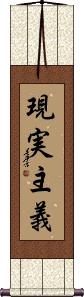
現実主義 means realistic or practical in Japanese.
If you need a reminder to remain grounded in your life, this is a great way to do that.
Realistic / Practical
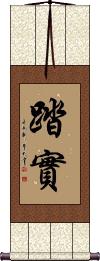
踏實 means realistic or practical.
If you need a reminder to remain grounded in your life, this is a great way to do that. 踏實 also can have the meanings of “at ease,” “down to earth,” “to have peace of mind,” “free from anxiety,” steady, or steadfast.
Reality / Realistic
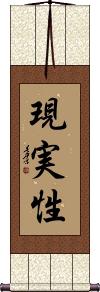
現実性 is a Japanese word that expresses the idea of reality or coming to understand what is true and real.
This can also be translated as realistic, practical, or feasible.
See Also: Illusion
Keep Your Feet on the Ground
Be Down-to-Earth
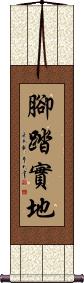
腳踏實地 is a four-character proverb that suggests that you should be practical, realistic, and grounded.
Some translate this as a suggestion to be down-to-earth.
The first character means “feet.”
The second means “step on” or “stand.”
The third means “solid,” “real,” or “true.”
The last character means “ground,” “earth,” or “terra.”
Literally, this means “[keep your] Feet Standing [on] Solid Ground.”
Wisdom comes from Experience
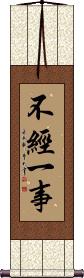
不經一事 means “You can't gain knowledge without practical experience.”
This is the short form (first half) of a longer Chinese proverb. These 4 characters remind you that wisdom only comes from experience.
Toyama-Ryu

戸山流 or Toyama-Ryu is a relatively modern Japanese swordsmanship style (gendai budo) developed in the early 20th century at the Toyama Military Academy in Japan.
It was designed to efficiently train Imperial Japanese Army officers in swordsmanship, with a focus on practical application for battlefield use.
Self-Discipline and Martial Virtue

克己武術 can be translated as “Self-Discipline Martial Arts Techniques,” or “Self-Discipline and Martial Virtue.”
克己 = Self-mastery, or overcome the self.
武術 = Martial techniques/arts, or practical combat methods.
Self-mastery; overcome the self. Martial techniques/arts; practical combat methods.
Kenjutsu / Kenjitsu
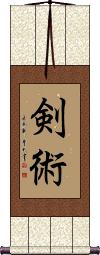
In Japanese, the modern definition, using simple terms, 剣術 is “A martial art involving swords” or “The art of the sword.”
However, in Chinese, this is the word for fencing (as in the Olympic sport).
I will suppose that you want this for the Japanese definition, which comes from skills and techniques developed in the 15th century. At that time, Kenjutsu (or swordsmanship) was a strictly military art taught to Samurai and Bushi (soldiers). The fact that swords are rarely used in military battles anymore, and with the pacification of Japan after WWII, Kenjutsu is strictly a ceremonial practice often studied as a form of martial art (more for the discipline aspect rather than practical purpose).
Language note: The Korean definition is close to the Japanese version described above. However, it should be noted that this can mean “fencing” depending on the context in Japanese, Chinese, and Korean.

 Character variation notes: There are slight variations possible with the second character. Either way is correct and understood by both Japanese and Chinese folks.
Since there are about 5 common ways to write the sword character, if you are particular about which version you want, please note that in the “special instructions” when you place your order.
Romanization note: This term is often Romanized as Kenjitsu; however, following the rules of Japanese Romaji, it should be Kenjutsu.
These search terms might be related to Practical:
Do No Harm / Harmless
Eternal Energy / Eternal Matter
Fear No Evil
Fear No Man / Fear Nothing
Fire and Water Have No Mercy
Handy
Healing Hands
Hold Hands With You, Grow Old With You
Honorable Death - No Surrender
Ichigo No Hana / Strawberry Flower
Jiko No Kansei / Self-Completion
Kawa No Kami / River God
Kemo No Shin
Kokoro No Heiwa
Kokoro No Michi
Kunshi No Ken
Makoto No Kokoro
Mind Over Matter
Mono No Aware
Mujo No Kaze / Wind of Impermanence
No Apologies
No Arrogance in Victory, No Despair in Defeat
No Fear
No Guts, No Glory
No Limitations
No Limits
No Man Knows What He Owes to His Parents Until He Comes to Have Children of His Own
No Mercy
No Mind / Mushin
No One Knows a Son Better Than the Father
No Pain No Gain
No Place Like Home
No Rain No Flowers
No Regrets
No Surrender
No Trouble / Freedom From Problems
No Worries
Osu No Seishin
Preparation Yields No Fear or Worries
Preparation Yields No Regrets
Pushing Hands / Tui Sau
Realistic / Practical
Reality / Realistic
Rose Flowers Given, Frangrance Remains on Hands of Giver
Safe and Sound
Shingeki No Kyojin
Shinobi No Mono
Spare No Effort
Sticky Hands / Chi Sau
The Brave Have No Fears
The Great Path Has No Gate
The Sea of Knowledge Has No Limits
The Way of Learning Has No End
There is No God but Allah, and Muhammad is His Messenger
There is No Pleasure Without Pain
There is No Royal Road to Learning
There’s No Place Like Home
Time and Tide Wait for No Man
Time Waits for No One
Trust No One / Trust No Man
Tsuki No Kokoro / Mind Like the Moon
The following table may be helpful for those studying Chinese or Japanese...
| Title | Characters | Romaji (Romanized Japanese) | Various forms of Romanized Chinese | |
| Realistic Practical | 現実主義 | genjitsu shugi / genjisu syugi | ||
| Realistic Practical | 踏實 踏实 | tā shí / ta1 shi2 / ta shi / tashi | t`a shih / tashih / ta shih | |
| Reality Realistic | 現実性 | gen jitsu sei genjitsusei | ||
| Keep Your Feet on the Ground | 腳踏實地 脚踏实地 | jiǎo tà shí dì jiao3 ta4 shi2 di4 jiao ta shi di jiaotashidi | chiao t`a shih ti chiaotashihti chiao ta shih ti |
|
| Wisdom comes from Experience | 不經一事 不经一事 | bù jīng yī shì bu4 jing1 yi1 shi4 bu jing yi shi bujingyishi | pu ching i shih puchingishih |
|
| Toyama-Ryu | 戸山流 | to yama ryuu toyamaryuu to yama ryu | ||
| Self-Discipline and Martial Virtue | 克己武術 | kokki bu jutsu kokkibujutsu koki bu jutsu | kè jǐ wǔ shù ke4 ji3 wu3 shu4 ke ji wu shu kejiwushu | k`o chi wu shu kochiwushu ko chi wu shu |
| Kenjutsu Kenjitsu | 剣術 剑术 | kenjutsu | jiàn shù / jian4 shu4 / jian shu / jianshu | chien shu / chienshu |
| In some entries above you will see that characters have different versions above and below a line. In these cases, the characters above the line are Traditional Chinese, while the ones below are Simplified Chinese. | ||||

Successful Chinese Character and Japanese Kanji calligraphy searches within the last few hours...



