Many custom options...


And formats...



Prepare in Chinese / Japanese...
Buy a Prepare calligraphy wall scroll here!
Appreciation and Love for Your Parents
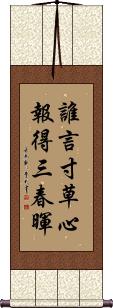
誰言寸草心報得三春暉 is the last line of a famous poem. It is perceived as a tribute or ode to your parents or mother from a child or children that have left home.
The poem was written by Meng Jiao during the Tang Dynasty (about 1200 years ago). The Chinese title is “You Zi Yin” which means “The Traveler's Recite.”
The last line as shown here speaks of the generous and warm spring sunlight which gives the grass far beyond what the little grass can could ever give back (except perhaps by showing its lovely green leaves and flourishing). The metaphor is that the sun is your mother or parents, and you are the grass. Your parents raise you and give you all the love and care you need to prepare you for the world. A debt that you can never repay, nor is repayment expected.
The first part of the poem (not written in the characters to the left) suggests that the thread in a loving mother's hands is the shirt of her traveling offspring. Vigorously sewing while wishing them to come back sooner than they left.
...This part is really hard to translate into English that makes any sense but maybe you get the idea. We are talking about a poem that is so old that many Chinese people would have trouble reading it (as if it was the King James Version of Chinese).
These search terms might be related to Prepare:
A Wise Person Reflecting a Thousand Times Can Still Make a Mistake
Better to Choose Nothing, Rather Than Make a Poor Choice
Groom
Life is What You Make It
Life is What You Make of It
Make Guests Feel at Home
One Frost Doesn't Make Winter
One Swallow Doesn’t Make a Summer
Practice / Train / Drill
Training / Practice / Cultivation
Not the results for prepare that you were looking for?
Below are some entries from our dictionary that may match your prepare search...
| Characters If shown, 2nd row is Simp. Chinese |
Pronunciation Romanization |
Simple Dictionary Definition |
備 备 see styles |
bèi bei4 pei sonae そなえ |
(bound form) to prepare; to equip; (literary) fully; completely (surname, female given name) Sonae (be) provided with |
庀 see styles |
pǐ pi3 p`i pi |
to prepare |
庤 see styles |
zhì zhi4 chih |
to prepare |
殮 殓 see styles |
liàn lian4 lien |
to prepare a dead body for coffin |
治 see styles |
zhì zhi4 chih haru はる |
to rule; to govern; to manage; to control; to harness (a river); to treat (a disease); to wipe out (a pest); to punish; to research (1) (rare) politics; government; administration; rule; (2) (rare) (See 治に居て乱を忘れず) (ant: 乱) peace; (3) (archaism) medical treatment; cure; (surname, given name) Haru Rule, govern; prepare; treat, cure; repress, punish. |
籌 筹 see styles |
chóu chou2 ch`ou chou hikaru ひかる |
chip (in gambling); token (for counting); ticket; to prepare; to plan; to raise (funds); resource; way; means (archaism) wooden skewer used for counting; (given name) Hikaru To calculate, devise, plan; a tally. |
蕆 蒇 see styles |
chǎn chan3 ch`an chan |
to complete; to prepare |
辦 办 see styles |
bàn ban4 pan ben |
to take care of (a matter); to deal with (a task, procedure etc); to organize (an event); to establish; to set up; to manage; to run (an enterprise); (law) to handle; to investigate; to prosecute (a case or suspect); (bound form) office (as in 招辦|招办[zhao1 ban4], admissions office) (abbr. for 辦公室|办公室[ban4 gong1 shi4]) To transact, carry out; prepare; punish. |
預 预 see styles |
yù yu4 yü ranzou / ranzo らんぞう |
to advance; in advance; beforehand; to prepare (personal name) Ranzou At ease, contented, pleased; arranged, provided for; beforehand; an autumn trip. |
下廚 下厨 see styles |
xià chú xia4 chu2 hsia ch`u hsia chu |
to go to the kitchen (to prepare a meal); to cook |
作る see styles |
tsukuru つくる |
(transitive verb) (1) to make; to produce; to manufacture; to build; to construct; (2) to prepare (food term); to brew (alcohol); (3) to raise; to grow; to cultivate; to train; (4) to till; (5) to draw up (a document); to make out; to prepare; to write; (6) to create (an artistic work, etc.); to compose; (7) to coin (a phrase); to organize; to organise; to establish; to found; (8) to have (a child); (9) to make up (one's face, etc.); (10) to fabricate (an excuse, etc.); (11) to form (a line, etc.); (12) to set (a record); (13) to commit (a sin, etc.) |
候場 候场 see styles |
hòu chǎng hou4 chang3 hou ch`ang hou chang |
(of an actor, athlete etc) to prepare to make one's entrance; to wait in the wings |
做飯 做饭 see styles |
zuò fàn zuo4 fan4 tso fan |
to prepare a meal; to cook |
備下 备下 see styles |
bèi xià bei4 xia4 pei hsia |
to prepare; to arrange (something to be offered) |
備戰 备战 see styles |
bèi zhàn bei4 zhan4 pei chan |
prepared against war; to prepare for war; warmongering |
備料 备料 see styles |
bèi liào bei4 liao4 pei liao |
to get the materials ready; to prepare feed (for livestock) |
備考 备考 see styles |
bèi kǎo bei4 kao3 pei k`ao pei kao bikou / biko びこう |
to prepare for an exam; (of an appendix, note etc) for reference note (for reference); remarks; N.B. |
備荒 备荒 see styles |
bèi huāng bei4 huang1 pei huang bikou / biko びこう |
to prepare against natural disasters provision for famine |
具す see styles |
gusu ぐす |
(Godan verb with "su" ending) (1) (See 具する) to accompany; to follow; (2) to assemble (necessary items); to prepare |
刷題 刷题 see styles |
shuā tí shua1 ti2 shua t`i shua ti |
to do a lot of practice questions (to prepare for an exam) |
創る see styles |
tsukuru つくる |
(transitive verb) (1) to make; to produce; to manufacture; to build; to construct; (2) to prepare (food term); to brew (alcohol); (3) to raise; to grow; to cultivate; to train; (4) to till; (5) to draw up (a document); to make out; to prepare; to write; (6) to create (an artistic work, etc.); to compose; (7) to coin (a phrase); to organize; to organise; to establish; to found; (8) to have (a child); (9) to make up (one's face, etc.); (10) to fabricate (an excuse, etc.); (11) to form (a line, etc.); (12) to set (a record); (13) to commit (a sin, etc.) |
受死 see styles |
shòu sǐ shou4 si3 shou ssu |
to submit to death; prepare to die!; meet your doom! |
悉修 see styles |
xī xiū xi1 xiu1 hsi hsiu shisshu |
to prepare |
捌く see styles |
sabaku さばく |
(transitive verb) (1) (kana only) to handle well; to handle deftly; (transitive verb) (2) (kana only) to deal with; to manage; to settle; to sort; to process; (transitive verb) (3) (kana only) to prepare (meat or fish) for cooking; to dress (meat, etc.); to cut and trim (fish); (transitive verb) (4) (kana only) to sell out (completely); to dispose of (all stock); (transitive verb) (5) (kana only) to untangle; to disentangle; to part; to arrange (e.g. the hem of a kimono) |
掌廚 掌厨 see styles |
zhǎng chú zhang3 chu2 chang ch`u chang chu |
to prepare meals; chef |
整地 see styles |
zhěng dì zheng3 di4 cheng ti seichi / sechi せいち |
to prepare the soil (agriculture) (n,vs,vt,vi) (1) levelling of ground (for construction); (n,vs,vt,vi) (2) preparation of soil (for planting) |
整治 see styles |
zhěng zhì zheng3 zhi4 cheng chih seiji / seji せいじ |
to bring under control; to regulate; to restore to good condition; (coll.) to fix (a person); to prepare (a meal etc) (given name) Seiji |
期す see styles |
gosu ごす |
(vs-c,vi) (1) (See 期する・ごする・2) to expect; to hope for; to look forward to; to foresee; to anticipate; (vs-c,vi) (2) (See 期する・ごする・3) to resolve (to do); to decide upon; to prepare for; to promise; to pledge |
樹人 树人 see styles |
shù rén shu4 ren2 shu jen tatsuhito たつひと |
to prepare children to become capable citizens (personal name) Tatsuhito |
氽湯 氽汤 see styles |
tǔn tāng tun3 tang1 t`un t`ang tun tang |
to prepare a soup |
Click here for more prepare results from our dictionary
The following table may be helpful for those studying Chinese or Japanese...
| Title | Characters | Romaji (Romanized Japanese) | Various forms of Romanized Chinese | |
| Appreciation and Love for Your Parents | 誰言寸草心報得三春暉 谁言寸草心报得三春晖 | shuí yán cùn cǎo xīn bào dé sān chūn huī shui2 yan2 cun4 cao3 xin1 bao4 de2 san1 chun1 hui1 shui yan cun cao xin bao de san chun hui | shui yen ts`un ts`ao hsin pao te san ch`un hui shui yen tsun tsao hsin pao te san chun hui |
|
| In some entries above you will see that characters have different versions above and below a line. In these cases, the characters above the line are Traditional Chinese, while the ones below are Simplified Chinese. | ||||

Successful Chinese Character and Japanese Kanji calligraphy searches within the last few hours...



