Many custom options...


And formats...



Not what you want?
Try other similar-meaning words, fewer words, or just one word.
Protection Symbol in Chinese / Japanese...
Buy a Protection Symbol calligraphy wall scroll here!
Personalize your custom “Protection Symbol” project by clicking the button next to your favorite “Protection Symbol” title below...
1. Protection
4. Under the Protection of the Dragon Saint
5. God Bless You / God Be With You
6. Goshin-Kai
7. Goshin-Do
9. Shield
10. Divine Blessing
12. God Bless You / May God Protect You
13. Warrior Saint / Saint of War
14. Protector
15. Guan Yu
Protection
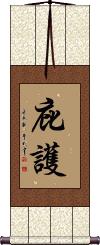
庇護 is not the most common word for a wall scroll, but this is the word for protection in Chinese, Japanese Kanji, and old Korean Hanja.
庇護 is the non-religious, non-superstitious form of protection.
庇護 can be translated as shelter, shield, defend, safeguard, take under one's wing, to put under protection. In a certain context, it means to grant asylum or give refuge and sanctuary.
See Also: Guardian Angel
Blessings and Protection
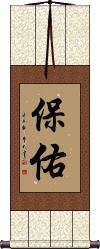
保佑 is the more religious and sometimes superstitious word for protection in Chinese. It's sort of a blessing of protection and is often translated as “bless and protect,” “blessing,” or “to bless.”
This would be used as the protection or blessing that a deity (such as God) would bestow upon you. It is not religion-specific in the same way a language cannot be specific to any religion.
 Note: Sometimes the second character is written in the form shown to the right. Let us know if you have a preference when you place your order.
See Also: Guardian Angel
Blessings and Protection
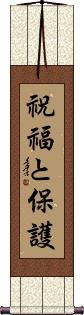
祝福と保護 means “blessings and protection,” in Japanese.
Divine Protection
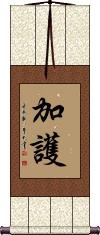
加護 is Japanese for “divine protection” or “the saving grace of God.”
Please consider this blessing to be Japanese only. This can have the same meaning in the context of Buddhism in Chinese, but it's also a nickname for “intensive care” at Chinese hospitals.
Note: My Japanese translator says this is not commonly used in Japanese. I added this because a customer asked for it. There is no better Japanese phrase to express this idea - so this is it if you want it.
Under the Protection of the Dragon Saint
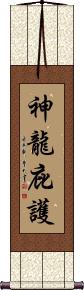
神龍庇護 is not the most common thing to say in Chinese, but it is grammatically correct and a cool title.
The first character means “supernatural or saintly.” The second is “dragon.” The last two mean protection. You could also translate this as something like “Protected by the Dragon God” or more closely “Holy Dragon.”
God Bless You / God Be With You
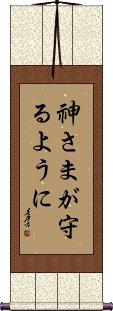
神さまが守るように is about as close as you can get to, “God Bless You” in Japanese.
This literally means “[May] God Protect [You].” It can also mean “God is Always With You,” as the word in this phrase that means “protect” can also mean to follow or be with. In fact, the Japanese dictionary entry for that word reads like this: to protect; to guard; to defend; to keep (i.e. a promise); to abide; to observe; to follow.
Note: Because this selection contains some special Japanese Hiragana characters, it should be written by a Japanese calligrapher.
Goshin-Kai
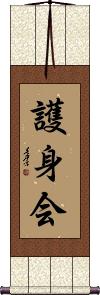
護身会 is the title for the Goshin-Kai school of Japanese martial arts.
護身 (Goshin) means self-protection, protection of the body.
会 (Kai) means meeting, assembly, society, association, or club.
Goshin-Do
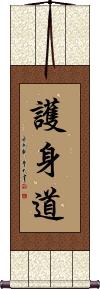
護身道 is the title for the school of martial arts known as Goshin-Do.
The literal translation of these three characters is something like “self-protection way” or “protection of the body way.”
To put this in context, the term 護身 is often used for charms or amulets that are meant to protect the wearer from harm.
Note: This phrase is pronounceable in Chinese, but it not commonly known in China.
Love and Protect
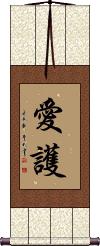
愛護 is the Chinese and Japanese Kanji for cherish, to treasure, to take care of, to love and protect, to provide loving protection, or tender care.
Shield
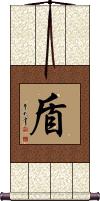
盾 is the single character for “shield” in Chinese, Japanese Kanji, and old Korean Hanja.
This can also be translated as escutcheon, protection, buckler, or aegis.
Divine Blessing
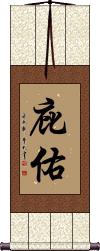
庇佑 is a Chinese way to say “divine blessing.”
This can also mean: to bless, to protect, or divine protection.
Also written as 庇祐 (variant second character).
Soldier of the Gods
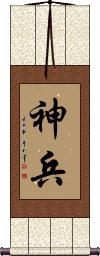
神兵 is a Japanese, Chinese, and Korean title that means “soldier dispatched by a god,” or “soldier under the protection of the gods.”
神兵 is used more in Japanese (especially in animation) than the other languages.
God Bless You / May God Protect You
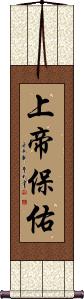
上帝保佑 is a blessing exchanged between Chinese Christians.
The first two characters mean God (The God of Zion). The second two characters express the idea of giving protection. Another way to translate this is “May God protect you.”
See Also: Guardian Angel
Warrior Saint / Saint of War
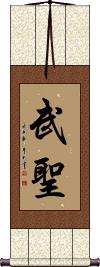
This Chinese title, Wusheng, means Saint of War.
武聖 is usually a reference to Guan Yu (關羽), also known as Guan Gong (關公).
Some Chinese soldiers still pray to Wusheng for protection. They would especially do this before going into battle.
Protector
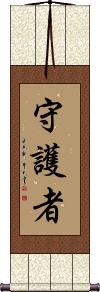
守護者 is a Chinese, Japanese Kanji, and old Korean Hanja title for a protector, watcher, or keeper.
The character breakdown:
守護 = to guard; to protect; protection; safeguard.
者 = person; someone of that nature; someone doing that work, the one [who, which].
From this breakdown, you can translate this as “The one who protects,” “Someone who safeguards,” or “guardian.”
Guan Yu
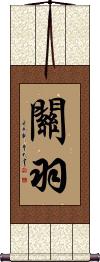
關羽 is the name Guan Yu, Army General for the Kingdom of Shu.
He is also known as Guan Gong (like saying Duke Guan or Sir Guan)
He was immortalized in the novel, “Romance of the Three Kingdoms.”
He was a fearsome fighter, also famous for his virtue and loyalty. He is worshiped by some modern-day soldiers and has the title “Warrior Saint” in China. Some believe he offers safety and protection for military servicemen.
Guan Yu lived until 219 A.D.
Guan Gong / Warrior Saint
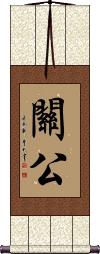
關公 is a Chinese title, Guan Gong, that means Lord Guan (The warrior saint of ancient China).
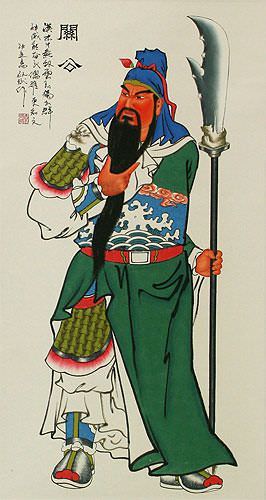 While his real name was Guan Yu / 關羽, he is commonly known by the title of Guan Gong (關公).
Some Chinese soldiers still pray to Guan Gong for protection. They would especially do this before going into battle. Statues of Guan Gong are seen throughout China.
Crisis equals Danger plus Opportunity?
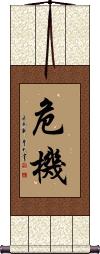
危機 means crisis in Chinese and Japanese.
Separately, the first character here does mean “danger” or “to endanger,” and the second character can mean “opportunity.”
However, I want to debunk a myth that was propagated by some westerners who did not have a clear understanding of Asian languages...
While often, Chinese/Japanese/Korean compound words (words of two or more characters) are the sum of their parts, this is not always the case. The compound is often understood with a completely different meaning than the two characters individually.
Many have said that the Chinese/Japanese/Korean word for Crisis is made up of the characters for “danger” and “opportunity.” 危機 is true when phrased this way.
However, it's not absolutely correct to say that “danger + opportunity = crisis” in Asian cultures.
English example:
If I tell you that...
Bovine creature + Guy behind the plate in baseball = Locomotive train protection

...you would think I was mad. But consider that “cow + catcher = cowcatcher,” which is the device that used to be found on steam engines to protect them if they hit an animal on the tracks. When we hear the word “cowcatcher,” we don't separate the words into their individual meanings (necessarily).
The same is true with the word for crisis in Chinese/Japanese/Korean. While you can separate the characters, few Asian people would automatically do so in their minds.
The final answer:
It is a half-truth to say, “danger plus opportunity equals crisis” in Chinese/Japanese/Korean. Use this statement and concept with caution.
Also, the second character can mean “secret” or “machine,” depending on context so I guess you have to say “a dangerous machine = crisis” or “danger + a secret = crisis.” Both of these are only slightly more ridiculous than the first premise.
PS: 危機 is probably not a great word for a scroll unless you have a special use for it.
This in-stock artwork might be what you are looking for, and ships right away...


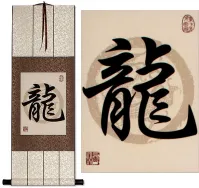




Gallery Price: $200.00
Your Price: $124.88

Gallery Price: $200.00
Your Price: $98.88

Gallery Price: $40.00
Your Price: $16.88
The following table may be helpful for those studying Chinese or Japanese...
| Title | Characters | Romaji (Romanized Japanese) | Various forms of Romanized Chinese | |
| Protection | 庇護 庇护 | hi go / higo | bì hù / bi4 hu4 / bi hu / bihu | pi hu / pihu |
| Blessings and Protection | 保佑 / 保祐 保佑 | bǎo yòu / bao3 you4 / bao you / baoyou | pao yu / paoyu | |
| Blessings and Protection | 祝福と保護 | shukufuku to hogo shukufukutohogo | ||
| Divine Protection | 加護 加护 | ka go / kago | jiā hù / jia1 hu4 / jia hu / jiahu | chia hu / chiahu |
| Under the Protection of the Dragon Saint | 神龍庇護 神龙庇护 | shén lóng bì hù shen2 long2 bi4 hu4 shen long bi hu shenlongbihu | shen lung pi hu shenlungpihu |
|
| God Bless You God Be With You | 神さまが守るように | kami sa ma ga mamo ru you ni kamisamagamamoruyouni kami sa ma ga mamo ru yo ni | ||
| Goshin-Kai | 護身会 护身会 | go shin kai goshinkai | ||
| Goshin-Do | 護身道 护身道 | gou shin dou goushindou go shin do | hù shēn dào hu4 shen1 dao4 hu shen dao hushendao | hu shen tao hushentao |
| Love and Protect | 愛護 爱护 | ai go / aigo | ài hù / ai4 hu4 / ai hu / aihu | |
| Shield | 盾 | tate | dùn / dun4 / dun | tun |
| Divine Blessing | 庇佑 / 庇祐 庇佑 | bì yòu / bi4 you4 / bi you / biyou | pi yu / piyu | |
| Soldier of the Gods | 神兵 | shin pei / shinpei | shén bīng shen2 bing1 shen bing shenbing | shen ping shenping |
| God Bless You May God Protect You | 上帝保佑 | shàng dì bǎo yòu shang4 di4 bao3 you4 shang di bao you shangdibaoyou | shang ti pao yu shangtipaoyu |
|
| Warrior Saint Saint of War | 武聖 武圣 | wǔ shèng / wu3 sheng4 / wu sheng / wusheng | ||
| Protector | 守護者 守护者 | shu go sha / shugosha | shǒu hù zhě shou3 hu4 zhe3 shou hu zhe shouhuzhe | shou hu che shouhuche |
| Guan Yu | 關羽 关羽 | guān yǔ / guan1 yu3 / guan yu / guanyu | kuan yü / kuanyü | |
| Guan Gong Warrior Saint | 關公 关公 | guān gōng guan1 gong1 guan gong guangong | kuan kung kuankung |
|
| Crisis equals Danger plus Opportunity? | 危機 危机 | kiki | wēi jī / wei1 ji1 / wei ji / weiji | wei chi / weichi |
| In some entries above you will see that characters have different versions above and below a line. In these cases, the characters above the line are Traditional Chinese, while the ones below are Simplified Chinese. | ||||

Successful Chinese Character and Japanese Kanji calligraphy searches within the last few hours...



