Many custom options...


And formats...



Pursue in Chinese / Japanese...
Buy a Pursue calligraphy wall scroll here!
Personalize your custom “Pursue” project by clicking the button next to your favorite “Pursue” title below...
2. Seek / Quest
5. No Surrender
6. Realize Your Ambitions / Embrace Your Ambition
Pursue Your Dreams
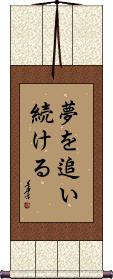
夢を追い続ける is the Japanese way to express “pursue your dreams,” “follow your dreams,” or “chase your dreams.”
If you have dreams that you want to pursue and make true, this is the phrase for you.
The first character is “dream” or “dreams.” The rest of the characters establish the idea of chasing or pursuing.
Note: Because this selection contains some special Japanese Hiragana characters, it should be written by a Japanese calligrapher.
See Also: Pursuit of Happiness
Pursue Your Dreams
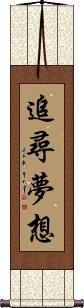
追尋夢想 means “pursue your dreams,” “follow your dreams,” or “chase your dreams” in Chinese.
The first two characters mean “to pursue,” “to track down,” or “to search for.”
The last two mean dreams. This version of dreams refers to those with an element of reality (not the dreams you have when you sleep but rather your aspirations or goals in life).
This title will tell everyone that you want to make your dreams come true.
See Also: Pursuit of Happiness
Seek / Quest
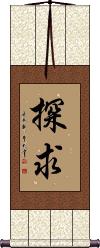
探求 means: to seek; to pursue; to investigate; quest; pursuit.
探求 has the same meaning in Chinese, Japanese Kanji, and old Korean Hanja.
Pursuit of Happiness
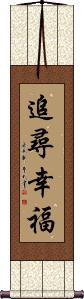
追尋幸福 is the best way to translate the English phrase “pursuit of happiness” into Chinese.
The first two characters mean “to pursue,” “to track down,” or “to search for.”
The last two mean happiness, happy, or being blessed.
See Also: Follow Your Dreams
Pursuit of Happiness
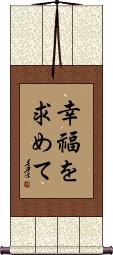
幸福を求めて is “Pursuit of Happiness” or “In Search of Happiness” in Japanese.
Here's how the characters break down:
幸福 (koufuku) happiness; blessedness; joy; well-being.
を (o) particle
求め (motome) to want; to seek; to pursue; to request
て (te) particle
Note: Because this selection contains some special Japanese Hiragana characters, it should be written by a Japanese calligrapher.
See Also: Follow Your Dreams
Seeker of Wisdom
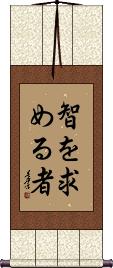
智を求める者 means “seeker of wisdom” in Japanese.
To break it down:
智 is wisdom.
を is a particle that connects wisdom to the next idea.
求める is a transitive verb that means to want, to wish for, to ask for, to seek, to search for, to look for, or to pursue.
者 is a literary way to write “person.”
Note: Because this selection contains some special Japanese Hiragana characters, it should be written by a Japanese calligrapher.
No Surrender
Honor Does Not Allow Second Thoughts
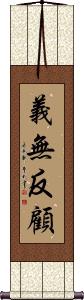
義無反顧 is a Chinese proverb that can be translated in a few different ways. Here are some examples:
Honor does not allow one to glance back.
Duty-bound not to turn back.
No surrender.
To pursue justice with no second thoughts.
Never surrender your principles.
This proverb is about the courage to do what is right without questioning your decision to take the right and just course.
Realize Your Ambitions / Embrace Your Ambition
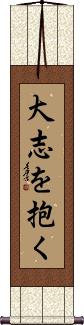
大志を抱く is a Japanese proverb that suggests you should embrace, pursue, and realize your ambitions.
The first part means ambitions or aspirations.
The last part means to embrace or to hold in your arms.
Here's the character breakdown:
大志 (taishi) ambition; aspiration.
を (o) particle
抱く (idaku) to embrace; to hold in the arms (e.g. a baby); to hug; to harbor/harbour; to bear (e.g., a grudge); to entertain (e.g., suspicion); to sleep with; to sit on eggs.
Note: Because this selection contains some special Japanese Hiragana characters, it should be written by a Japanese calligrapher.
5. Right Living / Right Livelihood / Perfect Livelihood
Samyag Ajiva / Samma Ajiva
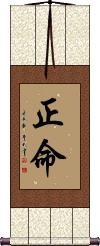
正命 (right living) is one of the Noble Eightfold Paths of Buddhism.
Right Living, along with Right Speech and Right Action, constitute the path to Virtue.
Right Living means that a Buddhist should only take a job or pursue a career in a field that does no harm. Buddhists should not work in the arms trade, as pimps or in the field of prostitution, as a butcher or in a shop that kills or sells meat, in a laboratory that does animal research, or in any other business that involves scheming or unethical behavior.
Another definition: Avoidance of professions that are harmful to sentient beings, such as slaughterer, hunter, dealer in weaponry or narcotics, etc.
This term is exclusively used by devout Buddhists. It is not a common term, and is remains an unknown concept to most Japanese and Chinese people.
See Also: Buddhism | Enlightenment | Noble Eightfold Path
Live Laugh Love
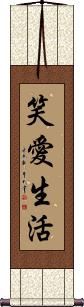
In English, the word order shown in the title is the most natural or popular. In Chinese, the natural order is a little different:
The first character means laugh (sometimes means smile).
The second character means love.
The last two characters mean “live” as in “to be alive” or “pursue life.”
Please note: 笑愛生活 is not a normal phrase in that it does not have a subject, verb, or object. It is a word list. Word lists are not common in Asian languages/grammar (at least not as normal as in English). We only added this entry because so many people requested it.
We put the characters in the order shown above, as it almost makes a single word with the meaning “A life of laughter and love.” It's a made-up word, but it sounds good in Chinese.
We removed the Japanese pronunciation guide from this entry, as the professional Japanese translator deemed it "near nonsense" from a Japanese perspective. Choose this only if your audience is Chinese and you want the fewest-possible characters to express this idea.
In Korean, this would be 소애생활 or "so ae saeng hwar" but I have not confirmed that this makes sense in Korean.
Dana: Almsgiving and Generosity
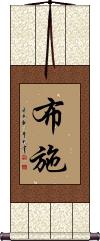
布施 is the Buddhist practice of giving known as Dāna or दान from Pali and Sanskrit.
Depending on the context, this can be alms-giving, acts of charity, or offerings (usually money) to a priest for reading sutras or teachings.
Some will put Dāna in these two categories:
1. The pure or unsullied charity, which looks for no reward here but only in the hereafter.
2. The sullied almsgiving whose object is personal benefit.
The first kind is, of course, the kind that a liberated or enlightened person will pursue.
Others will put Dāna in these categories:
1. Worldly or material gifts.
2. Unworldly or spiritual gifts.
You can also separate Dāna into these three kinds:
1. 財布施 Goods such as money, food, or material items.
2. 法布施 Dharma, as an act to teach or bestow the Buddhist doctrine onto others.
3. 無畏布施 Courage, as an act of facing fear to save someone or when standing up for someone or standing up for righteousness.
The philosophies and categorization of Dāna will vary among various monks, temples, and sects of Buddhism.
Breaking down the characters separately:
布 (sometimes written 佈) means to spread out or announce, but also means cloth. In ancient times, cloth or robs were given to the Buddhist monks annually as a gift of alms - I need to do more research, but I believe there is a relationship here.
施 means to grant, to give, to bestow, to act, to carry out, and by itself can mean Dāna as a single character.
Dāna can also be expressed as 檀那 (pronounced “tán nà” in Mandarin and dan-na or だんな in Japanese). 檀那 is a transliteration of Dāna. However, it has colloquially come to mean some unsavory or unrelated things in Japanese. So, I think 布施 is better for calligraphy on your wall to remind you to practice Dāna daily (or whenever possible).
The following table may be helpful for those studying Chinese or Japanese...
| Title | Characters | Romaji (Romanized Japanese) | Various forms of Romanized Chinese | |
| Pursue Your Dreams | 夢を追い続ける | yume wo oi tsudukeru yumewooitsudukeru | ||
| Pursue Your Dreams | 追尋夢想 追寻梦想 | zhuī xún mèng xiǎng zhui1 xun2 meng4 xiang3 zhui xun meng xiang zhuixunmengxiang | chui hsün meng hsiang chuihsünmenghsiang |
|
| Seek Quest | 探求 | tankyuu / tankyu | tàn qiú / tan4 qiu2 / tan qiu / tanqiu | t`an ch`iu / tanchiu / tan chiu |
| Pursuit of Happiness | 追尋幸福 追寻幸福 | zhuī xún xìng fú zhui1 xun2 xing4 fu2 zhui xun xing fu zhuixunxingfu | chui hsün hsing fu chuihsünhsingfu |
|
| Pursuit of Happiness | 幸福を求めて | koufuku o motome te koufukuomotomete kofuku o motome te | ||
| Seeker of Wisdom | 智を求める者 | chi o motomeru mono chiomotomerumono | ||
| No Surrender | 義無反顧 义无反顾 | yì wú fǎn gù yi4 wu2 fan3 gu4 yi wu fan gu yiwufangu | i wu fan ku iwufanku |
|
| Realize Your Ambitions Embrace Your Ambition | 大志を抱く | taishi wo Idaku taishiwoIdaku | ||
| 5. Right Living Right Livelihood Perfect Livelihood | 正命 | sei myou / seimyou / sei myo | zhèng mìng zheng4 ming4 zheng ming zhengming | cheng ming chengming |
| Live Laugh Love | 笑愛生活 笑爱生活 | xiào ài shēng huó xiao4 ai4 sheng1 huo2 xiao ai sheng huo xiaoaishenghuo | hsiao ai sheng huo hsiaoaishenghuo |
|
| Dana: Almsgiving and Generosity | 布施 | fuse | bù shī / bu4 shi1 / bu shi / bushi | pu shih / pushih |
| In some entries above you will see that characters have different versions above and below a line. In these cases, the characters above the line are Traditional Chinese, while the ones below are Simplified Chinese. | ||||

Successful Chinese Character and Japanese Kanji calligraphy searches within the last few hours...



