Many custom options...


And formats...



Realize in Chinese / Japanese...
Buy a Realize calligraphy wall scroll here!
Personalize your custom “Realize” project by clicking the button next to your favorite “Realize” title below...
2. Realize Your Ambitions / Ride on the Crest of Success
5. Realize Your Ambitions / Embrace Your Ambition
7. Wisdom
9. Awareness
10. Power of Understanding and Wisdom
11. Four Noble Truths: Elimination of Desire or Attachment
13. Do not shed a tear until you see the coffin
14. Teacher / Master / Old Sage
15. The Middle Way
16. No man knows what he owes to his parents until he comes to have children of his own
17. Unselfish: Perfectly Impartial
18. Tea Fate
Realize Your Dreams
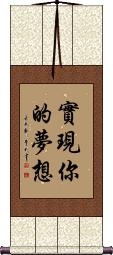
實現你的夢想 means “realize your dreams” or “live your dreams” in Chinese.
實現 means to achieve, to implement, to realize, or to bring about.
The characters 你的 effectively mean “your.”
夢想 means to dream, imagine, or have a vision.
Realize Your Ambitions / Ride on the Crest of Success
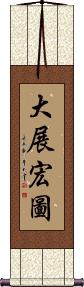
大展宏圖 is a four-character proverb used in Chinese to mean “realize your ambitions” or “exhibit your ambition and success.”
It's used to talk about someone with great career ambitions. Almost literally, it expresses the idea of someone unfolding a great career like a map or a set of blueprint plans.
Very literally translated, these four characters mean “Great unfolding of a huge map” or “Great exhibition of a colossal plan.”
Wake Up to Reality
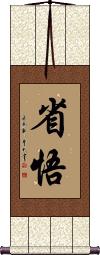
省悟 is a Chinese word that means “to wake up to reality,” “to come to oneself,” “to realize,” “to see the truth,” or “to reflect and become aware.”
省悟 is often used in the context of Buddhism.
In Japanese, this has the same meaning but is more often used as a given name, Seigo.
Satori / Enlightenment
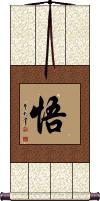
悟 means enlightenment but can also mean to perceive, discern, realize, understand or comprehend.
悟 has the same meaning in Chinese, Japanese and Korean, though used most often with deep significance in Japanese culture and language. 悟 is often seen in Japan along with a secondary Hiragana character. We also offer that option but this is the more universal single-character entry.
Satori / Enlightenment
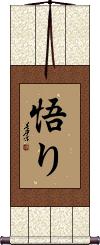
悟り is the Japanese term for enlightenment which can also mean to perceive, discern, realize, understand, or comprehend.
The first character has the same meaning in Chinese and Korean but has deeper significance in Japanese culture and language. This version of Satori incorporates the Japanese secondary character (Hiragana, not Kanji) that adds the “ri” to Satori. It's unnecessary to have the second character, as it does not add to the meaning as much as clarity for the context in which you are using this term.
Realize Your Ambitions / Embrace Your Ambition
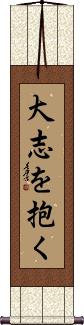
大志を抱く is a Japanese proverb that suggests you should embrace, pursue, and realize your ambitions.
The first part means ambitions or aspirations.
The last part means to embrace or to hold in your arms.
Here's the character breakdown:
大志 (taishi) ambition; aspiration.
を (o) particle
抱く (idaku) to embrace; to hold in the arms (e.g. a baby); to hug; to harbor/harbour; to bear (e.g., a grudge); to entertain (e.g., suspicion); to sleep with; to sit on eggs.
Note: Because this selection contains some special Japanese Hiragana characters, it should be written by a Japanese calligrapher.
Perception of Knowledge
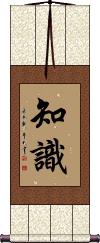
知識 has the very strong meaning of “knowledge” and, in some contexts, “learning.”
The first character represents “to know” or “to realize.”
The second character alone refers to the ability to “recognize” or “realize” and can also be used to mean “knowing.”
See Also: Wisdom | Learn From Wisdom
Wisdom
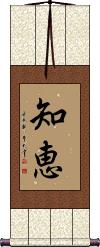
The simple translation of 知惠 is wisdom, but the more expanded version is “to know all things in their entirety.”
The first Kanji represents “to know” or “to realize.” Combined, these two Kanji mean “learn, know, and understand completely.”
Note: While vaguely understood in Chinese, this is only a real word in Japanese.
 Ancient Japanese/Korean version: This is also a word in old Korean Hanja, with a slight difference in the last character - if you want that version (which is also the ancient Japanese version) please click on the character to the right, instead of the button above.
The Bodhi Mind
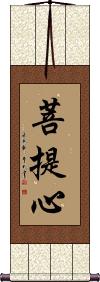
菩提心 means Bodhi-mind or Bodhi-heart.
This title represents the will to realize supreme enlightenment. The awakening of the Bodhi-mind is of utmost importance in Buddhist training.
Other definitions include the mind for or of bodhi, the awakened, enlightened mind, or having Buddha-nature.
Awareness
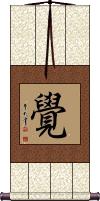
覺 can mean to feel; to figure out; thinking; awake; aware; bodhi; knowing; understanding; enlightenment; illumination; apprehend; perceive; realize.
覺 is a character that is impossible to define in a single word.
This term is often associated with Buddhism where it's understood to be: Illumination, enlightenment, or awakening in regard to the real in contrast to the seeming. However, it can also refer to enlightenment in regard to morality and evil.
Notes:
In Japanese, this can be the personal name Satoru.
In certain context, and only when pronounced as "jiao" in Chinese, it can refer to a nap, sleep or the state of sleeping. However, as a single character on a wall scroll, everyone will read this with the awareness or enlightenment context.
By no means is this the only way to write enlightenment. In fact, you should only choose this character if you are looking more for a word meaning awareness.
See Also: Enlightenment | Wisdom | Knowledge
Power of Understanding and Wisdom
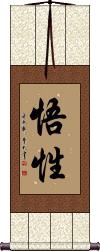
悟性 means the power of understanding and insight in Chinese.
It is often associated with Neo-Confucianism. In that regard, it means to realize, perceive, or have the perception of man's true nature. It can also mean finding your soul, the soul of others, or the soul of the world. Some will translate this simply as the state of being “savvy.”
In Japanese, this is often translated as wisdom and understanding.
Four Noble Truths: Elimination of Desire or Attachment
Nirodha
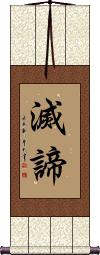
滅諦 suggests that once you eliminate desire or attachment to worldly things, only then can you achieve enlightenment.
Realize that things are impermanent. That fancy car, beautiful spouse, big house, and impressive career are things you can't take with you. These things are a flash in the pan compared to the infinite span of history, generations to come, time, and space.
This term is exclusively used by devout Buddhists. It is not a common term, and is remains an unknown concept to most Japanese, Korean, and Chinese people.
See Also: Buddhism | Enlightenment
Enlightened Warrior
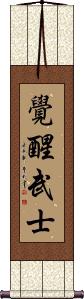
覺醒武士 is not a commonly used title in Chinese but is sometimes used in Martial arts and military contexts to refer to a warrior who seems always to be fully aware, enlightened, knowledgeable, noble, and just.
The first two characters are a word that means: to awaken; to come to realize; awakened to the truth; the truth dawns upon one; scales fall from the eyes; to become aware.
The last two characters mean warrior but can also refer to a samurai, soldier, or fighter.
Do not shed a tear until you see the coffin
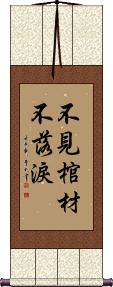
不見棺材不落淚 is a cautionary tale that suggests you are unknowingly (though it should be obvious)on a bad course.
It further suggests that you will not realize your folly until the worst has happened.
This can also be a warning of inaction until it's too late to take action. Again, not realizing your error until it's too late.
In an alternate interpretation, some will suggest this means doing something bad and not looking back - Then the worst happens.
It should be noted that this is one of the oddest selections for a wall scroll in our whole Asian calligraphy database. All of our translators are convinced that no Chinese person would ever hang this on their wall.
Teacher / Master / Old Sage
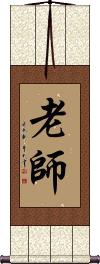
老師 directly translates as “old teacher,” “old master,” or “old sage.”
Together, they are understood as “teacher.” When you think about that, also realize that with age comes respect in Asian cultures. So calling someone old is a term of respect (not like the way we mean it in English). You could replace “old” with “respected” and be closer to how this is meant in Chinese.
Teachers, in general, are more respected by their students and the population in China. When I was a teacher in China, I certainly felt that.
This term is also used for masters of certain fields. For instance, a master calligrapher would respectfully be addressed as a “teacher.” In this case, “master” and “teacher” are synonymous.
Other artists (especially those who are famous or accomplished) should be addressed with this term. Also, some martial arts schools use this term of respect for their masters/teachers/instructors.
This title is recognized in Japanese as "roushi" with the same meaning but it’s rarely used in Japan.
The Middle Way
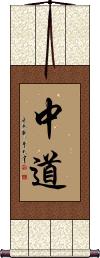
In the most basic translation, 中道 means road through the middle or middle road.
The expanded meaning can be moderation or the golden mean.
But if you are looking for this title, you are probably seeking the Buddhist definition, which is more complex.
中道 is the middle way or middle path of Buddhism. This has various interpretations. In general, it denotes the mean between two extremes and has special reference to the mean between realism and nihilism, or eternal substantial existence and annihilation.
The Buddha teaches that one should not take things to extremes. Don't be extremely evil and engage in debauchery and murder. But do not spend every waking out trying to be a perfect saint. Instead, take the middle path, try to help others, show loving kindness wherever you can, and try not to do harm. If you inadvertently harm another being, make amends if you can, and move on. Realize you are not perfect, but in time, a path of moderation lead toward proper living and enlightenment.
No man knows what he owes to his parents until he comes to have children of his own
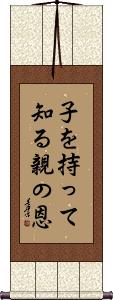
子を持って知る親の恩 literally translates as: Only after you have a baby, you would appreciate your parents (feel the way they do, etc).
This is a bit like the “walk a mile in another man's shoes” saying. Basically, it's about you cannot fully understand the plight of others until you experience it yourself. It also shows appreciation for the plight of parents.
This Japanese proverb can also be translated a few more ways:
No man knows what he owes to his parents till he comes to have children of his own.
One knows not what one owes to one's parents till one comes to have children of one's own.
Only after you have a baby, you will appreciate your parents or feel the way they do.
Only after becoming a parent yourself do you realize how much you owe [how indebted you are] to your own parents.
Note: Because this selection contains some special Japanese Hiragana characters, it should be written by a Japanese calligrapher.
Unselfish: Perfectly Impartial
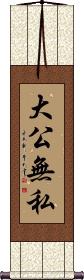
大公無私 is a Chinese proverb that comes from an old story from some time before 476 BC. About a man named Qi Huangyang, who was commissioned by the king to select the best person for a certain job in the Imperial Court.
Qi Huangyang selected his enemy for the job. The king was very confused by the selection, but Qi Huangyang explained that he was asked to find the best person for the job, not necessarily someone that he liked or had a friendship with.
Later, Confucius commented on how unselfish and impartial Qi Huangyang was by saying, “Da Gong Wu Si” which, if you look it up in a Chinese dictionary, is generally translated as “Unselfish” or “Just and Fair.”
If you translate each character, you'd have something like
“Big/Deep Justice Without Self.”
Direct translations like this leave out a lot of what the Chinese characters really say. Use your imagination, and suddenly you realize that “without self” means “without thinking about yourself in the decision” - together, these two words mean “unselfish.” The first two characters serve to drive the point home that we are talking about a concept that is similar to “blind justice.”
One of my Chinese-English dictionaries translates this simply as “just and fair.” So that is the short and simple version.
Note: This can be pronounced in Korean, but it's not a commonly used term.
See Also: Selflessness | Work Unselfishly for the Common Good | Altruism
Tea Fate
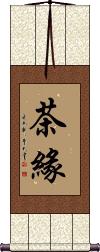
茶緣 is a special title for the tea lover. This kind of means “tea fate,” but it's more spiritual and hard to define. Perhaps the tea brought you in to drink it. Perhaps the tea will bring you and another tea-lover together. Perhaps you were already there, and the tea came to you. Perhaps it's the ah-ha moment you will have when drinking the tea.
I've been told not to explain this further, as it will either dilute or confuse the purposefully-ambiguous idea embedded in this enigma.
I happen to be the owner of a piece of calligraphy written by either the son or nephew of the last emperor of China, which is the title he wrote. It was given to me at a Beijing tea house in 2001. 茶緣 is where I learned to love tea after literally spending weeks tasting and studying everything I could about Chinese tea. I did not understand the significance of the authorship or the meaning of the title at all. Some 10 years later, I realized the gift was so profound and had such providence. Only now do I realize the value of a gift that it is too late to give proper thanks for. It was also years later that I ended up in this business and could have the artwork properly mounted as a wall scroll. It has been borrowed for many exhibitions and shows and always amazes native Chinese and Taiwanese who read the signature. This piece of calligraphy I once thought was just a bit of ink on a thin and wrinkled piece of paper, is now one of my most valued possessions. And fate has taught me to be more thankful for seemingly simple gifts.
These search terms might be related to Realize:
Achieve Inner Peace; Find Deep Understanding
Determination to Achieve
Determination to Achieve / Will-Power
My Life is Complete Because of You
Reach Peace and Calm Through Meditation
The True and Complete Enlightenment
Those Who Understand Are Clever, Those Who Know Themselves Are Truly Wise
Uniform / Complete / Perfect / Order
We Are Not Born With Knowledge, How Does One Achieve Maturity?
You Must Endure a Harsh Winter to Appreciate the Warmth of Springtime
The following table may be helpful for those studying Chinese or Japanese...
| Title | Characters | Romaji (Romanized Japanese) | Various forms of Romanized Chinese | |
| Realize Your Dreams | 實現你的夢想 实现你的梦想 | shí xiàn nǐ de mèng xiǎng shi2 xian4 ni3 de meng4 xiang3 shi xian ni de meng xiang shixiannidemengxiang | shih hsien ni te meng hsiang shihhsiennitemenghsiang |
|
| Realize Your Ambitions Ride on the Crest of Success | 大展宏圖 大展宏图 | dà jiǎn hóng tú da4 jian3 hong2 tu2 da jian hong tu dajianhongtu | ta chien hung t`u tachienhungtu ta chien hung tu |
|
| Wake Up to Reality | 省悟 | shō go / shōgo | xǐng wù / xing3 wu4 / xing wu / xingwu | hsing wu / hsingwu |
| Satori Enlightenment | 悟 | sato / go | wù / wu4 / wu | |
| Satori Enlightenment | 悟り | satori | ||
| Realize Your Ambitions Embrace Your Ambition | 大志を抱く | taishi wo Idaku taishiwoIdaku | ||
| Perception of Knowledge | 知識 知识 | chishiki | zhī shi / zhi1 shi / zhi shi / zhishi | chih shih / chihshih |
| Wisdom | 知惠 知恵 | chie | zhī huì / zhi1 hui4 / zhi hui / zhihui | chih hui / chihhui |
| The Bodhi Mind | 菩提心 | bo dai shin bodaishin | pú tí xīn pu2 ti2 xin1 pu ti xin putixin | p`u t`i hsin putihsin pu ti hsin |
| Awareness | 覺 觉 | gaku / satoru | jué / jiào jue2 / jiao4 jue / jiao jue/jiao | chüeh chiao chüehchiao |
| Power of Understanding and Wisdom | 悟性 | gosei | wù xìng / wu4 xing4 / wu xing / wuxing | wu hsing / wuhsing |
| Four Noble Truths: Elimination of Desire or Attachment | 滅諦 灭谛 | mettai | miè dì / mie4 di4 / mie di / miedi | mieh ti / miehti |
| Enlightened Warrior | 覺醒武士 觉醒武士 | jué xǐng wǔ shì jue2 xing3 wu3 shi4 jue xing wu shi juexingwushi | chüeh hsing wu shih chüehhsingwushih |
|
| Do not shed a tear until you see the coffin | 不見棺材不落淚 不见棺材不落泪 | bú jiàn guān cái bú luò lèi bu2 jian4 guan1 cai2 bu2 luo4 lei4 bu jian guan cai bu luo lei bujianguancaibuluolei | pu chien kuan ts`ai pu lo lei puchienkuantsaipulolei pu chien kuan tsai pu lo lei |
|
| Teacher Master Old Sage | 老師 老师 | lǎo shī / lao3 shi1 / lao shi / laoshi | lao shih / laoshih | |
| The Middle Way | 中道 | chuu dou / chuudou / chu do | zhōng dào zhong1 dao4 zhong dao zhongdao | chung tao chungtao |
| No man knows what he owes to his parents until he comes to have children of his own | 子を持って知る親の恩 | ko wo motte shiru oya no on kowomotteshiruoyanoon | ||
| Unselfish: Perfectly Impartial | 大公無私 大公无私 | dà gōng wú sī da4 gong1 wu2 si1 da gong wu si dagongwusi | ta kung wu ssu takungwussu |
|
| Tea Fate | 茶緣 茶缘 | chá yuán / cha2 yuan2 / cha yuan / chayuan | ch`a yüan / chayüan / cha yüan | |
| In some entries above you will see that characters have different versions above and below a line. In these cases, the characters above the line are Traditional Chinese, while the ones below are Simplified Chinese. | ||||

Successful Chinese Character and Japanese Kanji calligraphy searches within the last few hours...



