Many custom options...


And formats...



Reverence in Chinese / Japanese...
Buy a Reverence calligraphy wall scroll here!
Personalize your custom “Reverence” project by clicking the button next to your favorite “Reverence” title below...
1. Gassho
2. Respect out of fear is never genuine; Reverence out of respect is never false
3. Love and Respect / Kindness and Respect
4. Qin / Chin
5. Fear God
6. Chong
10. Respectful Heart
Gassho
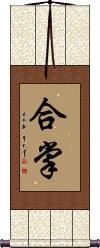
合掌 is the act of greeting someone (can also be done when departing) with hands brought together prayerfully.
In India, this would be accompanied by the verbal greeting and blessing of “Namaste.” In China, Japan, and Korea, this is how Buddhists will greet each other. Sometimes done by people who are not devout Buddhists in China, Japan, and Korea to show respect, reverence, or great thanks to someone for a gift, forgiveness, or some honor that has been bestowed.
In Japan, this is almost always associated with a deep bow. In China, where bowing is not an everyday occurrence, there may be a shallow bow, but the act will be done with deep feeling. Korean culture seems to have more bowing than China but less than Japan.
See Also: Namaste
Respect out of fear is never genuine; Reverence out of respect is never false
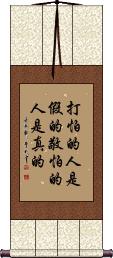
打怕的人是假的敬怕的人是真的 is a proverb that seems to be aimed at world leaders or others in power. Perhaps a suggestion to avoid the practice of “fear-mongering” opting instead for a policy of benevolence and justice.
An example: When the Bush administration told Pakistan they could either join America in the “war on terror,” or expect some bombs to be coming their way, Bush gained this kind of “less-than-genuine respect” from Pakistanis.
Leaders in places like North Korea and even Saudi Arabia reap the same bogus respect from their own citizens.
Note that calligraphers do not like to repeat the same characters in exactly the same way in the same piece of artwork. So expect the characters that are repeated to be written in different forms in the real artwork (unlike the way they are displayed to the left).
Love and Respect / Kindness and Respect
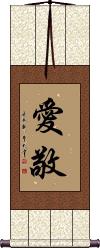
愛敬 is a Chinese, Japanese Kanji, and old Korean Hanja title that can mean “love and respect,” “kindness and respect,” “to love with reverence,” “charm,” “amiability,” “winsomeness,” “courtesy,” or “ingratiating behavior.”
Note: The wide-ranging definitions show that this word is a bit ambiguous without the context of being used in a sentence.
Qin / Chin
Surname
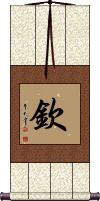
欽 is one of a few Chinese characters that can be a surname romanized as Qin or Chin.
The actual meaning of this character is reverence; respect; admire; venerate; by the emperor himself; imperial.
In Japanese, this can be the name Makoto.
Fear God
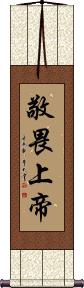
敬畏上帝 is probably the best way to translate the Christian English phrase “Fear God” into Chinese.
The first two characters mean to revere, be in awe of, or a general term of reverence. It can mean fear, but only in the context of respect or fear of authority.
Chong
Surname
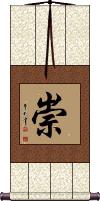
This is the surname “Chong” or “Zhong” in Mandarin Chinese, “Sung” in Cantonese and Korean, and Su in Japanese.
崇 is used in other Chinese words and other Asian languages with the following meanings:
high; sublime; lofty; to esteem; to worship; eminent; honorable; honourable; reverence; adore/adoration.
Love and Respect
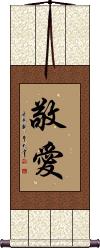
敬愛 is the short and sweet way to say “love and respect” in Chinese, Japanese Kanji, and old Korean Hanja.
Besides “respect and love,” this could be translated as “respect and affection,” “Reverence and love,” or “reverent love.”
In Japanese, this can also be the personal name Yoshinari.
Respect / Honor / Esteem
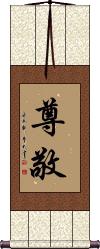
尊敬 is how to express the ideas of respect, honor, reverence, esteem, nobility, and sometimes the state of being noble, all in one word. Most of the time, this is used as “giving respect,” but depending on the context, it can suggest that you should try to be “worthy of respect.”
Although pronounced differently, the Chinese characters, Japanese Kanji, and Korean Hanja are the same across these languages. This is an indication that this word is very old and crosses many barriers and cultures in the Orient (East Asia).
Love and Respect
Love each other and show mutual respect
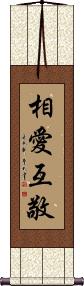
相愛互敬 is a nice way to say “Love and Respect” in Chinese.
This proverb is about the mutual exchange of love and respect within a good relationship.
The first two characters create a word that means “to love each other” or “mutual love.”
The third character means mutual, interlocking, or in some contexts, “to dovetail” (as in how joints are made in fine furniture).
The last character means “to respect,” “to venerate,” “to salute,” “reverence,” or simply “respect.”
Respectful Heart
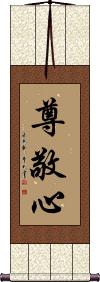
尊敬心 means respectful heart in Japanese, Chinese and Korean.
The root is 尊敬 which means respect, honor, reverence, esteem, and/or nobility. Therefore, you can also define this as an honorable heart, reverent heart, noble heart, etc.
In ancient times, it was thought your brain was the heart in your chest. Therefore, 心 or heart can also mean “mind.” Hence, 尊敬心 can also be translated as respectful mind, honorable mind, etc.
You'll see 尊敬心 romanized as Sonkeishin or Sonkeshin from Japanese.
This in-stock artwork might be what you are looking for, and ships right away...


Gallery Price: $50.00
Your Price: $29.88

Gallery Price: $200.00
Your Price: $69.88
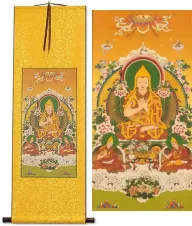
Gallery Price: $108.00
Your Price: $59.88

Gallery Price: $50.00
Your Price: $29.88
These search terms might be related to Reverence:
Awesome / Awe-Inspiring
Love and Respect
Love and Respect / Kindness and Respect
Love Loyalty Respect
Loyalty and Respect
Mutual Respect
Respect
Respect / Honor / Esteem
Respect and Loyalty
Respect Out of Fear is Never Genuine; Reverence Out of Respect is Never False
Respect, Honor, Truth
Self-Respect / Self-Esteem
The following table may be helpful for those studying Chinese or Japanese...
| Title | Characters | Romaji (Romanized Japanese) | Various forms of Romanized Chinese | |
| Gassho | 合掌 | gasshou / gasho | hé zhǎng / he2 zhang3 / he zhang / hezhang | ho chang / hochang |
| Respect out of fear is never genuine; Reverence out of respect is never false | 打怕的人是假的敬怕的人是真的 | dǎ pà de rén shì jiǎ de jìng pà de rén shì zhēn de da3 pa4 de ren2 shi4 jia3 de jing4 pa4 de ren2 shi4 zhen1 de da pa de ren shi jia de jing pa de ren shi zhen de | ta p`a te jen shih chia te ching p`a te jen shih chen te ta pa te jen shih chia te ching pa te jen shih chen te |
|
| Love and Respect Kindness and Respect | 愛敬 爱敬 | aikei / aikyou aikei / aikyo | ài jìng / ai4 jing4 / ai jing / aijing | ai ching / aiching |
| Qin Chin | 欽 钦 | kin | qīn / qin1 / qin | ch`in / chin |
| Fear God | 敬畏上帝 | jìng wèi shàng dì jing4 wei4 shang4 di4 jing wei shang di jingweishangdi | ching wei shang ti chingweishangti |
|
| Chong | 崇 | sū | chóng / chong2 / chong | ch`ung / chung |
| Love and Respect | 敬愛 敬爱 | kei ai / keiai | jìng ài / jing4 ai4 / jing ai / jingai | ching ai / chingai |
| Respect Honor Esteem | 尊敬 | sonkei | zūn jìng / zun1 jing4 / zun jing / zunjing | tsun ching / tsunching |
| Love and Respect | 相愛互敬 相爱互敬 | xiāng ài hù jìng xiang1 ai4 hu4 jing4 xiang ai hu jing xiangaihujing | hsiang ai hu ching hsiangaihuching |
|
| Respectful Heart | 尊敬心 | son kei shin sonkeishin | zūn jìng xīn zun1 jing4 xin1 zun jing xin zunjingxin | tsun ching hsin tsunchinghsin |
| In some entries above you will see that characters have different versions above and below a line. In these cases, the characters above the line are Traditional Chinese, while the ones below are Simplified Chinese. | ||||

Successful Chinese Character and Japanese Kanji calligraphy searches within the last few hours...



