Many custom options...


And formats...



Not what you want?
Try other similar-meaning words, fewer words, or just one word.
Ri Ri Shi Hao Ri in Chinese / Japanese...
Buy a Ri Ri Shi Hao Ri calligraphy wall scroll here!
Personalize your custom “Ri Ri Shi Hao Ri” project by clicking the button next to your favorite “Ri Ri Shi Hao Ri” title below...
Switched to secondary search mode due to lack of results using primary.
These secondary results may not be very accurate. Try a different but similar meaning word or phrase for better results. Or...
Look up Ri Ri Shi Hao Ri in my Japanese Kanji & Chinese Character Dictionary(My dictionary is a different system then the calligraphy search you just tried)
If you want a special phrase, word, title, name, or proverb, feel free to contact me, and I will translate your custom calligraphy idea for you.
1. Adoring Love
2. Akashi
5. You are always a beauty in your lover’s eyes
6. Birth / Life
7. Benevolent and Skilled Doctor
8. Enjoy Life
10. Guan Shi Yin: Protector Of Life
11. Hao
12. Happu Fudo
13. Hello / Ni Hao
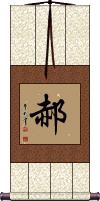
14. Hao
15. A Journey of 1000 Miles Begins with a Single Step
17. Kyoto-Shi
18. Fatherly Master / Sifu / Shi Fu / Shifu
19. Sensei / Master / Teacher / Mister
20. Nashi
23. Stone / Rock
24. A Journey of 1000 Miles Feels Like One
25. Xishi / Xi Shi
Adoring Love
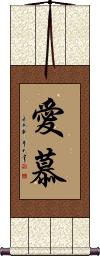
愛慕 means “adoring love” in Chinese, Japanese, and Korean.
I suppose this is the best kind of love to have. 愛慕 has the common character for love. But the second character modifies and reinforces the meaning to become adore, adoring love, or to love and adore.
Ancient Chinese warning:
Adoring someone is fine until you are in the shoes of the Prince of the Kingdom of Wu. This Prince adored a certain beautiful woman (Xi Shi) so much that he neglected his duties and soon let the kingdom fall into ruins.
Akashi
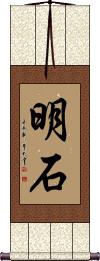
This is a version of the Japanese name Akashi.
This can also be Meiseki, Miyouishi, Myouishi, Ageishi, Akeshi, Akeishi, Akiishi, or Akaishi.
This would be read as “Ming Shi” in Mandarin but would be understood to be a Japanese name.
Asahi / Morning Sun
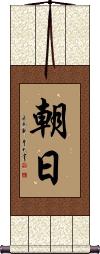
朝日 is a version of the Japanese name Asahi.
This can also be Ahisa, Asuka, Ashita, or Asaka. This means morning sun and is the name of the famous beer company in Japan.
This would be read as “Zhao Ri” in Mandarin where it means morning sun but is also known to be the Asahi company (maker of beer and other beverages).
Unmoved by the Eight Winds

八風吹不動 is an ancient Buddhist phrase from about 1000 years ago.
Literal meaning: “The Eight Winds cannot move [me].”
The original famous anecdote is from Song Dynasty China, involving the poet-official 蘇東坡 (Su Dongpo / Su Shi, 1037–1101) and Zen master 佛印 (Foyin).
Su Dongpo wrote 八風吹不動,一屁打過江
“The Eight Winds cannot move me; Yet one fart blows me across the river.”
Foyin’s irreverent reply exposed Su Dongpo’s ego, which is kind of a classic Zen/Chan teaching story.
利 gain
衰 loss
毀 disgrace
譽 praise
稱 honor
譏 ridicule
苦 suffering
樂 pleasure
“The Eight Winds cannot move [him / the mind].”
“Unmoved by the Eight Winds.”
“The Eight Winds do not move me.”
“Not moved by the Eight Winds.”
“Unshaken by the Eight Winds.”
“Unaffected by the Eight Winds.”
“Unmoved by worldly forces.”
“Steadfast against the Eight Winds.”
“Remaining unmoved amid the Eight Winds.”
There is a shorter Japanese Zen version, 八風不動, which drops the middle character. Often romanized as happū fudō. The romanization of 八風吹不動 is arguably happū fukedomo ugokazu or happū sui fudō.
You are always a beauty in your lover’s eyes
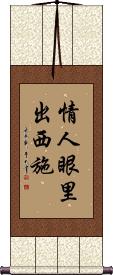
Any woman with affection for Asian art will love a gift of this Chinese proverb calligraphy on a wall scroll.
She will melt in your arms as you tell her the meaning of these characters.
Contained in this phrase is a reference to the most beautiful woman in Chinese history. Her name was Xi Shi, and she was known to have good looks that need not have fine robes or makeup. Her charms were so powerful that she brought down an entire kingdom (in a successful effort to bring honor and pride back to her people).
情人眼里出西施 is a great way to express that the woman in your life is your one love.
Birth / Life
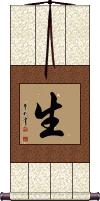
生 is a Chinese word that means “to be born” and “to give birth.”
Also, it's often used to refer to life itself, and sometimes “to grow.”
生 is used in a lot of compound words such as “yi sheng,” which means “doctor” (literally “healer of life”), “sheng ri” which means “birthday” (literally “birth-day”), and “xue sheng” which means student (literally “studying life” or “learner [about] life”). Few Chinese people will think of the literal meaning when this uses words like doctor and student - but it is interesting to note.
生 has the same root meaning in Korean Hanja and Japanese. However, in Japanese, there are many possible pronunciations, and this can be used to mean “raw” or “unprocessed” (as in draft beer). Therefore, not be the best if your audience is Japanese.
See Also: Vitality
Benevolent and Skilled Doctor
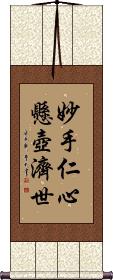
妙手仁心悬壶济世 is a phrase that celebrates the benevolence, skill, and service to his/her patients.
Here's a breakdown of the characters:
妙手 miào shǒu admirable skill in curing disease (when used in reference to doctors).
仁心 rén xīn kindheartedness, charity, benevolent heart.
悬壶济世 xuán hú jì shì practice medicine or pharmacy to help the people or the public.
Enjoy Life
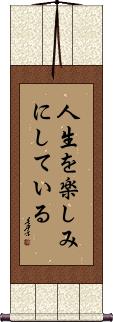
人生を楽しみにしている is one way to write “enjoy life” in Japanese.
The character breakdown:
人生 (jinsei) life (i.e. conception to death) human lifetime, living.
を (o) connecting particle.
楽しみ (tanoshimi) enjoyment; pleasure; anticipation; looking forward to.
に (ni) connecting particle.
し (shi) to do; to cause; to become; to make (into).
て (te) connecting particle.
いる (iru) indicates continuing action or resulting state.
Note: Because this selection contains some special Japanese Hiragana characters, it should be written by a Japanese calligrapher.
Galatians 5:25
If we live in the Spirit, let us also walk in the Spirit
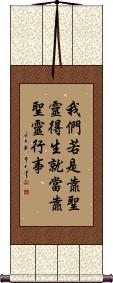
我們若是靠聖靈得生就當靠聖靈行事 is the translation of Galatians 5:25 into Mandarin Chinese via the Chinese Union Bible.
KJV: If we live in the Spirit, let us also walk in the Spirit.
NIV: Since we live by the Spirit, let us keep in step with the Spirit.
The annotation of this Chinese translation:
1.我们 wǒ men - we / us / ourselves
2.若是 ruò shì - if
3.靠 kào - depend upon / lean on / near / by / against / to support
4.圣灵 shèng líng - Holy Ghost
5.得 děi - to have to / must / ought to / degree or possibility
6.生就 shēng jiù - born one way or another (nervous, suspicious, etc.)
7.当 dàng - suitable / adequate / fitting / proper
8.靠 kào - depend upon / lean on / near / by / against / to support
9.圣灵 shèng líng - Holy Ghost
10.行事 xíng shì - how one does things / how one runs things (in this case, it suggests, “to walk in step with”)
Guan Shi Yin: Protector Of Life
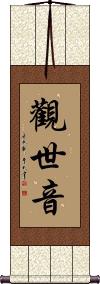
觀世音 is an alternate title for Guanyin, the Bodhisattva of Compassion or Goddess of Mercy.
觀世音 is the Buddhist bestower of children, the protector of life and all in distress (especially of those at sea).
Happu Fudo
Unmoved by the Eight Winds

八風不動 is the short version, popularized in Japanese Zen Buddhism, of the original Chinese phrase 八風吹不動.
Literal meaning: “Unmoved by the Eight Winds”
The origin is Chinese, but it was later adopted into Japanese Zen. Here’s a little backstory:
The original famous anecdote is from Song Dynasty China, involving the poet-official 蘇東坡 (Su Dongpo / Su Shi, 1037–1101) and Zen master 佛印 (Foyin).
Su Dongpo wrote 八風吹不動,一屁打過江
“The Eight Winds cannot move me; Yet one fart blows me across the river.”
Foyin’s irreverent reply exposed Su Dongpo’s ego, which is kind of a classic Zen teaching story.
Hello / Ni Hao
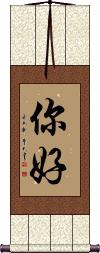
你好 is the day-to-day way to say hello in Chinese.
The characters literally mean, “You good?” It's the equivalent of “What's up?” in English, where nobody expects an actual answer.
This explanation is here for educational purposes only. 你好 is an oral word that is not appropriate for a scroll (not a bad meaning, just very odd for a wall scroll).
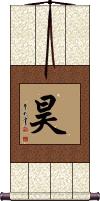
This means vast and limitless or the vast sky.
昊 is also a Chinese surname that romanizes as Hao.
In Japanese, this can be the given names Hiroshi, Takashi, Sora, or Atsushi.
A Journey of 1000 Miles Begins with a Single Step
senri no michi mo ippo kara
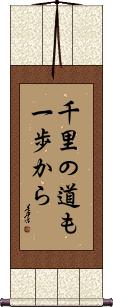
千里の道も一歩から is the Japanese version of an ancient Chinese proverb that means “a journey of a thousand miles begins with a single step.”
Some will also translate this as a 1000-mile road starts with one brick (a small amount).
In this case, the real measurement is an ancient Chinese “li” or 里, which is romanized as “ri” in Japanese. It's about half a kilometer, so three 里 would be a western mile. A journey of 333 miles begins with a single step, just doesn't sound as natural.
Note: Because this selection contains some special Japanese Hiragana characters, it should be written by a Japanese calligrapher.
Perception of Knowledge
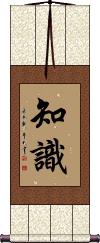
知識 has the very strong meaning of “knowledge” and, in some contexts, “learning.”
The first character represents “to know” or “to realize.”
The second character alone refers to the ability to “recognize” or “realize” and can also be used to mean “knowing.”
See Also: Wisdom | Learn From Wisdom
Kyoto-Shi
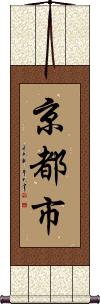
This is the title for Kyōto city
Kyōto is arguably, the cultural capital of Japan.
Fatherly Master / Sifu / Shi Fu / Shifu
Martial Arts Teacher
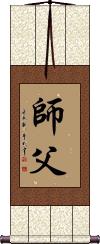
師父 means master in Chinese (occasionally used in Korean Hanja and Japanese). In the context of Martial Arts, this is the master and teacher who instructs students.
The second character by itself means father. Thus, you get the “Fatherly Master” translation. There's an old Chinese saying that goes something like, “One who is your teacher for one day is your father for life.”
Language notes: I've often seen this romanized as “sifu,” this is actually the Cantonese romanization. In Mandarin Chinese, it's “Shifu.” The pronunciation in Mandarin is actually like “sure foo” (using typical English pronunciation). There's an “R-sound” in there, which is not obvious from the romanization. Many martial arts studios incorrectly pronounce this like “she foo” (which is actually the Japanese pronunciation). In Cantonese, it sounds like “Sea foo” (almost like “seafood,” minus the “d” at the end).
師父 is kind of a weird selection for a calligraphy wall scroll; this entry is more for educational purposes. But you are welcome to buy it if it suits your circumstances.
Sensei / Master / Teacher / Mister
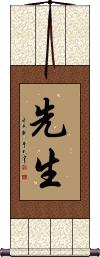
先生 is sensei, which is associated in the west with a master or instructor of karate, aikido, judo, and other Japanese martial arts.
In reality, this is a term of respect for almost any professional or skilled person (doctor, lawyer, teacher, etc.). Sometimes, it is used for musicians and artists who have achieved a certain level of fame, skill, or accomplishment.
It should be noted that this is also a courtesy title in Chinese but more like calling someone “mister” or “gentleman.” It doesn't have the “master” or “teacher” meaning in Chinese - see our Chinese “Master / Sifu / Shi Fu” entry if your audience is Chinese.
In Korean Hanja, this means teacher, instructor, schoolmaster, or schoolmistress.
This entry is for educational purposes. 先生 is kind of a strange thing to put on a wall scroll. It's a title that is used more orally to show respect rather than something written in calligraphy. If you feel it is appropriate in your circumstances, we will create a piece of sensei Japanese calligraphy artwork for you.
Nashi
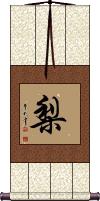
This Japanese Kanji means pear.
This refers specifically to the Pyrus pyrifolia and more specifically the culta variety. This is also known as the Japanese pear, Asian pear, sand pear, or apple pear.
梨 is also a female given name or surname in Japan that beyond Nashi, can be romanized as Rin, Rika, Ri, Nashisaki, or Shina.
In Chinese, this is pronounced like lee or li and just means pear.
Satori / Enlightenment
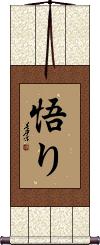
悟り is the Japanese term for enlightenment which can also mean to perceive, discern, realize, understand, or comprehend.
The first character has the same meaning in Chinese and Korean but has deeper significance in Japanese culture and language. This version of Satori incorporates the Japanese secondary character (Hiragana, not Kanji) that adds the “ri” to Satori. It's unnecessary to have the second character, as it does not add to the meaning as much as clarity for the context in which you are using this term.
Shiken Haramitsu Daikomyo
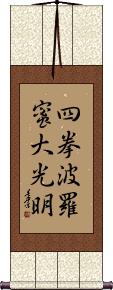
四拳波羅蜜大光明 is “shiken haramitsu daikōmyō,” a famous Japanese Buddhist mantra.
四拳 = shi-ken = four fists (many translate this as “four hearts”).
波羅蜜 = ha-ra-mitsu = A loanword representing pāramitā, or entrance into Nirvana. Awkwardly, it also means jackfruit.
大光明 = dai-kou-myo = big/great light bright (great bright light).
Shiken represents four hearts:
1. The Merciful Heart - Love and caring for all living things.
2. The Sincere Heart - Pursues righteousness, or the right path - sincerely trying to do what is right.
3. The Attuned Heart - Knows that nature and fate have their ways, and thus stay in tune with the universe.
4. The Dedicated Heart - Steadfast on the chosen path to the end.
Stone / Rock
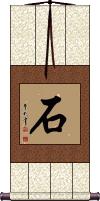
石 is the character that means rock or stone in both Chinese and Japanese.
Alone, this will be read as “stone” in Japanese but in some context, it is a unit of measure for the volume of about five bushels.
This can also refer to a gem or jewel.
This can also be the Japanese surnames that romanize as Ishi, Tsuruishi, Soku, Seki, Shi, Kazu, Iso, Ishizaki, Ishisaki, or Koku.
A Journey of 1000 Miles Feels Like One
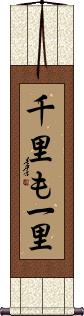
千里も一里 is a Japanese proverb that states “A journey of a thousand miles feels like only one mile.” It is understood that in the proverb, this applies when going to see the one you love.
Note that the “mile” or 里 used in this proverb is an old Chinese “li” (pronounced “ri” in Japanese). It's not actually a mile, as the measurement is really closer to 500 meters (it would take 3 of these to get close to a western mile). Still, 1000里 (333 miles) is a long way.
Xishi / Xi Shi
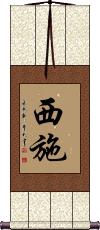
西施 is the Chinese title for Xishi, who lived around 450 BC. She was a famous Chinese beauty, perhaps the foremost of the Four Beauties (四大美女). She was given by King Gou Jian of the Yue Kingdom as a concubine to the King of Wu. This was part of an elaborate plan to destroy the Wu Kingdom - and it worked.
Note: In Japanese, this can be an unrelated given name, Seishi. Though the Xishi story is somewhat known in Japan.
The following table may be helpful for those studying Chinese or Japanese...
| Title | Characters | Romaji (Romanized Japanese) | Various forms of Romanized Chinese | |
| Adoring Love | 愛慕 爱慕 | ai bou / aibou / ai bo | ài mù / ai4 mu4 / ai mu / aimu | |
| Akashi | 明石 | akashi | míng shí ming2 shi2 ming shi mingshi | ming |
| Asahi Morning Sun | 朝日 | asahi | zhāo rì zhao1 ri4 zhao ri zhaori | chao |
| Unmoved by the Eight Winds | 八風吹不動 八风吹不动 | happuu sui fudou happuusuifudou hapu sui fudo | bā fēng chuī bù dòng ba1 feng1 chui1 bu4 dong4 ba feng chui bu dong bafengchuibudong | pa feng ch`ui pu tung pafengchuiputung pa feng chui pu tung |
| You are always a beauty in your lover’s eyes | 情人眼里出西施 | qíng rén yǎn lǐ chū xī shī qing2 ren2 yan3 li3 chu1 xi1 shi1 qing ren yan li chu xi shi qingrenyanlichuxishi | ch`ing jen yen li ch`u hsi shih chingjenyenlichuhsishih ching jen yen li chu hsi shih |
|
| Birth Life | 生 | shou / iku / sho / iku | shēng / sheng1 / sheng | |
| Benevolent and Skilled Doctor | 妙手仁心懸壺濟世 妙手仁心悬壶济世 | miào shǒu rén xīn xuán hú jì shì miao4 shou3 ren2 xin1 xuan2 hu2 ji4 shi4 miao shou ren xin xuan hu ji shi | miao shou jen hsin hsüan hu chi shih | |
| Enjoy Life | 人生を楽しみにしている | jin sei o tano shi mi ni shi te i ru | ||
| Galatians 5:25 | 我們若是靠聖靈得生就當靠聖靈行事 我们若是靠圣灵得生就当靠圣灵行事 | wǒ men ruò shì kào shèng líng shēn jiù dāng kào shèng líng xíng shì wo3 men ruo4 shi4 kao4 sheng4 ling2 dei3 shen1 jiu4 dang1 kao4 sheng4 ling2 xing2 shi4 wo men ruo shi kao sheng ling dei shen jiu dang kao sheng ling xing shi | wo men jo shih k`ao sheng ling tei shen chiu tang k`ao sheng ling hsing shih wo men jo shih kao sheng ling tei shen chiu tang kao sheng ling hsing shih |
|
| Guan Shi Yin: Protector Of Life | 觀世音 观世音 | kanzeon | guān shì yīn guan1 shi4 yin1 guan shi yin guanshiyin | kuan shih yin kuanshihyin |
| Hao | 郝 | hǎo / hao3 / hao | ||
| Happu Fudo | 八風不動 八风不动 | happuu fudou happuufudou hapu fudo | bā fēng bù dòng ba1 feng1 bu4 dong4 ba feng bu dong bafengbudong | pa feng pu tung pafengputung |
| Hello Ni Hao | 你好 | nǐ hǎo / ni3 hao3 / ni hao / nihao | ||
| Hao | 昊 | hiroshi | hào / hao4 / hao | |
| A Journey of 1000 Miles Begins with a Single Step | 千里の道も一歩から | sen ri no michi mo i-ppo ka ra senrinomichimoi-ppokara sen ri no michi mo i-po ka ra | ||
| Perception of Knowledge | 知識 知识 | chishiki | zhī shi / zhi1 shi / zhi shi / zhishi | chih shih / chihshih |
| Kyoto-Shi | 京都市 | kyou to shi kyoutoshi kyo to shi | jīng dū shì jing1 du1 shi4 jing du shi jingdushi | ching tu shih chingtushih |
| Fatherly Master Sifu Shi Fu Shifu | 師父 师父 | shi fu / shifu | shī fù / shi1 fu4 / shi fu / shifu | shih fu / shihfu |
| Sensei Master Teacher Mister | 先生 | sen sei / sensei | xiān shēng xian1 sheng1 xian sheng xiansheng | hsien sheng hsiensheng |
| Nashi | 梨 | nashi | lí / li2 / li | |
| Satori Enlightenment | 悟り | satori | ||
| Shiken Haramitsu Daikomyo | 四拳波羅蜜大光明 | shi ken ha ra mitsu dai kou myou shi ken ha ra mitsu dai ko myo | ||
| Stone Rock | 石 | ishi | shí / shi2 / shi | shih |
| A Journey of 1000 Miles Feels Like One | 千里も一里 | sen ri mo ichi ri senrimoichiri | ||
| Xishi Xi Shi | 西施 | sei shi / seishi | xī shī / xi1 shi1 / xi shi / xishi | hsi shih / hsishih |
| In some entries above you will see that characters have different versions above and below a line. In these cases, the characters above the line are Traditional Chinese, while the ones below are Simplified Chinese. | ||||

Successful Chinese Character and Japanese Kanji calligraphy searches within the last few hours...



