Many custom options...


And formats...



Not what you want?
Try other similar-meaning words, fewer words, or just one word.
Feel free to email me with your request. If it's easy, I'll translate it for free and add it to this database of calligraphy for you.
Sense of Shame in Chinese / Japanese...
Buy a Sense of Shame calligraphy wall scroll here!
Sense of Shame / Sense of Honor / Integrity / Modesty (Korean)
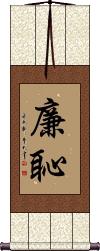
廉恥 simultaneously means “sense of honor” and “sense of shame” in Korean.
This term is often used as a tenet of Taekwondo, where the English terms “integrity” and “modesty” are applied.
廉恥 is also a Chinese word, though it is usually read with the “sense of shame” meaning, and is a poor choice for a wall scroll if your audience is Chinese.
This in-stock artwork might be what you are looking for, and ships right away...

Gallery Price: $178.00
Your Price: $98.88
Not the results for sense of shame that you were looking for?
Below are some entries from our dictionary that may match your sense of shame search...
| Characters If shown, 2nd row is Simp. Chinese |
Pronunciation Romanization |
Simple Dictionary Definition |
廉恥 廉耻 see styles |
lián chǐ lian2 chi3 lien ch`ih lien chih renchi れんち |
More info & calligraphy: Sense of Shame / Sense of Honor / Integrity / Modesty (Korean)sense of honour (honor) |
四維 四维 see styles |
sì wéi si4 wei2 ssu wei yotsui よつい |
the four social bonds: propriety, justice, integrity and honor; see 禮義廉恥|礼义廉耻[li3 yi4 lian2 chi3]; the four directions; the four limbs (Chinese medicine); four-dimensional (1) (See 四隅・2) four ordinal directions; (2) (しい only) (from Guanzi) four cardinal principles of the state (propriety, justice, integrity, sense of shame); (surname) Yotsui The four half points of the compass, N. E., N. W., S. E., S. W. |
無恥 无耻 see styles |
wú chǐ wu2 chi3 wu ch`ih wu chih muchi むち |
without any sense of shame; unembarrassed; shameless (noun or adjectival noun) shameless shameless |
知恥 知耻 see styles |
zhī chǐ zhi1 chi3 chih ch`ih chih chih |
to have a sense of shame |
要臉 要脸 see styles |
yào liǎn yao4 lian3 yao lien |
(coll.) to have a sense of shame |
不要臉 不要脸 see styles |
bù yào liǎn bu4 yao4 lian3 pu yao lien |
to have no sense of shame; shameless |
修慚愧 修惭愧 see styles |
xiū cán kuì xiu1 can2 kui4 hsiu ts`an k`uei hsiu tsan kuei shu zanki |
to cultivate a sense of shame |
不知羞恥 不知羞耻 see styles |
bù zhī xiū chǐ bu4 zhi1 xiu1 chi3 pu chih hsiu ch`ih pu chih hsiu chih |
to have no sense of shame; brazen |
修習慚愧 修习惭愧 see styles |
xiū xí cán kuì xiu1 xi2 can2 kui4 hsiu hsi ts`an k`uei hsiu hsi tsan kuei shushū zanki |
to cultivate a sense of shame |
恥を知る see styles |
hajioshiru はじをしる |
(exp,v5r) to know shame; to have a sense of shame; to be ashamed |
恬不知恥 恬不知耻 see styles |
tián bù zhī chǐ tian2 bu4 zhi1 chi3 t`ien pu chih ch`ih tien pu chih chih |
to have no sense of shame |
禮義廉恥 礼义廉耻 see styles |
lǐ yì lián chǐ li3 yi4 lian2 chi3 li i lien ch`ih li i lien chih |
(idiom) propriety, justice, integrity and a sense of shame (i.e. the four social bonds, 四維|四维[si4 wei2]) |
大不善地法 see styles |
dà bù shàn dì fǎ da4 bu4 shan4 di4 fa3 ta pu shan ti fa dai fuzenchi hō |
The two great characteristics of the evil state, 無慚無愧 no sense of shame or disgrace, shameless. |
慚愧所對治 惭愧所对治 see styles |
cán kuì suǒ duì zhì can2 kui4 suo3 dui4 zhi4 ts`an k`uei so tui chih tsan kuei so tui chih zanki sho taiji |
remedied by a sense of shame and conscience |
The following table may be helpful for those studying Chinese or Japanese...
| Title | Characters | Romaji (Romanized Japanese) | Various forms of Romanized Chinese | |
| Sense of Shame Sense of Honor Integrity Modesty (Korean) | 廉恥 廉耻 | ren chi / renchi | lián chǐ / lian2 chi3 / lian chi / lianchi | lien ch`ih / lienchih / lien chih |
| In some entries above you will see that characters have different versions above and below a line. In these cases, the characters above the line are Traditional Chinese, while the ones below are Simplified Chinese. | ||||

Successful Chinese Character and Japanese Kanji calligraphy searches within the last few hours...



