Asian Art Outpost

Adventures in Asian Art


Buy a Custom Soldier Chinese or Japanese Calligraphy Wall Scroll

We have many options to create artwork with the Chinese characters / Asian symbols / Japanese Kanji for Soldier on a wall scroll or portrait.
If you want to create a cool Soldier Asian character tattoo, you can purchase that on our Chinese and Japanese Tattoo Image Service page and we'll help you select from many forms of ancient Asian symbols that express the idea of Soldier.

Quick links to words on this page...

  1. Soldiers
  2. Marine / Soldier of the Sea
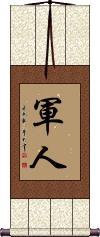
  3. Soldier / Private
  4. Soldier / Serviceman
  5. Warrior
  6. Peaceful Warrior
  7. Warrior for Peace
  8. Value of Warrior Generals
  9. Warrior / Musha
10. Warrior / Fighter
11. Warrior Soul / Heroic Spirit
12. Soul of a Warrior
13. Warrior Essence / Warrior Spirit / Martial
14. Fighter
15. Fighter / Champion
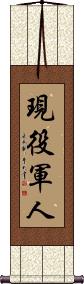
16. Active Duty
17. Active Duty Military
18. Advance Bravely / Indomitable Spirit
19. Archer
20. Army / Military
21. Sun Tzu - Art of War
22. Attack When The Enemy Has Low Morale
23. Mind of the Beginner
24. If you cannot bite, do not show your teeth
25. Boxing
26. Bravery / Courage
27. Bushido / The Way of the Samurai
28. Bravery / Courage
29. Death Before Dishonor
30. Frightful Demon / Asura
31. Enlisted Sailor
32. Fight / Beat Someone
33. Fight for a Goal
34. Fighting Spirit
35. Filial Piety
36. Flying Tigers AVG
37. Freedom / Liberty
38. Furinkazan
39. In Flowers the Cherry Blossom, In Men the Samurai
40. Hapkido
41. Hero
42. Woman of Strong Character / Woman Hero
43. Immovable Mind
44. A Life of Serenity Yields Understanding
45. Jing Mo / Jing Wu
46. Kamikaze / Divine Wind
47. Kenpo / Kempo / Quan Fa / Chuan Fa
48. Knight
49. Know Your Enemy, Know Yourself,...
50. Kobudo
51. Lingering Mind
52. Maintain An Army For 1000 Days,...
53. Marine
54. Marine Corps
55. Martial Morality...
56. Martial Arts Master
57. Martial Arts Skills
58. Martial Arts
59. Military Discipline
60. Monkey Fist
61. Morality of Deed
62. Morality of Mind
63. Musashi
64. Ninja
65. Ninjutsu / Ninjitsu
66. No Mind / Mushin
67. Past experience is the teacher for the future.
68. Undaunted After Repeated Setbacks
69. Purified Spirit / Enlightened Attitude
70. Samurai
71. Shogun / Japanese General
72. Chinese or Korean Army General
73. Southern Praying Mantis
74. Sword
75. Sworn Friend / Ally
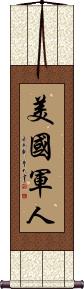
76. United States Marine Corps
77. War
78. Woman Hero / Heroine
79. Ultimate Loyalty to Your Country

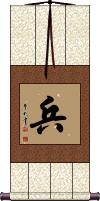
Soldiers

bīng
hei
兵

This character can be used to express soldiers, troops, a force, an army, weapons, arms, military, warfare, tactics, strategy, or warlike. The final meaning depends on context. It's also part of the Chinese title for the Terracotta soldiers. In fact, this character is usually used in compound words (words of more than one character). Sometimes this single character is the title used for the pawns in a chess game (in a related issue, this is also a nickname for soldiers with the rank of Private).

See Also...  Military | Warrior

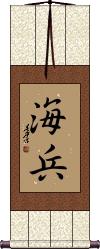
Marine / Soldier of the Sea

Japanese / Korean

kai hei
해병
海
兵

This way to express "Marine" as in an individual "Soldier of the Sea" in Japanese Kanji and old Korean Hanja characters (not to be confused with Korean Hangul).

Breaking down each character, this means:
"ocean/sea soldier/army/warrior".

Please note that this Japanese/Korean version kind of means "sailor" or "navy" in Chinese.

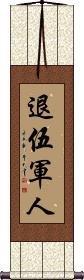
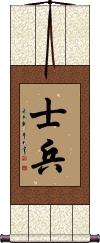
Soldier / Private

shì bīng
사병
士
兵

This means "Soldier", but more specifically, a rank-and-file soldier (a private or troop - you could say a ground-pounder). Our other entry for "solider / serviceman" is probably better for a wall scroll (since someday, you will be promoted

Note: In Japanese, they use these characters in opposite order to create the same meaning word. In that order, it's pronounced "heishi" in Japanese. Just let us know if you want it in Japanese Kanji order when you place your order.

See Also...  Military | Warrior

Soldier / Serviceman

jūn rén
gun jin
군인
軍
人

This means "Soldier" or literally "Military Person". This can also be translated as, "military personnel", "soldier", or "serviceman" (it is unisex, so male or female is not indicated).

See Also...  Military | Warrior

Warrior

wǔ shì
bu shi
무사
武
士

The first character is the spirit or essence of a warrior. The second character means soldier, officer, or official. This character is also used appropriately enough to describe a piece of a chess game. This can also be translated as soldier, cavalier, palace guard, or samurai and sometimes as knight. I've occasionally seen this translated as strong man or tough man (gender not necessarily implied).

By far, this is the most common way to write warrior in Chinese characters, Japanese Kanji, and old Korean Hanja.

Note: In Japanese, this is Bushi, as in Bushido.

See Also...  Knight | Army | Marines | Samurai

Peaceful Warrior

píng hé de wǔ shì
平
和
的
武
士

This means "Peaceful Warrior" in Chinese. This does in fact sound like an oxymoron in Chinese - but many of you have asked for this special title.

Note, this is not the same thing as "warrior for peace".

See Also...  Peace

Warrior for Peace

hé píng wǔ shì
和
平
武
士

This means "Warrior for Peace" (warrior who fights for peace) in Chinese.

Note, this is not the same thing as "peaceful warrior".

See Also...  Peace

Back to the top of this page

Value of Warrior Generals

bīng zài jīng ér bù zài duō jiàng zài móu ér bù zài yǒng
而
不
在
勇
在
多
將
在
謀
兵
在
精
而
不

Characters shown
above are read
vertically, starting
from the right

This literally means: [Just as] soldiers/warriors [are valued for their] quality and not [just] for quantity, [so] generals [are valued] for their tactics, not [just] for [their] bravery.

This is a phrase that follows one about how it is better to have warriors of quality, rather than just a large quantity of warriors in your army/force.

See Also...  兵在精而不在多

Warrior / Musha

mu sha
武
者

This is an alternate title for a warrior or samurai in Japanese. It is often romanized as "Musha".

The literal meaning of these Kanji is "war person", "military person", or "martial person".

Warrior / Fighter

sen shi
戦
士

This is an alternate title for warrior, soldier, fighter, or combatant in Japanese. From Japanese, this is often romanized as "Senshi".

See Also...  Knight | Army | Marines | Samurai

Back to the top of this page

Warrior Soul / Heroic Spirit

yǒng shì jīng shén
용사정신
勇
士
精
神

This can be translated as the warrior's spirit or warrior's soul. The first two characters can be translated as "warrior" or literally "brave soldier/man" although some will translate this word as "hero". Therefore, this is also how to say "heroic spirit".

The second two characters mean vigor, vitality, drive, spirit, mind, heart, mental essence and psychological component. Basically "your soul".

We have two versions of this phrase. The only difference is the first two and last two characters are swapped. The version here suggests that you admire or like the idea of the spirit of a warrior. The other version suggests that you are the warrior or hero.

Soul of a Warrior

jīng shén yǒng shì
정신용사
精
神
勇
士

This can be translated as the spirit or soul of a warrior. The first two characters can be translated as vigor, vitality, drive, spirit, mind, heart, mental essence and psychological component. Basically "your soul".

The second two characters mean "warrior" or literally "brave soldier/man" although some will translate this word as "hero". Therefore, this is also how to say "soul of a hero".

Note: This title is best for Chinese and old Korean. It does make sense in Japanese, but is not a common or natural Kanji combination in Japanese.

We have two versions of this phrase. The only difference is the first two and last two characters are swapped. The version here suggests that you are the warrior or hero. The other version suggests that you admire or like the idea of the spirit of a warrior.

Warrior Essence / Warrior Spirit / Martial


bu
武

This character is the essence or spirit of a warrior. This character is part of the word "wu shu" which is sometimes translated as "martial arts" or "kung fu".

In more modern speech and other context, this can mean military, martial, warlike, fierce, and perhaps violent, but usually as a prefix for a longer word or phrase.

Back to the top of this page

Fighter

Warrior / Soldier

zhàn shì
sen shi
전사
戰
士

The first character means war, warfare, or battle.
The second character means soldier, officer, man or pawn.

This is how to write "fighter" in Chinese, ancient Japanese Kanji and old Korean Hanja. This word can also mean soldier or warrior, but there are better terms for those two ideas. This one is more specifically "fighter" or "one who fights". This is an odd selection for a wall scroll, unless you are a boxer, ultimate fighter, or otherwise participate in combat sports.

Other translations include combatant or champion.

戦Note that after WWII, the first Kanji was reformed/simplified. This modern Japanese version is shown to the right. If you want this version, click on the Kanji to the right, instead of the button above.

See Also...  Knight | Army | Marines | Samurai | Warrior

Fighter / Champion

dòu shì
tou shi
투사
鬪
士

This is how to write "fighter" in Chinese and old Korean Hanja.

Chinese: This is usually used to mean "fighter" in Chinese. It can also be translated as "warrior" or "activist".

Korean: This means fighter or champion (in terms of a fighter) in Korean Hanja.

鬥斗闘Note: The first character can also be written in three alternate ways, as shown to the right. Give us a note if you have a certain preference when you place your order.

Fighter / Champion

Japanese Only

tou shi
闘
士

This is how to write "fighter" in Japanese Kanji.

This can mean "fighter for something", "militant", "champion of something/someone", gladiator, or may refer to a "boxer" in Japanese.

Back to the top of this page

Active Duty

xiàn yì
geneki
현역
現
役

When I got off active duty in the Marines, I suddenly discovered that everyone who was on active duty seemed to be very proud of that fact. These Japanese / Chinese characters are offered to those servicemen with that pride.

Please note that there is a longer, yet more natural phrase that means "Active Duty Soldier" or literally "Active Duty Military Person" - see the next entry...

Active Duty Military (person)

xiàn yì jūn rén
geneki gunjin
현역군인
現
役
軍
人

This means "Active Duty Soldier" or literally "Active Duty Military Person". It's a great way to show your pride in being an active duty member of the armed forces.

The first two characters mean "active duty" and the second two characters can be translated as "military personnel", "soldier", or "serviceman" (it is unisex, so male or female is not indicated).

If anyone is looking for "reservist" just post your request on our Asian calligraphy forum.

See Also...  Military | Warrior

Advance Bravely / Indomitable Spirit

yǒng wàng zhí qián
勇
往
直
前

This phrase creates an image of a warrior bravely advancing against an enemy regardless of the odds.

This phrase can also be translated as "indomitable spirit" or "march fearlessly onward".

See Also...  Indomitable | Fortitude

Back to the top of this page

Archer

shè shǒu
i te / sha shu
사수
射
手

This means archer, shooter, or marksman in Chinese, Japanese Kanji, and old Korean Hanja. Depending on context, it can also mean "goal getter" in Chinese. This would also be the word for bowman.

This word is kind of modern in Asia, meaning that it's only been in use for a few hundred years. However, the more ancient version of archer is often not even recognized by the current generation of Chinese and Japanese people.

The first character means "shoot" or "fire" (in the context of a gun or bow). It's also a suffix for radioactive things (in the context of chemistry) - radioactive things "fire off" electrons. In Japanese, that first Kanji is a shortname and suffix for archery.

The second character means "hand", but hand can also mean a person, in the same way that "farmhand" is a person in English.

Archer

Ancient title, Chinese and Japanese

yì rén
yokujin
익인
弋
人

This is the ancient way to write archer in both Chinese, Korean and Japanese. If you carried a bow into battle in an army of ancient Asia, this would be your title.

Note: This is an antiquated term that is rarely used in modern Chinese, Korean or Japanese. Beyond archer, this can also mean a ceremonial hunter in Japanese.

Note: This title is so old, that most Asian people will not recognize this as a normal word. It has not been in regular use for many generations.

Archer

Modern Chinese

gōng jiàn shǒu
궁전수
弓
箭
手

This is how to write "archer" in modern Chinese. It literally means "bow arrow hand". There are other ways to write "archer" in Chinese, but this is probably the most common title for modern China. The other, less-common version of archer, is also more universal, in that it has the same meaning in Japanese (this one is not used in Japan).

Back to the top of this page

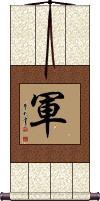
Army / Military

jūn
gun
軍

This character means army, military, or arms.

This is also a character used in the compound word that means "army general". It's the "gun" in the well-known Japanese title "Shogun" which means general.

See Also...  Shogun | Navy | Marine | Military

Sun Tzu - Art of War

military strategy, tactics, and procedure

sūn zǐ bīng fǎ
son shi hyou hou
손자병법
孫
子
兵
法

This is the full title of the most famous book about warfare in the history of the world. The English title is "Sun Tzu's The Art of War".

The last two characters have come to be known in the west as "The Art of War", but a better translation would be, "military strategy and tactics", "military skills" or "army procedures".

Note: Sometimes the author's name is Romanized as "Sun Zi" or "Sunzi".

It's written the same in Chinese, Japanese Kanji and Korean Hanja.

See Also...  Military | Warrior

Attack When The Enemy Has Low Morale

bì qí ruì qì jī qí duò guī
擊
其
惰
歸
避
其
鋭
氣

Characters shown
above are read
vertically, starting
from the right

This literally translates as: Avoid [your enemy's] fighting spirit [and] attack [when] his [morale is] declining.

Figuratively, this means: Avoid the enemy when his morale is high. and strike him when his morale is flagging.

Back to the top of this page

Mind of the Beginner

chū xīn
shoshin
初
心

This is often translated in Japanese as "beginner's mind". In Chinese, the dictionary definition is "one's original intention".

The first character means first, initial, primary, junior, beginning, or basic.

The second character means heart, mind, soul, or essence.

This is one of the five spirits of the warrior (budo), and is often used as a Japanese martial arts tenet. Under that context, places such as the Budo Dojo define it this way: The state of shoshin is that of a beginners mind. It is a state of awareness the remains always fully conscious, aware, and prepared to see things for the first time. The attitude of shoshin is essential to continued learning.

If you cannot bite, do not show your teeth

If you cannot fight, don't start one

bù néng yǎo rén jiù bié zī yá
就
別
齜
牙
不
能
咬
人

Characters shown
above are read
vertically, starting
from the right

This literally translates as: [if you] can't bite people, don't bare [your] teeth.

Figuratively, this means: Don't show your anger if you can't do anything about the situation.

Some will also say this means, "Don't start a fight that you cannot win". Others will say it means that you must be willing to back up your words (perhaps with your fists).

Boxing

quán jī
권격
拳
擊

This is the term used in Chinese to refer to the original Olympic sport of combat and fighting. If you like to strap on your boxing gloves and go a few rounds, or are just a fan of boxing, this could make a nice wall scroll for you.

Note that Japanese use the same first character (which means fist) but a different Kanji for the second. Please see our Japanese boxing entry for that version.

Back to the top of this page

Boxing (Japanese)

ken tou
拳
闘

This is the term used in Japanese Kanji to refer to the original Olympic sport of combat and fighting. This can also be translated as "prize fighting".

The first Kanji means fist. The second means fight. So when literally translated, this means "fist fight" (though understood in Japanese as a more refined sport, versus street fighting).

Note: A completely different second character is used in the Chinese word for boxing, but a Chinese person would still be able to guess the meaning of these Kanji.

Bravery / Courage

Courage in the face of Fear

yǒng gǎn
yuu kan
용감
勇
敢

This word is about courage is bravery in the face of fear. You do the right thing even when it is hard or scary. When you are courageous, you don't give up. You try new things. You admit mistakes. This kind of courage is the willingness to take action in the face of danger and peril.

These characters can also be translated as: braveness, valor, heroic, fearless, boldness, prowess, gallantry, audacity, daring, dauntless and/or courage in Japanese, Chinese, and Korean. This version of bravery/courage can be an adjective or a noun. The first character means bravery and courage by itself. The second character means "daring" by itself. The second character just emphasizes the meaning of the first, but adds an idea that you are not afraid of taking a dare, and you are not afraid of danger.

This is about brave behavior versus the mental state of being brave. You'd more likely use this to say, "He fought courageously in the battle", rather than "He is very courageous".

See Also...  Warrior

Bushido / The Way of the Samurai

wǔ shì dào
bushido
무사도
武
士
道

The Code of the Samurai

Sometimes called "The Seven Virtues of the Samurai", "The Bushido Code", or "The Samurai Code of Chivalry".

This would be read in Chinese characters, Japanese Kanji, and old Korean Hanja as "The Way of the Warrior", "The Warrior's Way", or "The Warrior's Code".

It's a set of virtues that the Samurai of Japan and ancient warriors of China and Korea had to live and die by.

See our page with just Code of the Samurai / Bushido here

See Also...  Samurai | Warrior

Back to the top of this page

Bravery / Courage

Courageous Energy

yǒng qì
yuuki
용기
勇
氣

There are several ways to express bravery and courage in Chinese, Japanese, and Korean. This version is the most spiritual. This is the essence of bravery from deep within your being. This is the mental state of being brave versus actual brave behavior. You'd more likely use this to say, "He is very courageous", rather than "He fought courageously in the battle".

The first character also means bravery or courage when it's seen alone. With the second character added, an element of energy or spirit is added. The second character is the same "chi" or "qi" energy that Kung Fu masters focus when they strike. For this reason, you could say this means "spirit of courage" or "brave spirit".

This is certainly a stronger word than just the first character alone.

Beyond bravery or courage, dictionaries also translate this word as valour, valor, nerve, audacity, daring, pluck, plucky, gallantry, guts, gutsy and boldness.

Japanese 気While the version shown to the left is commonly used in Chinese and Korean Hanja (and ancient Japanese Kanji), please note that the second character is written with slightly fewer strokes in modern Japanese. If you want the modern Japanese version, please click on the character to the right. Both styles would be understood by native Chinese, Japanese, and many (but not all) Korean people. You should choose character based on the intended audience for your calligraphy artwork. Or pick the single-character form of bravery/courage which is universal.

See Also...  Warrior

Death Before Dishonor

A soldier can die or kill, but never dishonor or disgrace himself

shì kě shā bù kě rǔ
士
可
殺
不
可
辱

This almost directly matches the military idea of "Death Before Dishonor", while also being an ancient Chinese phrase.

The direct meaning is, "[A] soldier/warrior can die/kill [but he/she] cannot [allow] dishonor/disgrace [upon himself/herself]". Chinese grammar, and especially ancient grammar is a little different than English. Not nearly as many articles are needed, and a lot is implied.

There are a lot of ways to express ideas similar to "Death Before Dishonor" in Chinese, and I would rate this one in the top two.

This is the original form of this phrase with the character for "soldier/warrior" at the beginning. Most of the time, this character is dropped, and this becomes a five-character phrase (the soldier/warrior part is implied, even without the character being present in the phrase). We also offer the shorter version.

Frightful Demon / Asura

ē xiū luó
ashura
아수라
阿
修
羅

This demon title comes from the ancient Sanskrit word Asura. This is often used in Buddhism when describing various demons. Sometime defined as "Fighting and battling giant demon".

In the context of Buddhism: This title originally meant a spirit, spirits, or even the gods (perhaps before 1700 years ago). It now generally indicates titanic demons, enemies of the gods, with whom, especially Indra, they wage constant war. They are defined as "not devas", and "ugly", and "without wine". There are four classes of asuras, separated according to their manner of rebirth. They can be egg-born, womb-born, transformation-born, and spawn- or water-born. Their abode is in the ocean, north of Sumeru, but certain of the weaker dwell in a western mountain cave. They have realms, rulers, and palaces, as have the devas.

In terms of power, Asuras rank above humans but below most of the other deities. They live in the area near the coastal foot of Mount Sumeru (on the northern side). Their domain is partially or wholly in the ocean.

Back to the top of this page

Enlisted Sailor

shuǐ bīng
suihei
수병
水
兵

These are the Chinese and Japanese characters for "Sailor". Specifically this refers to an enlisted sailor.

These two characters literally mean "water soldier".

See Also...  Military

Fight / Beat Someone

dòu
斗

This is how to express the act of fighting in Chinese. Generally this means fighting against someone or some force whether physically or metaphorically.

Note: There is more than one way to write this character. You will notice variations on the next page after you click "Select and Customize". If you have a preference, please let us know when you place your order.

Please note that there is a secondary pronunciation and meaning of this character. It can also mean "measuring cup" or in Japanese "sake dipper" or even "The Big Dipper". In Japanese and Korean, this does not have the fighting meaning associated with it. You should therefor select this character only if your audience is Chinese, or you are a big fan of sake dippers or The Big Dipper (as that is how it will be read by Japanese and Korean people).

Fight for a Goal

zhēng
爭

This is the way to express the idea of fighting for a goal. It can also mean to struggle or to argue. This is okay for a Chinese audience, and while it is a word in Korean, this character is seldom seen alone in Korean grammar.

Back to the top of this page

Fighting Spirit

The Will to Fight

dòu zhì
斗
志

This literally means fighting spirit. As in the spirit that a warrior, soldier, athlete or fighter must possess.

斗Note: There is more than one way to write the first character of this word. It is sometimes written like the version shown to the right (yes, it's completely different, but has the same meaning & pronunciation). If you have a preference, please let us know in the special instructions about your order.

Fighting Spirit (Japanese only)

tou shi
闘
志

This literally means "fighting spirit" or "the will to fight". As in the spirit that a warrior, soldier, athlete or fighter must possess.

Fighting Spirit (Japanese only)

Alternate version

tou kon
闘
魂

This is an alternate title with the meaning "fighting spirit" or "the will to fight".

Back to the top of this page

Filial Piety

xiào
kou
孝

This character represents filial piety. Some will define this in more common English as "respect for your parents and ancestors".

This is a subject deeply emphasized by the ancient philosophy and teachings of Confucius.

Some have included this in the list for the Bushido, although generally not considered part of the 7 core virtues of the warrior.

Note: This character is not the best of meanings when seen along as a single character. Some will read the single character form to mean "missing my dead ancestors". However, when written at part of Confucian tenets, or in the two-character word that means filial piety, the meaning is better or read differently (context is important for this character).

We suggest one of our other two-character filial piety entries instead of this one.

See our page with just Code of the Samurai / Bushido here

See Also...  Filial Piety | Confucius

Flying Tigers AVG

fēi hǔ duì
비호대
飛
虎
隊

This is the full title of the "Flying Tigers Group". These were the American pilots that volunteered to go to China and fight the Japanese prior to the entry of the USA into World War Two. These fighter pilots were so esteemed in China, that fallen American pilots could always find refuge in villages, and safe passage and escape to areas of China that were not occupied by Japan at that time. Chinese villagers helped such fallen pilots with full knowledge that when the Japanese occupation forces found out, all the men, women, and children in the village would be massacred by Japanese troops (there are more than a few known cases of such massacres).

The Flying Tigers successfully kept supply lines to the Chinese resistance open, and divided Japanese forces at a crucial time while America prepared to officially join WWII.

A wall scroll like this honors the men who risked or gave their lives as noble volunteers, and is a reminder of the best moment in history of Sino-American relations.

These three characters literally mean "flying tiger(s) group/team/squad".

Note: Hanging these characters on your wall will not make you any friends with Japanese people who are aware or this history (most Japanese have no idea, as Japan's involvement in WWII has all but been erased from school textbooks in Japan).

Freedom / Liberty

zì yóu
jiyuu
자유
自
由

This is a common word to express the idea of freedom in both Chinese and Japanese.

This word is the essence of "being free" but also acts as the suffix to create words like freestyle swimming, free trade, civil liberties, free will, freedom fighter, religious freedom, and liberal.

Note: If you need any of these other words or meanings, just post your request on our Asian calligraphy forum.

Back to the top of this page

Furinkazan

military strategy

fēng lín huǒ shān
fuu rin ka zan
風
林
火
山

This is the battle strategy and motto of Japanese feudal lord Takeda Shingen (1521–1573 A.D.). This came from the Art of War by Chinese strategist and tactician Sun Tzu (Sunzi).

You can think of this as a sort of abbreviation to remind officers and troops how to conduct battle.

This is literally a word list: Wind, Forest, Fire, Mountain.

The more expanded meaning is supposed to be...

"Swift as wind, quiet as forest, fierce as fire, and immovable as a mountain"

"As fast as the wind, as quiet as the forest, as daring as fire, and immovable as the mountain"

"Move as swift as a wind, stay as silent as forest, attack as fierce as fire, undefeatable defense like a mountain"

"Move swiftly like the wind, stay silent like the forest, attack fiercely like fire, take tactical position on the mountain"

See Also...  Art Of War

In Flowers the Cherry Blossom, In Men the Samurai

Hana wa sakura hito wa bushi

hana wa sakura hito wa bushi
人
な
武
士
花
な
櫻
木

Characters shown
above are read
vertically, starting
from the right

This phrase simply reads, "[In] Flowers it's Cherry Blossoms, [In] Men it's Warriors".

This is meant to say that of all the flowers in the world, the cherry blossom is the best. And of all men in the world, the Samurai or Warrior is the best

This phrase has been around for a long time. It's believed to have been composed sometime before the Edo Period in Japan (which started in 1603).

Hapkido

Korean Martial Art of re-directing force

hé qì dào
ai ki do
합기도
合
氣
道

Hapkido is a mostly-defensive martial art of Korea. It has some connection to Aikido of Japan. In fact, they are written with the same characters in both languages. However, it should be noted that the Korean Hanja characters shown here are the traditional Chinese form - but in modern Japan, the middle character was slightly simplified.
Note: You can consider this to be the older Japanese written form of Aikido. Titles on older books and signs about Aikido use this form.

The connection between Japanese Aikido and Korean Hapkido is a bit muddled in history. This is probably due to the relationship between the two countries - especially during WWII when many Koreans became virtual slaves for the Japanese (many Koreans are still bitter about that, so many things were disassociated from having any Japanese origin).

Looking at the characters, the first means "union" or "harmony."
The second character means "universal energy" or "spirit".
The third means "way" or "method".
One way to translate this into English is "Harmonizing Energy Method". This makes since, as Hapkido has more to do with redirecting energy, rather that fighting with strength against strength.

More Hapkido info

More notes:
1. Sometimes Hapkido is Romanized as "hap ki do", "hapki-do" "hab gi do" or "hapgido".

2. Korean Hanja characters are actually Chinese characters that usually hold the same meaning in both languages. There was a time when these characters were the standard and only written form of Korean. The development of modern Korean Hangul characters is a somewhat recent event in the greater scope of history. There was a time when Chinese characters were the written form of many languages in places known in modern times as North Korea, South Korea, Japan, Vietnam, Singapore, Hong Kong, Taiwan, Mainland China, and a significant portion of Malaysia. Even today, more people in the world can read Chinese characters than can read English.

3. While these Korean Hanja characters can be pronounced in Chinese, this word is not well-known in China and is not considered part of the Chinese lexicon.


Back to the top of this page

Hero

yīng xióng
ei yuu
영웅
英
雄

This is the best way to write hero in Chinese and Japanese - especially for calligraphy. This is also the name of the Chinese movie titled Hero starring Jet Li.

The first character means brave (it can also mean British or English, but not in this case).
The second character means heroic, but also suggests a male person.
My Japanese dictionary also defines this as "a great man".

Woman of Strong Character / Woman Hero

nǚ jiá
joketsu
女
傑

This can mean brave woman, heroine, lady of character, distinguished woman, outstanding woman, and sometimes prominent woman.

In modern usage, some people might use this to give a title to women like Oprah Winfrey, Hillary Clinton, or Sarah Palin. I would rather use it for a woman like Araceli Segarra (the first woman from Spain to climb Mt. Everest).

Immovable Mind

A Japanese martial arts title/concept

fu dou shin
부동심
不
動
心

The first two Kanji alone mean immobility, firmness, fixed, steadfastness, motionless, idle.

The last Kanji means heart, mind, soul, or essence.

Together, these three Kanji create a title that is defined as "immovable mind" within the context of Japanese martial arts. However, in Chinese it would mean "motionless heart" and in Korean Hanja, "wafting heart" or "floating heart".

This is one of the five spirits of the warrior (budo), and is often used as a Japanese martial arts tenet. Under that context, places such as the Budo Dojo define it this way: An unshakable mind and an immovable spirit is the state of fudoshin. It is courage and stability displayed both mentally and physically. Rather than indicating rigid, inflexibility, fudoshin describes a condition that is not easily upset by internal thoughts or external forces. It is capable of receiving a strong attack while retaining composure and balance. It receives and yields lightly, grounds to the earth, and reflects aggression back to the source.

Back to the top of this page

A Life of Serenity Yields Understanding

dàn bó yǐ míng zhì, níng jìng ér zhì yuǎn
淡
泊
以
明
志
寧
靜
而
致
遠

This is a kind of complex ten-character proverb composed by Zhuge Liang about 1800 years ago. The proverb means "Leading a simple life will yield a clear mind, and having inner peace will help you see far (into the world)".

What I have translated as "simple life" means NOT being materialistic and NOT competing in the rat race.

The last word means "far", but the deeper meaning is that you will surpass what you can currently see or understand. Perhaps even the idea of opening up vast knowledge and understanding of complex ideas.

The whole phrase has a theme that suggests if you are NOT an aggressive cut-throat person who fights his way to the top no matter how many people he crushes on the way, and instead seek inner peace, you will have a happier existence and be more likely to understand the meaning of life.

See Also...  Serenity

Jing Mo / Jing Wu

jīng wǔ
jing mo
정무
精
武

This two-character title is used for a certain type of martial arts. You can translate this roughly as "Excellent Marital Arts" or "Excellence in Martial Arts". You will notice that the second character is "wu" as in wushu (martial arts) and wushi (warrior).

More information can be found at the Jing Mo website. You should probably only order this if you are a member of this association.

Note that "jing mo" is the Cantonese pronunciation of these characters. In Mandarin, they are "jing wu".
Also used in Korean, but only by those involved with martial arts who can also read Korean Hanja (a small percentage of the population).

Kamikaze / Divine Wind

kami kaze
神
風

This is the famous title used during WWII to describe Japanese fighter plane pilots, many of whom performed suicide attacks by flying their planes into ships and other Allied targets.

The Japanese word, Kamikaze actually means "divine wind".

See Also...  Kamikaze

Back to the top of this page

Kenpo / Kempo / Quan Fa / Chuan Fa

quán fǎ
kenpou
권법
拳
法

This form of martial arts can be translated in several ways. Some will call it "fist principles" or "the way of the fist", or even "law of the fist". The first character literally means fist. The second can mean law, method, way, principle or Buddhist teaching.

Kempo is really a potluck of martial arts. Often a combination of Chinese martial arts such as Shaolin Kung Fu with Japanese martial arts such as Karate, Jujutsu (Jujitsu), Aikido, and others. You may see the term "Kempo Karate" which basically means Karate with other disciplines added. In this way, Kempo becomes an adjective rather than a title or school of martial arts.

These facts will long be argued by various masters and students of Kempo. Even the argument as to whether it should be spelled "kenpo" or "Kempo" ensues at dojos around the world (the correct Romaji should actually be "kenpou" if you precisely follow the rules).

The benefit of Kempo is that the techniques are easier to learn and master compared to pure Kung Fu (wu shu). Students are often taught basic Karate moves, kicks, and punches before augmenting the basic skills with complex Kung Fu techniques. This allows students of Kempo achieve a level where they can defend themselves or fight in a relatively short amount of time (a few years rather than a decade or more).

Because the definition of this word is so fluid, I should make some notes here:

1. Purists in Okinawa will claim that "Okinawa Kenpo" or "Ryukyu Hon Kenpo" is the original and true version of this martial art from the old kingdom. There is actually little or no connection between Okinawa Kenpo and the way the word is used elsewhere.

2. In Chinese, where these characters are pronounced "quan fa" (sometimes Romanized as "chuan fa" because the Chinese-pinyin "q" actually sounds like an English "ch" sound), these characters do not hold the connotation of being a mixed martial art. It is simply defined as "the law of the fist".

3. In my Japanese dictionary, it oddly defines Kenpo as "Chinese art of self-defense". I personally don't feel this is the most common way that people perceive the word, but just something you should know.

Knight

qí shì
ki shi
기사
騎
士

The first character has the element of "horse" in it, and alone can mean "one who rides". Together, these characters can be translated as "riding soldier" or "horseman soldier", which of course can also be translated as "knight".

Can also be translated as "cavalier".

See Also...  Warrior | Horse

Know Your Enemy, Know Yourself,
and You Cannot Lose

zhí bǐ zhí jī bǎi zhàn bú dài
百
戰
不
殆
知
彼
知
己

Characters shown
above are read
vertically, starting
from the right

This is from Sun Tzu's (Sunzi's) Art of War. It means that if you know and understand the enemy, you also know yourself, and thus with this complete understanding, you cannot lose.

This phrase is often somewhat-directly translated as, "Know the enemy and know yourself, and you can fight a hundred battles without defeat".

It can also be translated as, "If you know both yourself and your enemy, you can come out of hundreds of battles without danger", or "Know your enemy, know yourself, and your victory will not be threatened".

Back to the top of this page

Kobudo (Japanese)

gǔ wǔ dào
kubudou
古
武
道

This is the title for Kubudo, which can be defined as Okinawan weapons fighting.

The literal translation would be something like "Old Martial Way". The last two characters are often translated as "martial arts" so "Old Martial Arts" is another possible translation.

Please note that even though these are Chinese characters, and can be pronounced in Chinese, this is a Japanese only title. It is not often used nor understood in Chinese. So please consider this to only be appropriate for a Japanese audience.

Lingering Mind

A Japanese martial arts title/concept

cán xīn
zan shin
殘
心

First off, this should only be used in context of Japanese martial arts. In Chinese, it's a rather sad title (like a broken heart). In Chinese, the first character alone means destroyed, spoiled, ruined, injured, cruel, oppressive, savage, incomplete, disabled. However, in Japanese, it's remainder, leftover, balance, or lingering.
The second character means heart, mind, soul, or essence in both languages.

This is one of the five spirits of the warrior (budo), and is often used as a Japanese martial arts tenet. Under that context, places such as the Budo Dojo define it this way: The spirit of zanshin is the state of the remaining or lingering spirit. It is often described as a sustained and heightened state of awareness and mental follow-through. However, true zanshin is a state of focus or concentration before, during, and after the execution of a technique, where a link or connection between uke and nage is preserved. Zanshin is the state of mind that allows us to stay spiritually connected, not only to a single attacker, but to multiple attackers and even an entire context; a space, a time, an event.

In modern Japan (and Simplified Chinese), they use a different version of the first character, as seen to the right. Click on this character to the right instead of the button above if you want this modern Japanese version of lingering mind / zanshin.

Maintain An Army For 1000 Days,
Use It For An Hour

yǎng bīng qiān rì, yàng bīng yì shí
양병천일용병일시
用
兵
一
時
養
兵
千
日

Characters shown
above are read
vertically, starting
from the right

Nothing could be more true. When I was in the Marine Corps, we trained for years for combat that often lasts only hours.

This phrase also reminds me of a common phrase used in the military to describe combat: "Weeks of total boredom, punctuated with five minutes of shear terror".

This may have some roots in Sun Tzu's The Art of War. Though I can not find this passage in his writings.

On the subject of the Art of War, if you have a favorite passage, we can create a custom calligraphy scroll with that phrase.

Back to the top of this page

Marine

Amphibious Warrior (Chinese)

hǎi jūn lù zhàn duì yuán
海
軍
陸
戰
隊
員

This is the Chinese way to express "Marine". (as in a member of the Marine Corps). It is not country-specific, so it could be the Royal Marines, U.S. Marines, Chinese Marines, etc.
In Australian English, they would translate this as "Naval Infantryman".

Breaking down each character, this means:
"ocean/sea military/arms shore/land fighting/war/battle corps/team/group person/member". Note that the first two characters presented together, but outside of this phrase mean "navy" (sea military).

See Also...  Warrior | Military | Navy | Art Of War

Marine Corps

Chinese

hǎi jūn lù zhàn duì
海
軍
陸
戰
隊

This is the Chinese way to express "Marine Corps". This could be the Marine Corps of virtually any country that has an amphibious military force.

Let me know you want a more specific title such as British Royal Marines or U.S. Marine Corps.

The Chinese title for Marines is very verbose...
Breaking down each character, this means:
"ocean/sea military/arms shore/land fighting/war/battle corps/team/group".

Marine Corps

Japanese & Korean

kaiheitai
해병대
海
兵
隊

This is the Japanese and Korean way to express "Marine Corps" or simply "Marines". It is not specific, so this can be the Marine Corps of any country, such as the British Royal Marines to the U.S. Marines.

Breaking down each character, this means:
"ocean/sea soldiers/army corps/regiment/group".

Back to the top of this page

Martial Morality
Martial Arts Ethics / Virtue

wǔ dé
butoku
무덕
武
德

This refers to the virtue, morality, and ethics that any practitioner of martial arts should posses. This can be used in both Chinese and Japanese in lieu of English terms such as "soldierly virtue", "good conduct" (military), "warrior ethics", and being honorable in regards to any fight or competition.

See Also...  Morality Of Mind | Morality Of Deed

Martial Arts Master (Japanese Only)

wǔ yún zhě
bugeisha
무운자
武
芸
者

This is the Japanese Kanji title for "Martial Arts Master". It suggests that you have reached at least the level of black belt, and are probably to the level where you are ready to become an instructor.

Please consider carefully where you stand before ordering this phrase on a wall scroll. If you are not a master, this will make you look a bit foolish.

If you want to get this as a gift for your master at the dojo. Try to discreetly make sure this term is used in your school. Different schools and styles of Japanese martial arts use different terms. You may notice in the Romaji and the characters, this has the same characters as "geisha" which means "person skilled in arts" (what a geisha girl really is). The title here has the character for "martial", "warrior", and/or "military" in front of it. Therefore the literal translation is "martial art person".

These Kanji are valid Chinese characters and Korean Hanja, but this title does not really make sense in Chinese and not often used in Korean, though a Chinese or Korean would be able to guess the meaning by looking at the first and last characters.

Martial Arts Skills

wǔ jì
bugi
무기
武
技

This can be translated as "martial arts skills", "warrior skills", or "military skills" depending on usage. In both Japanese and Chinese, rather than meaning martial arts, this speaks more to the skills that you posses in regards to martial arts. This phrase also has a light suggestion of "having an itch to show off these skills".

Back to the top of this page

Martial Arts

Japanese

wǔ dào
budou
무도
武
道

This is more the Japanese way to say "Martial Arts", but it's understood in Korean Hanja and Chinese too. Some will use this title to mean chivalry (the conduct of a knight) or military art. The way this word is understood would depend on the context in which it is used.

The first character means "force" or "warlike" or "essence of a warrior".

The second character means "method", "path", and "the way". It is the same character used to describe/mean the philosophy of Taoism / Daoism.

Military Discipline

jūn jì
gun ki
군기
軍
紀

This word means military discipline or military principles.

If maintaining your military discipline is important to you personally, or important to your military unit, this is the wall scroll to have up behind your desk. In fact, it's the kind of thing I expect to see behind the desk of a First Sergeant or maybe a hardcore NCO.

Note: In some rare context, it could be extended to mean "morale", but "discipline" is much closer to the commonly-held definition.

Note: This term is not well-known outside of the military services in Asia (not used by the common person).

See Also...  Self-Discipline

Monkey Fist

hóu quán
후권
猴
拳

This literally means what you think, it's the "Monkey Fist" school of Kung Fu. A style that mimics the punches and movements of monkeys and apes.

Becoming popular during the Qing Dynasty, this style can trace its origins back to as early as the Song Dynasty. Some of the romance and popularity of this style comes from the novel "Journey to the West" which features the Monkey King and his fighting skills.

This novel and martial arts style has spawned a stream of Hong Kong movies featuring the Monkey King, and other Kung Fu style variations such as "Drunken Monkey" and "Monkey Stealing Peaches" (a technique of disabling your opponent by grabbing and yanking on his testicles).

Note: This kind of makes sense in Korean Hanja and Japanese Kanji, but probably unknown by all Koreans and Japanese except those who have an interest in this form of Kung Fu.

Back to the top of this page

Morality of Deed

xíng dé
行
德

The idea of "morality of deed" goes along with "wu de" (martial morality or virtues of the warrior).

Here, the first character is a representation of the actions or deeds that you engage in.
The second character refers to morality or virtue.

This translates better in English in the opposite order, as the Chinese order is literally "deed morality".

See Also...  Morality Of Mind | Martial Morality

Morality of Mind

xīn dé
心
德

The idea of "morality of mind" goes along with "wu de" (martial morality or virtues of the warrior).

Here, the first character is a representation of your heart or mind.
The second character refers to morality or virtue.

This can also be translated as "morality of heart", "virtue of heart", or "virtue of the mind".

Note that since ancient times in Asia, the idea of your mind (the place where your soul resides, and your thought originate from) has been associated with the heart. Just as in western culture where we say "it comes from the heart", or "heartfelt emotions", there is a belief that your heart and mind are one and the same (medical science now begs to differ).

See Also...  Morality Of Deed | Martial Morality

Musashi

The most famous Samurai

mu sashi
武
蔵

This is the short title for a man long in legend. Miyamoto Musashi is probably the most famous Samurai in all of Japanese history. While coming from a lower class, his new sword and fighting techniques put him on par with the best that feudal Japan had to offer. His long career started with his first duel was at age 13!

He is credited both with using two swords at once, and never losing a single battle in his career. After becoming a Buddhist, and getting older, like many old warriors, he took up a peaceful and solitary life until his death around 1645 A.D.

Note: Technically, Musashi is his given name, and Miyamoto is his surname. However, it's suggested that he assumed both of these names, and also had a few other names at childhood, as well as being given a Buddhist name. It's hard to know what to call him, as with most Kanji, there are multiple pronunciations. The characters for Musashi can also be pronounced "Takezō". But, everyone in modern times seems to know him by the name Musashi.

Back to the top of this page

Ninja

rěn zhě
ninja
忍
者

In feudal Japan, ninja or shinobi (literally, "one who is concealed" or "one that endures") were sometimes assassins and agents of espionage. The ninja, like samurai, followed their own special code of conduct.

The role of the ninja has been romanticized in many American movies (and to a lesser extent in Japanese movies). Because the ninja-craze has taken off in the west, Japan has followed the trend and you'll see plenty of ninja-related imagery in Japan.

忍Note that when writing this as Kanji, Japanese will tend to write the first character in the form shown to the right. If you select our Japanese master calligrapher, please expect that form. Our Chinese calligraphers can also write it in the Japanese form, but only if you request it (in the special instructions about your order during checkout).

See Also...  Samurai | Warrior | Ninjitsu

Ninjutsu / Ninjitsu

rěn shù
ninjutsu
忍
術

This is the "art of the ninja" in Japanese. Most Japanese people associate ninjas with some degree of romance and reverence to Japan's ancient past. But most will accept that the ninja is an idea or way of life whose time has passed. However, this has not stopped floods of movies about ninjas and dojos offering Ninjutsu training from keeping the idea of the ninja alive in modern times.

My modern Japanese dictionary defines this term as "assassination, stealth and combat techniques", or "fighting art of the ninja".

These character are sometimes Romanized as two words: Shin obi, or Shin-obi.

忍Note that when writing this as Kanji, Japanese will tend to write the first character in the form shown to the right. Because this is specifically a Japanese title, we only suggest our Japanese master calligrapher for this selection - and you will get the form shown to the right if you do that (please ignore the fact that some of the images you see during the following pages in the options process will be the Chinese/alternate form).

No Mind / Mushin

wú xīn
mu shin
무심
無
心

In Japanese, this word means innocent, or one with no knowledge of good and evil. It literally means "without mind".

This is one of the five spirits of the warrior (budo), and is often used as a Japanese martial arts tenet. Under that context, places such as the Budo Dojo define it this way: "No mind, a mind without ego. A mind like a mirror which reflects and dos not judge." The original term was "mushin no shin", meaning, "mind of no mind." It is a state of mind without fear, anger, or anxiety. Mushin is often described by the phrase, "mizu no kokoro", which means, "mind like water". The phrase is a metaphor describing the pond that clearly reflects it’s surroundings when calm, but whose images are obscured once a pebble is dropped into its waters.

This has a good meaning in conjunction with Chan / Zen Buddhism in Japan. However, out of that context, it means mindlessness or absent-minded. To non-Buddhists in China, this is associated with doing something without thinking.
In Korean, this usually means indifference.

Use caution and know your audience before ordering this selection.

More info: Wikipedia: Mushin

Back to the top of this page

Past experience is the teacher for the future.

Past events not forgotten serve as teachers for later events.

qián shì bú wàng hòu shí zhī shī
前
事
不
忘
后
事
之
師

The most literal translation to English of this ancient Chinese proverb is:
"Past events not forgotten serve as teachers for later events".

However, it's been translated several ways:
Past experience, if not forgotten, is a guide for the future.
Past calamity is my teacher.
A good memory for the past is a teacher for the future.
The remembrance of the past is the teacher of the future.
If one remembers the lessons of the past; They will serve as a guide to avoid mistakes in the future.

The origin:
This proverb comes from the 5th century B.C. just before the Warring States Period in the territory now known as China.
The head of the State of Jin, Zhi Bo, seized power in a coup. He did this with help from the armies of the State of Han and Wei. Instead of being grateful for the help from Han and Wei, he treacherously took the land of Han and Wei. Never satisfied, Zhi Bo employed the armies of Han and Wei to attack and seize the State of Zhao.

The king of Zhao took advice from his minister Zhang Mengtan and secretly contacted the Han and Wei armies to reverse their plans and attack the army of Zhi Bo instead. The plan was successful, and the State of Zhao was not only saved, but was set to become a powerful kingdom in the region.

Zhang Mengtan immediately submitted his resignation to a confused king of Zhao. When asked why, Zhang Mengtan said, "I've done my duty to save my kingdom, but looking back at past experience, I know sovereign kings are never satisfied with the power or land at hand. They will join others and fight for more power and more land. I must learn from past experiences, as those experiences are the teachers of future events".
The king could not dispute the logic in that statement and accepted Zhang Mengtan's resignation.

For generations, the State of Zhao continued to fight for power and land until finally being defeated and decimated by the State of Qin (which lead to the birth of the Qin Dynasty in 221 B.C.).

Undaunted After Repeated Setbacks

Persistence to overcome all challenges

bǎi zhé bù náo
hyaku setsu su tou
백절불요
百
折
不
撓

This phrase means "Be undaunted in the face of repeated setbacks". It's of Chinese origin, but is commonly used in Japanese, and somewhat in Korean (same characters, different pronunciation).

This phrase comes from a long, and occasionally tragic story of a man that lived sometime around 25-220 AD. His name was Qiao Xuan and he never stooped to flattery, but remained an upright person at all times. He fought to expose corruption of higher-level government officials at great risk to himself.

Then when he was at a higher level in the Imperial Court, bandits were regularly capturing hostages and demanding ransoms. But when his own son was captured, he was so focused on his duty to the Emperor and common good that he sent a platoon of soldiers to raid the bandits' hideout, and stop them once and for all even at the risk of his own son's life. While all of the bandits were arrested in the raid, they killed Qiao Xuan's son at first sight of the raiding soldiers.

Near the end of his career a new Emperor came to power, and Qiao Xuan reported to him that one of his ministers was bullying the people and extorting money from them. The new Emperor refused to listen to Qiao Xuan and even promoted the corrupt Minister. Qiao Xuan was so disgusted that in protest he resigned his post as minister (something almost never done) and left for his home village.

His tombstone reads "Bai Zhe Bu Nao" which is now a phrase used in Chinese culture to describe a person of strong will who puts up stubborn resistance against great odds.

My Chinese-English dictionary defines these 4 characters as, "keep on fighting in spite of all setbacks", "be undaunted by repeated setbacks" and "be indomitable".

Our translator says it can mean, "never give up" in modern Chinese.

Although the first two characters are translated correctly as "repeated setbacks", the literal meaning is "100 setbacks" or "a rope that breaks 100 times". The last two characters can mean "do not yield" or "do not give up".
Most Chinese, Japanese, and Korean people will not take this absolutely literal meaning, but will instead understand it as the title suggests above. If you want a single big word definition, it would be indefatigability or indomitableness.

See Also...  Tenacity | Fortitude | Strength | Perseverance

Purified Spirit / Enlightened Attitude

A Japanese martial arts title/concept

sen shin
先
心

The first Kanji alone means before, ahead, previous, future, precedence.

The second Kanji means heart, mind, soul, or essence.

Together, these two Kanji create a word that is defined as "purified spirit" or "enlightened attitude" within the context of Japanese martial arts.

This is one of the five spirits of the warrior (budo), and is often used as a Japanese martial arts tenet. Under that context, places such as the Budo Dojo define it this way: Senshin is a spirit that protects and harmonizes the universe. Senshin is a spirit of compassion that embraces and serves all humanity and whose function is to reconcile discord in the world. It holds all life to be sacred. It is the Buddha mind.

Back to the top of this page

Samurai

shì
samurai
侍

In Japanese, this character represents the warriors that attempted to hold peace when there was no Emperor in Japan. Be cautious though, as it is an old way to express "servant" or "waiter" in Chinese and Korean. Of course, if you are a samurai, you are a servant to your Shogun-ate, Lord, or the people (which is the root meaning).

See Also...  Warrior

Shogun / Japanese General

jiāng jūn
shougun
장군
将
軍

In the west, when someone mentions "Shogun" we may be filled with thoughts of gallant warriors. Some might even think of the TV mini-series with Richard Chamberlain. Often westerners use the words Samurai and Shogun interchangeably. So I will clear it up really quickly...

Shogun in the simplest definition is a General. You could also use words such as commander, lord, overlord, highest ranking, or commanding officer, since "Shogun" has held some slightly ambiguous meanings at times in Japanese history.

Sometimes a Shogun was a general, other times he was the leader of a military government in Japan.

Variants of the same characters are used in China for the rank and title of a General of the People's Liberation Army (and the same term and characters have been used for the last 2200 years since the Qin Dynasty).

Chinese or Korean Army General (Shogun)

jiāng jūn
shougun
장군
將
軍

There is a slight variation in the way the first character is written. This is the more Chinese and Korean Hanja version. So if you want to specifically refer to a Chinese or Korean General, this is the way. Japanese people would still easily identify this as "shogun".

Note: This term is also used for Admiral in Korean in certain context (if you need a better title for Admiral, just let me know).

Back to the top of this page

Southern Praying Mantis

nán pài táng láng
남파당랑
南
派
螳
螂

This can be translated literally as "Southern School Praying Mantis" or "Southern Style Praying Mantis".

Despite its name, the Southern Praying Mantis style of Chinese martial arts is unrelated to the Northern Praying Mantis style. Southern Praying Mantis is instead related most closely to fellow Hakka styles such as Dragon and more distantly to the Fujian family of styles that includes Fujian White Crane, Five Ancestors, and Wing Chun.

This style of martial arts focuses more on fighting skills rather than aesthetics.

Of course, you already knew that if you were looking for this term.

Note: This title can be pronounced and does have meaning in Korean, but only to Koreans familiar with Chinese martial arts.

Sword

jiàn
ken / tsurugi
劍

This Character is pronounced "jian" in Chinese. When you say it, imagine that you are making the sound of a sword as it clashes with a metal shield. This might get you closer to the correct pronunciation in Chinese.

I actually wonder if this word came from the metallic ringing sounds of a sword in battle - but such knowledge is lost in history.

The sword is a symbol of a warrior. The one thing that a soldier in ancient China lived and died by. A warrior with his skills and sword proves himself of great value. A warrior who losses his sword instantly becomes worthless.

This is an excellent scroll for someone in the military (especially officers of all services - as well as enlisted NCO Marines since they still carry swords even if mainly for ceremonial purposes). Or perhaps someone who practices variations of kung fu or tai chi that involve weapons.

Please note that while this character is understood with the sword meaning in Japanese, you might be looking for the word "katana" which also means sword in Japanese, but means "knife" in Chinese.

There are other ways to write sword, and here are a few...
Common Japanese and rare Chinese traditional form of sword Typical traditional form of sword in Chinese Old/Alternative way to write sword in Chinese Old/Alternative way to write sword in Chinese Old/Alternative way to write sword in Chinese This one kind of means Typical traditional form of sword in Chinese Common Japanese and rare Chinese traditional form of sword Old/Alternative way to write sword in Chinese Old/Alternative way to write sword in Chinese Old/Alternative way to write sword in Chinese This one kind of means Typical traditional form of sword in Chinese Typical traditional form of sword in Chinese Common Japanese and rare Chinese traditional form of sword Old/Alternative way to write sword in Chinese Old/Alternative way to write sword in Chinese Old/Alternative way to write sword in Chinese This one kind of means Typical traditional form of sword in Chinese Common Japanese and rare Chinese traditional form of sword Old/Alternative way to write sword in Chinese Old/Alternative way to write sword in Chinese Old/Alternative way to write sword in Chinese This one kind of means Typical traditional form of sword in Chinese Common Japanese and rare Chinese traditional form of sword Old/Alternative way to write sword in Chinese Old/Alternative way to write sword in Chinese Old/Alternative way to write sword in Chinese This one kind of means
If you are particular about the version you receive, please let me know when you place your order (Note: Special styles are only available from one of our master calligraphers).

We have a forum entry that addresses the many ways to write sword. You can find that here: 100 Ways to Write Sword - Deciphering Ancient Seal Script

Sworn Friend / Ally

méng yǒu
meiyuu
맹우
盟
友

This means a sworn friend or ally. If you stand on the same side of an issue with someone, and perhaps fight for the same cause together, this is the term you would use to describe such a partner.

There may not be a personal relationship, as this term is also used to describe whole countries that make a coalition, or fight against a common enemy.

This would be most appropriate if you are a high-level military officer, giving this wall scroll to an officer of another country as you join forces together, and go to war.

Back to the top of this page

United States Marine Corps

Japanese Only

bei kai hei tai
미해병대
米
海
兵
隊

This is the Japanese way to write "United States Marine Corps" or simply "U.S. Marines".

Breaking down each Kanji, this means:
"rice (American) ocean/sea soldiers/army/military corps/regiment/group".

This title will only make sense in Japanese, it is not the same in Chinese! Make sure you know your audience before ordering a custom wall scroll.

If you are wondering about the rice, America is known as "rice country" or "rice kingdom" when literally translated. The Kanji for rice is often used as an abbreviation in front of words (like a sub-adjective) to make something "American". Americans say "rice-burner" for a Japanese car, and "rice-rocket" for a Japanese motorcycle. If you did the same in Japanese, it would be exactly the opposite meaning.

Note: I have not verified this, but I've found this title used for U.S. Marines in Korean articles, so it's most likely a normal Korean term as well (but only in Korean Hanja).

See Also...  Marine Corps | Navy | Army | Art Of War | Warrior

War

zhàn
sen
戰

This means war, battle, or fight.

This is often used to title various wars. For instance, if you add the character for "2" before this character, you have the Chinese title for WWII.

In certain context, someone can use this word to mean campaign, game, or match.

戦Note: In Japan, they tend to use the form shown to the right. If you pick the Japanese master calligrapher, you may get/request this version. It should also be noted that this Kanji is seldom used alone in Japanese.

Woman Hero / Heroine

jīn guó yīng xióng
巾
幗
英
雄

This is a cool and somewhat ancient way to say woman hero in Chinese. This word is used in modern times to refer to an outstanding woman or a woman with great accomplishments.

In the old days, it was a title for a woman warrior (oh, did I mention that there were great female generals who led huge armies into battle in ancient China?)

Back to the top of this page

Ultimate Loyalty to Your Country

The most famous tattoo in Chinese history

jìn zhōng bào guó
盡
忠
報
國

This is the tattoo worn on the back of Yue Fei, a famous Chinese warrior who lived until 1142 A.D.

The tattoo can be translated as "Serve the country with the utmost loyalty". More literally, it means, "[The] Ultimate Loyalty [is too] Duty [of] Country".

Legend has it that this tattoo once saved his life when he was accused of treason.

The first two characters have come to create a word that means "serve the country faithfully" or "die for the country". Note: It's more a willingness to die for one's country than the actual act of dying.

The last two characters have come to mean, "Dedicate oneself to the service of one's country".

Both of these words are probably only in the Chinese lexicon because of this famous tattoo.

If you break it down, character-by-character, here is what you get:
1. To the utmost, to the limit of something, the ultimate.
2. Loyalty or duty (a sense of duty to one's master, lord, country, job).
3. Report, recompense, give back to (in this case, you are giving yourself to your country as payback).
4. Country, state, nation, kingdom.

More about the famous warrior and army general, Yue Fei


You should look at these ready-to-ship pieces of artwork:

Ancient Chinese Warrior Li Kui - The Black Tornado - Wall Scroll

Ancient Chinese Warrior Li Kui
The Black Tornado
Wall Scroll

This warrior comes from a classic Chinese novel written about 650 years ago often titled in English as "Outlaws of The Marsh" or "All Men Are Brothers".
DISCOUNTED


Compare: $44.00

Your Price: $24.00


More Info
Bull Fight - South Chinese Folk Art Painting

Bull Fight
South Chinese Folk Art Painting

The title written on this painting means "Bull Fight". But it's a little different than what a bull fight normally means...


Compare: $50.00

Your Price: $29.95


More Info
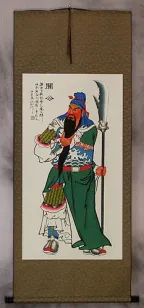
Guan Gong Warrior Saint Wall Scroll

Guan Gong Warrior Saint Wall Scroll

A very big silk wall scroll of a famous warrior from ancient China


Compare: $142.00

Your Price: $78.88


More Info
Guan Gong Warrior Saint Wall Scroll

Guan Gong Warrior Saint Wall Scroll

A very big silk wall scroll of a famous warrior from ancient China


Compare: $142.00

Your Price: $78.88


More Info
Bull Fight - South Chinese Folk Art Painting

Bull Fight
South Chinese Folk Art Painting

The title written on this painting means "Bull Fight". But it's a little different than what a bull fight normally means...


Compare: $50.00

Your Price: $29.95


More Info
Zhong Kui - Ghost Warrior Wall Scroll

Zhong Kui
Ghost Warrior Wall Scroll

This is Zhong Kui (sometimes spelled Chung Kwei) who can protect you from demons and ghosts while you sleep and keep your household safe from doom.


Compare: $106.00

Your Price: $58.88


More Info
Zhong Kui - Ghost Warrior Wall Scroll

Zhong Kui
Ghost Warrior Wall Scroll

This is Zhong Kui (sometimes spelled Chung Kwei) who can protect you from demons and ghosts while you sleep and keep your household safe from doom.


Compare: $106.00

Your Price: $58.88


More Info
WARRIOR SPIRIT Chinese Character / Japanese Kanji Wall Scroll

WARRIOR SPIRIT Chinese Character / Japanese Kanji Wall Scroll

This character is often associated with Kung Fu and other Asian Martial Arts.


Compare: $142.00

Your Price: $78.88


More Info
Warrior Saint Guan Gong on Horse - Partial-Print Wall Scroll

Warrior Saint Guan Gong on Horse
Partial-Print Wall Scroll

This is one of the most famous mythological warriors of ancient China. He is often depicted in bronze statutes and other artwork.


Compare: $200.00

Your Price: $88.88


More Info
Warrior Saint Guan Gong on Horse - Partial-Print Wall Scroll

Warrior Saint Guan Gong on Horse
Partial-Print Wall Scroll

This is one of the most famous mythological warriors of ancient China. He is often depicted in bronze statutes and other artwork.


Compare: $200.00

Your Price: $88.88


More Info
Zhong Kui - Ghost Warrior Wall Scroll

Zhong Kui
Ghost Warrior Wall Scroll

This is Zhong Kui (sometimes spelled Chung Kwei) who can protect you from demons and ghosts while you sleep and keep your household safe from doom.


Compare: $106.00

Your Price: $58.88


More Info
Zhong Kui - Ghost Warrior Wall Scroll

Zhong Kui
Ghost Warrior Wall Scroll

This is Zhong Kui (sometimes spelled Chung Kwei) who can protect you from demons and ghosts while you sleep and keep your household safe from doom.


Compare: $106.00

Your Price: $58.88


More Info
Zhong Kui - Ghost Warrior Wall Scroll

Zhong Kui
Ghost Warrior Wall Scroll

This is Zhong Kui (sometimes spelled Chung Kwei) who can protect you from demons and ghosts while you sleep and keep your household safe from doom.


Compare: $106.00

Your Price: $58.88


More Info
Warrior Saint Guan Gong on Horse - Partial-Print Wall Scroll

Warrior Saint Guan Gong on Horse
Partial-Print Wall Scroll

This is one of the most famous mythological warriors of ancient China. He is often depicted in bronze statutes and other artwork.


Compare: $200.00

Your Price: $88.88


More Info
Zhong Kui - Ghost Warrior Wall Scroll

Zhong Kui
Ghost Warrior Wall Scroll

This is Zhong Kui (sometimes spelled Chung Kwei) who can protect you from demons and ghosts while you sleep and keep your household safe from doom.


Compare: $200.00

Your Price: $78.88


More Info

A nice Chinese calligraphy wall scroll

The scroll that I am holding in this picture is a "medium size"
4-character wall scroll.
As you can see, it is a great size to hang on your wall.
(We also offer custom wall scrolls in larger sizes)

A professional Chinese Calligrapher

Professional calligraphers are getting to be hard to find these days.
Instead of drawing characters by hand, the new generation in China merely type roman letters into their computer keyboards and pick the character that they want from a list that pops up.

There is some fear that true Chinese calligraphy may become a lost art in the coming years. Many art institutes in China are now promoting calligraphy programs in hopes of keeping this unique form of art alive.

Trying to learn Chinese calligrapher - a futile effort

Even with the teachings of a top-ranked calligrapher in China, my calligraphy will never be good enough to sell. I will leave that to the experts.


A high-ranked Chinese master calligrapher that I met in Zhongwei

The same calligrapher who gave me those lessons also attracted a crowd of thousands and a TV crew as he created characters over 6-feet high. He happens to be ranked as one of the top 100 calligraphers in all of China. He is also one of very few that would actually attempt such a feat.


See: Our list of specifically Japanese Kanji Calligraphy Wall Scrolls. And, check out Our list of specifically old Korean Hanja Calligraphy Wall Scrolls.

The following table is only helpful for those studying Chinese (or Japanese), and perhaps helps search engines to find this page when someone enters Romanized Chinese or Japanese

Title
Characters 
Simplified
Traditional
Japanese Romaji
(Romanized Japanese)
Various forms of Romanized Chinese
Soldiers
heibīng
bing
ping
bing1
bing
Marine / Soldier of the Sea海兵
海兵
kai hei
kaihei
n/a
Soldier / Private士兵
士兵
n/ashì bīng
shi bing
shih ping
shi4 bing1
shibing
Soldier / Serviceman军人
軍人
gun jin
gunjin
jūn rén
jun ren
chün jen
jun1 ren2
junren
Warrior武士
武士
bu shi
bushi
wǔ shì
wu shi
wu shih
wu3 shi4
wushi
Peaceful Warrior平和的武士
平和的武士
n/apíng hé de wǔ shì
ping he de wu shi
p`ing ho te wu shih
ping2 he2 de wu3 shi4
pinghedewushi
pinghotewushih
ping ho te wu shih
Warrior for Peace和平武士
和平武士
n/ahé píng wǔ shì
he ping wu shi
ho p`ing wu shih
he2 ping2 wu3 shi4
hepingwushi
hopingwushih
ho ping wu shih
Value of Warrior Generals兵在精而不在多将在谋而不在勇
兵在精而不在多將在謀而不在勇
n/abīng zài jīng ér bù zài duō jiàng zài móu ér bù zài yǒng
bing zai jing er bu zai duo jiang zai mou er bu zai yong
ping tsai ching erh pu tsai to chiang tsai mou erh pu tsai yung
bing1 zai4 jing1 er2 bu4 zai4 duo1 jiang4 zai4 mou2 er2 bu4 zai4 yong3
Warrior / Musha武者
武者
mu sha
musha
n/a
Warrior / Fighter戦士
戦士
sen shi
senshi
n/a
Warrior Soul / Heroic Spirit勇士精神
勇士精神
n/ayǒng shì jīng shén
yong shi jing shen
yung shih ching shen
yong3 shi4 jing1 shen2
yongshijingshen
Soul of a Warrior精神勇士
精神勇士
n/ajīng shén yǒng shì
jing shen yong shi
ching shen yung shih
jing1 shen2 yong3 shi4
jingshenyongshi
Warrior Essence / Warrior Spirit / Martial
bu
wu
wu3
wu
Fighter战士 / 戦士
戰士
sen shi
senshi
zhàn shì
zhan shi
chan shih
zhan4 shi4
zhanshi
Fighter / Champion斗士 / 鬥士
鬪士 / 闘士
tou shi
toushi
to shi
dòu shì
dou shi
tou shih
dou4 shi4
doushi
Fighter / Champion鬪士
闘士
tou shi
toushi
to shi
n/a
Active Duty现役
現役
genekixiàn yì
xian yi
hsien i
xian4 yi4
xianyi
Active Duty Military (person)现役军人
現役軍人
geneki gunjin
genekigunjin
xiàn yì jūn rén
xian yi jun ren
hsien i chün jen
xian4 yi4 jun1 ren2
xianyijunren
Advance Bravely / Indomitable Spirit勇往直前
勇往直前
n/ayǒng wàng zhí qián
yong wang zhi qian
yung wang chih ch`ien
yong3 wang4 zhi2 qian2
yongwangzhiqian
yungwangchihchien
yung wang chih chien
Archer射手
射手
i te / sha shu
ite/shashu
shè shǒu
she shou
she4 shou3
sheshou
Archer弋人
弋人
yokujinyì rén
yi ren
i jen
yi4 ren2
yiren
Archer弓箭手
弓箭手
n/agōng jiàn shǒu
gong jian shou
kung chien shou
gong1 jian4 shou3
gongjianshou
Army / Military
gunjūn
jun
chün
jun1
jun
Sun Tzu - Art of War孙子兵法
孫子兵法
son shi hyou hou
sonshihyouhou
son shi hyo ho
sūn zǐ bīng fǎ
sun zi bing fa
sun tzu ping fa
sun1 zi3 bing1 fa3
sunzibingfa
Attack When The Enemy Has Low Morale避其锐气击其惰归
避其鋭氣擊其惰歸
n/abì qí ruì qì jī qí duò guī
bi qi rui qi ji qi duo gui
pi ch`i jui ch`i chi ch`i to kuei
bi4 qi2 rui4 qi4 ji1 qi2 duo4 gui1
biqiruiqijiqiduogui
pichijuichichichitokuei
pi chi jui chi chi chi to kuei
Mind of the Beginner初心
初心
shoshinchū xīn
chu xin
ch`u hsin
chu1 xin1
chuxin
chuhsin
chu hsin
If you cannot bite, do not show your teeth不能咬人就别龇牙
不能咬人就別齜牙
n/abù néng yǎo rén jiù bié zī yá
bu neng yao ren jiu bie zi ya
pu neng yao jen chiu pieh tzu ya
bu4 neng2 yao3 ren2 jiu4 bie2 zi1 ya2
bunengyaorenjiubieziya
Boxing拳击
拳擊
n/aquán jī
quan ji
ch`üan chi
quan2 ji1
quanji
chüanchi
chüan chi
Boxing (Japanese)拳斗
拳闘
ken tou
kentou
ken to
n/a
Bravery / Courage勇敢
勇敢
yuu kan
yuukan
yu kan
yǒng gǎn
yong gan
yung kan
yong3 gan3
yonggan
Bushido / The Way of the Samurai武士道
武士道
bushidowǔ shì dào
wu shi dao
wu shih tao
wu3 shi4 dao4
wushidao
Bravery / Courage勇气 / 勇気
勇氣
yuuki
yuki
yǒng qì
yong qi
yung ch`i
yong3 qi4
yongqi
yungchi
yung chi
Death Before Dishonor士可杀不可辱
士可殺不可辱
n/ashì kě shā bù kě rǔ
shi ke sha bu ke ru
shih k`o sha pu k`o ju
shi4 ke3 sha1 bu4 ke3 ru3
shikeshabukeru
shihkoshapukoju
shih ko sha pu ko ju
Frightful Demon / Asura阿修罗
阿修羅
ashuraē xiū luó
e xiu luo
o hsiu lo
e1 xiu1 luo2
exiuluo
Enlisted Sailor水兵
水兵
suiheishuǐ bīng
shui bing
shui ping
shui3 bing1
shuibing
Fight / Beat Someone
n/adòu
dou
tou
dou4
dou
Fight for a Goal
n/azhēng
zheng
cheng
zheng1
zheng
Fighting Spirit斗志
斗志
n/adòu zhì
dou zhi
tou chih
dou4 zhi4
douzhi
Fighting Spirit (Japanese only)闘志
闘誌
tou shi
toushi
to shi
n/a
Fighting Spirit (Japanese only)闘魂
闘魂
tou kon
toukon
to kon
n/a
Filial Piety
kou
ko
xiào
xiao
hsiao
xiao4
xiao
Flying Tigers AVG飞虎队
飛虎隊
n/afēi hǔ duì
fei hu dui
fei hu tui
fei1 hu3 dui4
feihudui
Freedom / Liberty自由
自由
jiyuu
jiyu
zì yóu
zi you
tzu yu
zi4 you2
ziyou
Furinkazan风林火山
風林火山
fuu rin ka zan
fuurinkazan
fu rin ka zan
fēng lín huǒ shān
feng lin huo shan
feng1 lin2 huo3 shan1
fenglinhuoshan
In Flowers the Cherry Blossom, In Men the Samurai花な櫻木人な武士
花な櫻木人な武士
hana wa sakura hito wa bushi
hanawasakurahitowabushi
n/a
Hapkido合气道
合氣道
ai ki do
aikido
hé qì dào
he qi dao
ho ch`i tao
he2 qi4 dao4
heqidao
hochitao
ho chi tao
Hero英雄
英雄
ei yuu
eiyuu
ei yu
yīng xióng
ying xiong
ying hsiung
ying1 xiong2
yingxiong
Woman of Strong Character / Woman Hero女杰
女傑
joketsunǚ jiá
nv jia
nü chia
nv3 jia2
nvjia
Immovable Mind不動心
不動心
fu dou shin
fudoushin
fu do shin
n/a
A Life of Serenity Yields Understanding淡泊以明志宁静而致远
淡泊以明志寧靜而致遠
n/adàn bó yǐ míng zhì, níng jìng ér zhì yuǎn
dan bo yi ming zhi, ning jing er zhi yuan
tan po i ming ning ching erh chih yüan
dan4 bo2 yi3 ming2 zhi4, ning2 jing4 er2 zhi4 yuan3
Jing Mo / Jing Wu精武
精武
n/ajīng wǔ
jing wu
ching wu
jing1 wu3
jingwu
Kamikaze / Divine Wind神风
神風
kami kaze
kamikaze
n/a
Kenpo / Kempo / Quan Fa / Chuan Fa拳法
拳法
kenpou
kenpo
quán fǎ
quan fa
ch`üan fa
quan2 fa3
quanfa
chüanfa
chüan fa
Knight骑士
騎士
ki shi
kishi
qí shì
qi shi
ch`i shih
qi2 shi4
qishi
chishih
chi shih
Know Your Enemy, Know Yourself, and You Cannot Lose知彼知己百战不殆
知彼知己百戰不殆
n/azhí bǐ zhí jī bǎi zhàn bú dài
zhi bi zhi ji bai zhan bu dai
chih pi chih chi pai chan pu tai
zhi2 bi3 zhi2 ji1 bai3 zhan4 bu2 dai4
zhibizhijibaizhanbudai
Kobudo (Japanese)古武道
古武道
kubudou
kubudo
gǔ wǔ dào
gu wu dao
ku wu tao
gu3 wu3 dao4
guwudao
Lingering Mind残心
殘心
zan shin
zanshin
cán xīn
can xin
ts`an hsin
can2 xin1
canxin
tsanhsin
tsan hsin
Maintain An Army For 1000 Days, Use It For An Hour养兵千日用兵一时
養兵千日用兵一時
n/ayǎng bīng qiān rì, yàng bīng yì shí
yang bing qian ri yang bing yi shi
yang ping ch`ien jih yang ping i shih
yang3 bing1 qian1 ri4 yang4 bing1 yi4 shi2
yang ping chien jih yang ping i shih
Marine海军陆战队员
海軍陸戰隊員
n/ahǎi jūn lù zhàn duì yuán
hai jun lu zhan dui yuan
hai chün lu chan tui yüan
hai3 jun1 lu4 zhan4 dui4 yuan2
haijunluzhanduiyuan
Marine Corps海军陆战队
海軍陸戰隊
n/ahǎi jūn lù zhàn duì
hai jun lu zhan dui
hai chün lu chan tui
hai3 jun1 lu4 zhan4 dui4
haijunluzhandui
Marine Corps海兵队
海兵隊
kaiheitain/a
Martial Morality / Martial Arts Ethics / Virtue武德
武德
butokuwǔ dé
wu de
wu te
wu3 de2
wude
Martial Arts Master (Japanese Only)武芸者
武芸者
bugeishawǔ yún zhě
wu yun zhe
wu yün che
wu3 yun2 zhe3
wuyunzhe
Martial Arts Skills武技
武技
bugiwǔ jì
wu ji
wu chi
wu3 ji4
wuji
Martial Arts武道
武道
budou
budo
wǔ dào
wu dao
wu tao
wu3 dao4
wudao
Military Discipline军纪
軍紀
gun ki
gunki
jūn jì
jun ji
chün chi
jun1 ji4
junji
Monkey Fist猴拳
猴拳
n/ahóu quán
hou quan
hou ch`üan
hou2 quan2
houquan
houchüan
hou chüan
Morality of Deed行德
行德
n/axíng dé
xing de
hsing te
xing2 de2
xingde
Morality of Mind心德
心德
n/axīn dé
xin de
hsin te
xin1 de2
xinde
Musashi武蔵
武蔵
mu sashi
musashi
n/a
Ninja忍者
忍者
ninjarěn zhě
ren zhe
jen che
ren3 zhe3
renzhe
Ninjutsu / Ninjitsu忍术
忍術
ninjutsurěn shù
ren shu
jen shu
ren3 shu4
renshu
No Mind / Mushin无心
無心
mu shin
mushin
wú xīn
wu xin
wu hsin
wu2 xin1
wuxin
Past experience is the teacher for the future.前事不忘后事之师
前事不忘后事之師
n/aqián shì bú wàng hòu shí zhī shī
qian shi bu wang hou shi zhi shi
ch`ien shih pu wang hou shih chih shih
qian2 shi4 bu2 wang4 hou4 shi2 zhi1 shi1
chien shih pu wang hou shih chih shih
Undaunted After Repeated Setbacks百折不挠
百折不撓
hyaku setsu su tou
hyakusetsusutou
hyaku setsu su to
bǎi zhé bù náo
bai zhe bu nao
pai che pu nao
bai3 zhe2 bu4 nao2
baizhebunao
Purified Spirit / Enlightened Attitude先心
先心
sen shin
senshin
n/a
Samurai
samuraishì
shi
shih
shi4
shi
Shogun / Japanese General将军
將軍
shougun
shogun
jiāng jūn
jiang jun
chiang chün
jiang1 jun1
jiangjun
Chinese or Korean Army General (Shogun)将军
將軍
shougun
shogun
jiāng jūn
jiang jun
chiang chün
jiang1 jun1
jiangjun
Southern Praying Mantis南派螳螂
南派螳螂
n/anán pài táng láng
nan pai tang lang
nan p`ai t`ang lang
nan2 pai4 tang2 lang2
nanpaitanglang
nanpaitanglang
nan pai tang lang
Sword
ken / tsurugi
ken/tsurugi
jiàn
jian
chien
jian4
jian
Sworn Friend / Ally盟友
盟友
meiyuu
meiyu
méng yǒu
meng you
meng yu
meng2 you3
mengyou
United States Marine Corps米海兵隊
米海兵隊
bei kai hei tai
beikaiheitai
n/a
War
戰 / 戦
senzhàn
zhan
chan
zhan4
zhan
Woman Hero / Heroine巾帼英雄
巾幗英雄
n/ajīn guó yīng xióng
jin guo ying xiong
chin kuo ying hsiung
jin1 guo2 ying1 xiong2
jinguoyingxiong
Ultimate Loyalty to Your Country尽忠报国
盡忠報國
n/ajìn zhōng bào guó
jin zhong bao guo
chin chung pao kuo
jin4 zhong1 bao4 guo2
jinzhongbaoguo

If you have not set up your computer to display Chinese, the characters in this table probably look like empty boxes or random text garbage.
This is why I spent hundreds of hours making images so that you could view the characters in the "soldier" listings above.
If you want your Windows computer to be able to display Chinese characters you can either head to your Regional and Language options in your Win XP control panel, select the [Languages] tab and click on [Install files for East Asian Languages]. This task will ask for your Win XP CD to complete in most cases. If you don't have your Windows XP CD, or are running Windows 98, you can also download/run the simplified Chinese font package installer from Microsoft which works independently with Win 98, ME, 2000, and XP. It's a 2.5MB download, so if you are on dial up, start the download and go make a sandwich.

Some people may refer to this entry as Kanji, Characters, in Mandarin Chinese, Characters, in Chinese Writing, in Japanese Writing, in Asian Writing, Ideograms, Chinese symbols, Hieroglyphics, Glyphs, in Chinese Letters, Hanzi, in Japanese Kanji, Pictograms, in the Chinese Written-Language, or in the Japanese Written-Language.

Did you like this? Share it:


Copyright Oriental Outpost 2002-2012   -   All Rights Reserved
Image Use Policy Privacy Policy