Sun Tzu Chinese Calligraphy
We have many options for Sun Tzu (Sunzi) phrases or proverbs on a wall scroll or portrait in Chinese calligraphy.
Switched to secondary search mode due to lack of results using primary.
These secondary results may not be very accurate. Try a different but similar meaning word or phrase for better results. Or...
Look up in my Japanese Kanji & Chinese Character Dictionary(My dictionary is a different system then the calligraphy search you just tried)
If you want a special phrase, word, title, name, or proverb, feel free to contact me, and I will translate your custom calligraphy idea for you.
1. Art of War
2. Art of War: 5 Points of Analysis
4. Attack When The Enemy Has Low Morale
5. Furinkazan
6. Know Thy Enemy, Know Thyself
7. Know Your Enemy, Know Yourself, and You Cannot Lose
8. Know Your Enemy, Know Yourself, and Win 100 Battles
Art of War
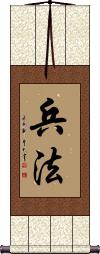
Art of War: 5 Points of Analysis
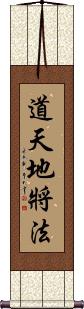
道天地將法 is a list of five key points to analyzing your situation from the first chapter of Sun Tzu's Art of War.
This reads like a 5-part military proverb. Sun Tzu says that to sharpen your skills, you must plan. To plan well, you must know your situation. Therefore, you must consider and discuss the following:
1. Philosophy and Politics: Make sure your way or your policy is agreeable among all of your troops (and the citizens of your kingdom as well). For when your soldiers believe in you and your way, they will follow you to their deaths without hesitation and will not question your orders.
2. Heaven/Sky: Consider climate / weather. This can also mean considering whether God is smiling upon you. In the modern military, this could be waiting for clear skies so that you can have air support for an amphibious landing.
3. Ground/Earth: Consider the terrain in which the battle will take place. This includes analyzing defensible positions, and exit routes, while using varying elevations to your advantage. When you plan an ambush, you must know your terrain and the best location from which to stage that ambush. This knowledge will also help you avoid being ambushed, as you will know where the likely places in which to expect an ambush from your enemy.
4. Leadership: This applies to you as the general and your lieutenants. A leader should be smart and be able to develop good strategies. Leaders should keep their word, and if they break a promise, they should punish themselves as harshly as they would punish subordinates. Leaders should be benevolent to their troops, with almost a fatherly love for them. Leaders must have the ability to make brave and fast decisions. Leaders must have steadfast principles.
5. [Military] Methods: This can also mean laws, rules, principles, models, or systems. You must have an efficient organization in place to manage both your troops and supplies. In the modern military, this would be a combination of how your unit is organized and your SOP (Standard Operating Procedure).
Notes: This is a simplistic translation and explanation. Much more is suggested in the actual text of the Art of War (Bing Fa). It would take a lot of study to master all of these aspects. In fact, these five characters can be compared to the modern military acronyms such as BAMCIS or SMEAC.
CJK notes: I have included the Japanese and Korean pronunciations but in Chinese, Korean and Japanese, this does not make a typical phrase (with subject, verb, and object) it is a list that only someone familiar with Sun Tzu’s writings would understand.
Sun Tzu - Art of War
military strategy, tactics, and procedure
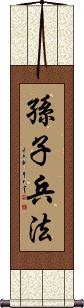
孫子兵法 is the full title of the most famous book of military proverbs about warfare.
The English title is “Sun Tzu's The Art of War.”
The last two characters have come to be known in the west as “The Art of War,” but a better translation would be “military strategy and tactics,” “military skills” or “army procedures.”
Note: Sometimes the author's name is Romanized as “Sun Zi” or “Sunzi.”
It's written the same in Chinese, Japanese Kanji, and Korean Hanja.
Attack When The Enemy Has Low Morale
bì qí ruì qì jī qí duò guī
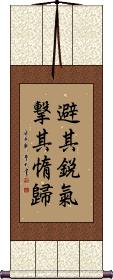
避其鋭氣擊其惰歸 is a Chinese proverb that literally translates as: Avoid [your enemy's] fighting spirit [and] attack [when] his [morale is] declining.
Figuratively, this means: Avoid the enemy when his morale is high and strike him when his morale is flagging.
Furinkazan
military strategy
fēng lín huǒ shān
fuu rin ka zan
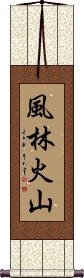
風林火山 is the battle strategy and proverb of Japanese feudal lord Takeda Shingen (1521-1573 AD).
This came from the Art of War by Chinese strategist and tactician Sun Tzu (Sunzi).
You can think of this as an abbreviation to remind officers and troops how to conduct battle.
風林火山 is a word list: Wind, Forest, Fire, Mountain.
The more expanded meaning is supposed to be...
“Swift as the wind, quiet as the forest, fierce as fire, and immovable as a mountain”
“As fast as the wind, as quiet as the forest, as daring as fire, and immovable as the mountain”
“Move as swift as the wind, stay as silent as a forest, attack as fierce as fire, undefeatable defense like a mountain”
“Move swiftly like the wind, stay silent like the forest, attack fiercely like fire, take a tactical position on the mountain”
See Also: Art of War
Know Thy Enemy, Know Thyself
zhí bǐ zhí jī
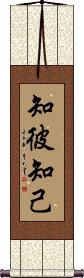
This proverb is from Sun Tzu's (Sunzi's) Art of War.
It means that if you know and understand the enemy, you also know yourself. Four secondary characters come after this in the Art of War (not included here) which suggests you cannot lose a battle when you follow this philosophy.
In a very literal and somewhat-boring way, this can also be translated as “Estimate correctly one's strength as well as that of one's opponent.”
Know Thy Enemy, Know Thyself
te ki o shi ri o no re o shi ru
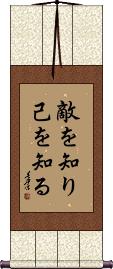
敵を知り己を知る is the Japanese version of “know your enemy, know yourself.”
There is a longer version of this proverb that adds, “...and you can win 100 battles.”
Note: Because this selection contains some special Japanese Hiragana characters, it should be written by a Japanese calligrapher.
Know Your Enemy, Know Yourself, and You Cannot Lose
zhí bǐ zhí jī bǎi zhàn bú dài
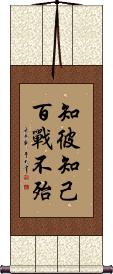
知彼知己百戰不殆 is from Sun Tzu's (Sunzi's) Art of War. It means that if you know and understand the enemy, you also know yourself, and thus with this complete understanding, you cannot lose.
This proverb is often somewhat directly translated as “Know the enemy and know yourself, and you can fight a hundred battles without defeat.”
It can also be translated as “If you know both yourself and your enemy, you can come out of hundreds of battles without danger,” or “Know your enemy, know yourself, and your victory will not be threatened.”
Know Your Enemy, Know Yourself, and Win 100 Battles
teki o shi ri o no o shi re ba hya ku sen aya u ka ra zu
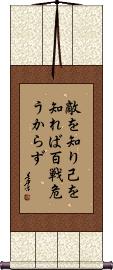
敵を知り己を知れば百戦危うからず is the longer/full Japanese version of this proverb. This means “Know your enemy, know yourself, and you will not fear a hundred battles.”
Others will translate this as “Know thy enemy, know thyself, yields victory in one hundred battles.”
Note: Because this selection contains some special Japanese Hiragana characters, it should be written by a Japanese calligrapher.
yǎng bīng qiān rì, yàng bīng yì shí
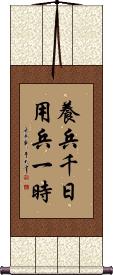
Nothing could be more true. When I was in the Marine Corps, we trained for years for combat that often lasts only hours.
養兵千日用兵一時 is a Chinese proverb that, also reminds me of a common phrase used in the military to describe combat: “Weeks of total boredom, punctuated with five minutes of sheer terror.”
This may have some roots in Sun Tzu's The Art of War. Though I can not find this passage in his writings.
On the subject of the Art of War, if you have a favorite passage, we can create a custom calligraphy scroll with that phrase.
Sun Tzu: Regard Your Soldiers as Children
shì cù rú yīng ér gù kě yǐ yú zhī fù shēn xī shì cù rú ài zǐ gù kě yú zhī jū sǐ
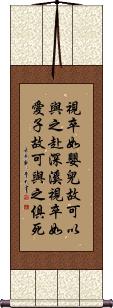
視卒如嬰兒故可以與之赴深溪視卒如愛子故可與之俱死 is an entry from the 10th section within the Earth/Terrain chapter of Sun Tzu's Art of War.
This is often translated as “Regard your soldiers as your children, and they will follow you into the deepest valleys. Look upon them as your own beloved sons, and they will stand by you even unto death.”
This in-stock artwork might be what you are looking for, and ships right away...

Gallery Price: $200.00
Your Price: $122.88

Gallery Price: $106.00
Your Price: $58.88
The following table may be helpful for those studying Chinese or Japanese...
| Title | Characters | Romaji (Romanized Japanese) | Various forms of Romanized Chinese | |
| Art of War | 兵法 | hyou hou / hyouhou / hyo ho | bīng fǎ / bing1 fa3 / bing fa / bingfa | ping fa / pingfa |
| Art of War: 5 Points of Analysis | 道天地將法 道天地将法 | dou ten chi shou hou doutenchishouhou do ten chi sho ho | dào tiān dì jiàng fǎ dao4 tian1 di4 jiang4 fa3 dao tian di jiang fa daotiandijiangfa | tao t`ien ti chiang fa taotientichiangfa tao tien ti chiang fa |
| Sun Tzu - Art of War | 孫子兵法 孙子兵法 | son shi hyou hou sonshihyouhou son shi hyo ho | sūn zǐ bīng fǎ sun1 zi3 bing1 fa3 sun zi bing fa sunzibingfa | sun tzu ping fa suntzupingfa |
| Attack When The Enemy Has Low Morale | 避其鋭氣擊其惰歸 避其锐气击其惰归 | bì qí ruì qì jī qí duò guī bi4 qi2 rui4 qi4 ji1 qi2 duo4 gui1 bi qi rui qi ji qi duo gui biqiruiqijiqiduogui | pi ch`i jui ch`i chi ch`i to kuei pichijuichichichitokuei pi chi jui chi chi chi to kuei |
|
| Furinkazan | 風林火山 风林火山 | fuu rin ka zan fuurinkazan fu rin ka zan | fēng lín huǒ shān feng1 lin2 huo3 shan1 feng lin huo shan fenglinhuoshan | |
| Know Thy Enemy, Know Thyself | 知彼知己 | zhí bǐ zhí jī zhi2 bi3 zhi2 ji1 zhi bi zhi ji zhibizhiji | chih pi chih chi chihpichihchi |
|
| Know Thy Enemy, Know Thyself | 敵を知り己を知る | te ki o shi ri o no re o shi ru tekioshirionoreoshiru | ||
| Know Your Enemy, Know Yourself, and You Cannot Lose | 知彼知己百戰不殆 知彼知己百战不殆 | zhí bǐ zhí jī bǎi zhàn bú dài zhi2 bi3 zhi2 ji1 bai3 zhan4 bu2 dai4 zhi bi zhi ji bai zhan bu dai zhibizhijibaizhanbudai | chih pi chih chi pai chan pu tai | |
| Know Your Enemy, Know Yourself, and Win 100 Battles | 敵を知り己を知れば百戦危うからず | teki o shi ri o no o shi re ba hya ku sen aya u ka ra zu | ||
| Maintain An Army For 1000 Days, Use It For An Hour | 養兵千日用兵一時 养兵千日用兵一时 | yǎng bīng qiān rì, yàng bīng yì shí yang3 bing1 qian1 ri4 yang4 bing1 yi4 shi2 yang bing qian ri yang bing yi shi | yang ping ch`ien jih yang ping i shih yang ping chien jih yang ping i shih |
|
| Sun Tzu: Regard Your Soldiers as Children | 視卒如嬰兒故可以與之赴深溪視卒如愛子故可與之俱死 视卒如婴儿故可以与之赴深溪视卒如爱子故可与之俱死 | shì cù rú yīng ér gù kě yǐ yú zhī fù shēn xī shì cù rú ài zǐ gù kě yú zhī jū sǐ shi4 cu4 ru2 ying1 er2 gu4 ke3 yi3 yu2 zhi1 fu4 shen1 xi1 shi4 cu4 ru2 ai4 zi3 gu4 ke3 yu2 zhi1 ju1 si3 shi cu ru ying er gu ke yi yu zhi fu shen xi shi cu ru ai zi gu ke yu zhi ju si | shih ts`u ju ying erh ku k`o i yü chih fu shen hsi shih ts`u ju ai tzu ku k`o yü chih chü ssu shih tsu ju ying erh ku ko i yü chih fu shen hsi shih tsu ju ai tzu ku ko yü chih chü ssu |
|
| In some entries above you will see that characters have different versions above and below a line. In these cases, the characters above the line are Traditional Chinese, while the ones below are Simplified Chinese. | ||||



