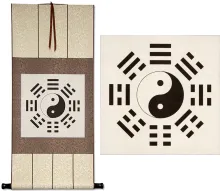
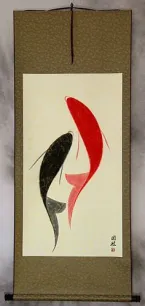
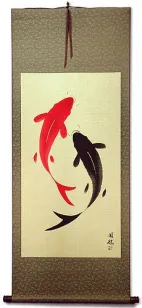
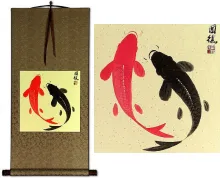
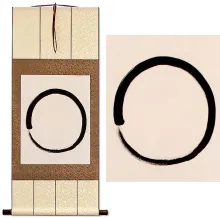
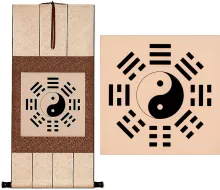
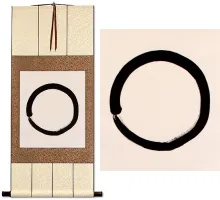
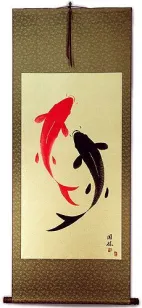
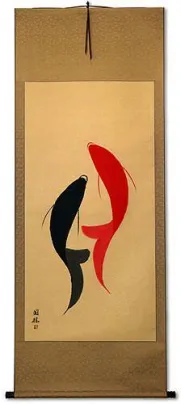
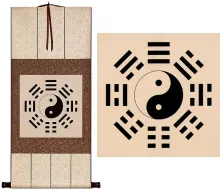
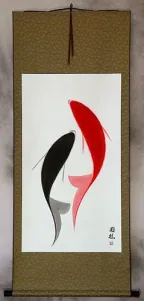
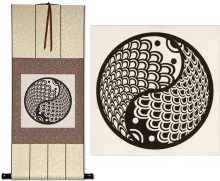
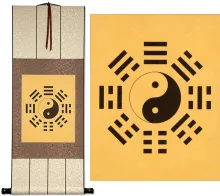
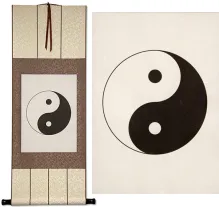
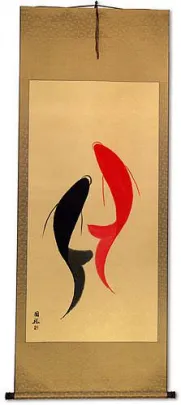
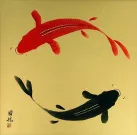
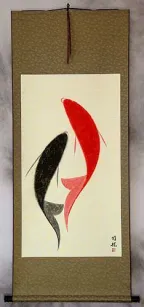
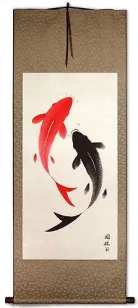
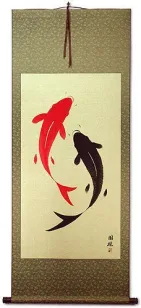
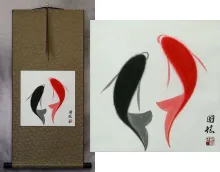
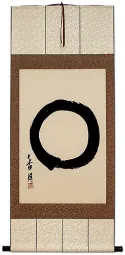
Custom Yin Yang Chinese & Japanese Calligraphy Wall Scroll
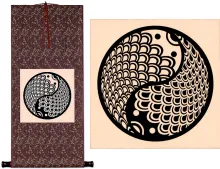
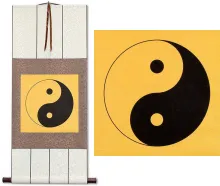
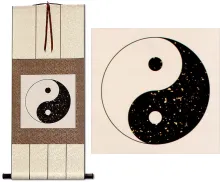
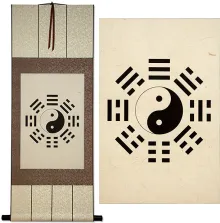
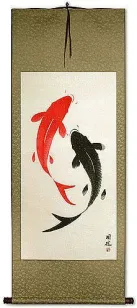
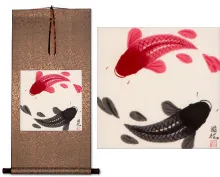
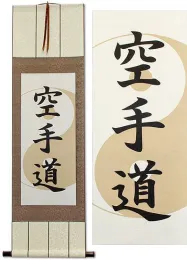
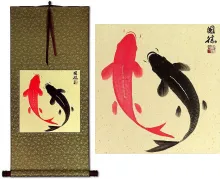
We have many options to create artwork with Yin Yang characters on a wall scroll or portrait. If you want to create a cool Yin Yang Asian character tattoo, you can purchase that on our Chinese and Japanese Tattoo Image Service page and we'll help you select from many forms of ancient Asian symbols that express the idea of yin yang.
Used in modern times for divorced couples that come back together
pò jìng chóng yuán
A husband and wife separated and reunited.
About 1500 years ago in China, there lived a beautiful princess named Le Chang. She and her husband Xu De Yan loved each other very much. But when the army of the Sui Dynasty was about to attack their kingdom, disposed of all of their worldly possessions and prepared to flee into exile.
They knew that in the chaos, they might lose track of each other, so the one possession they kept was a bronze mirror which is a symbol of unity for a husband and wife. They broke the mirror into two pieces, and each of them kept half of the mirror. They decided that if separated, they would try to meet in the fair during the 15th day of the first lunar month (which is the lantern festival). Unfortunately, the occupation was brutal, and the princess was forced to become the mistress of the new commissioner of the territory, Yang Su.
At the Lantern Festival the next year, the husband came to the fair to search for his wife. He carried with him, his half of the mirror. As he walked through the fair, he saw the other half of the mirror for sale at a junk market by a servant of the commissioner. The husband recognized his wife's half of the mirror immediately, and tears rolled down his face as he was told by the servant about the bitter and loveless life that the princess had endured.
As his tears dripped onto the mirror, the husband scratched a poem into his wife's half of the mirror:
You left me with the severed mirror, The mirror has returned but absent are you, As I gaze in the mirror I seek your face, I see the moon, but as for you, I see not a trace.
The servant brought the inscribed half of the mirror back to the princess. For many days, the princess could not stop crying when she found that her husband was alive and still loved her.
Commissioner Yang Su, becoming aware of this saga realized that he could never obtain the love of the princess. He sent for the husband and allowed them to reunite.
This phrase in Chinese is now used to describe a couple who has been torn apart for some reason (usually divorce), but have come back together (or remarried). It seems to be more common these days in America for divorced couples to reconcile and get married to each other again. This would be a great gift if you know someone who is about to remarry their ex.
This is the character "dao" which is sometimes written as "tao" but pronounced like "dow" in Mandarin.
This is the base of what is known as "Taoism". If you translate this literally, it can mean "the way" or "the path".
Dao is believed to be that which flows through all things, and keeps them in balance. It incorporates the ideas of yin and yang (e.g. there would be no love without hate, no light without dark, no male without female.)
The beginning of Taoism can be traced to a mystical man named Lao Zi (604-531 BC), who followed, and added to the teachings of Confucius.
Note that this is pronounced "dou" and sometimes "michi" when written alone in Japanese, but pronounced "do" in word compounds such as Karate-do and Bushido. It's also "do" in Korean.
Alternate translations and meanings: road, way, path; truth, principle province.
Important Japanese note: In Japanese, this will generally be read with the road, way, or path meaning. Taoism is not as popular or well-known in Japan, so that Daoist/Taoist philosophy is not the first thing a Japanese person will think of then they read this character.
This is the Buddhist deity known as the Goddess of Mercy or Bodhisattva of Compassion. In Chinese, the proper name of this being is Guan Yin. There is some debate as to whether Guan Yin is female. The argument comes from some scripture that suggests Buddhist deities take on male form. Others say that Guan Yin has no sex. And still others are okay with the female representation of Guan Yin.
This bodhisattva is also known or Romanized in the following ways: Mandarin Chinese: Guan Yin, Kuan Yin, Kwan Yin. Japanese: Kannon, Kwannon. Sanskrit: Bodhisattva Avalokitesvara. Korean: Gwan-eum. Vietnamese: Quan Âm. Thai: Kuan Eim. English: Bodhisattva of Mercy and Salvation, Goddess of Compassion, Buddha of Mercy, et al.
Note: The first character has a slight variation in Japanese. If your audience is specifically Japanese, you may want to select that version.
This is the longer, and perhaps more formal title for the Buddhist deity known as the Goddess of Mercy or Bodhisattva of Compassion.
The longer title of this bodhisattva is Romanized in the following ways: Mandarin Chinese: Guanshi Yin, Kuan-shih Yin. Japanese: Kanzeon. Sanskrit: Bodhisattva Avalokitesvara. Korean: Gwan-se-eum. Vietnamese: Quan Thế Âm. Thai: Prah Mae Kuan Eim. English: Bodhisattva of Mercy and Salvation, Goddess of Compassion, Buddha of Mercy, et al.
Please view our more common and shorter version "Guan Yin" before you make a decision. Also note that the first character has a slight variation in Japanese. If your audience is specifically Japanese, you may want to select that version.
This is the specifically Japanese version of Bodhisattva of Compassion or Guan Yin. In Japanese this is pronounced Kannon, and occasionally spelled Kwannon. The Chinese version is a bit more commonly-seen in Asia, but in Japanese, there is a slight variation with the first character.
Some time ago, a camera company in Japan named their company after this Buddhist deity. That camera company is still known as Canon (they chose a "C" instead of a "K" when they Romanized this name).
Goddess of Compassion (Japanese)
This is the long or more formal version of this title
quān shì yīn kan ze on
This is the longer and more formal Japanese version of Bodhisattva of Compassion or Guan Yin. In Japanese this is pronounced Kanzeon. The Chinese version is a bit more common in Asia, but in Japanese they use a slight variation of the first character. Choose this version only if your intended audience is specifically Japanese.
Appreciation & Love for Your Parents
shuí yán cùn cǎo xīn bào dé sān chūn huī
This is the last line of a famous poem. It is perceived as a tribute or ode to your parent's or mother from a child or children that have left home.
The poem was written by Meng Jiao during the Tang Dynasty (about 1200 years ago). The Chinese title is "You Zi Yin" which means "The Traveler's Recite".
The last line as shown here speaks of the generous and warm spring sun light which gives the grass far beyond what the little grass can could ever give back (except perhaps by showing its lovely green leaves and flourishing). The metaphor is that the sun is your mother or parents, and you are the grass. Your parents raise you and give you all the love and care you need to prepare you for the world. A debt which you can never repay, nor is repayment expected.
The first part of the poem (not written in the characters to the left) suggests that the thread in a loving mother's hands is the shirt of her traveling offspring. Vigorously sewing while wishing them to come back sooner than they left. ...This part is really hard to translate into English that makes any sense, but maybe you get the idea. We are talking about a poem that is so old that many Chinese people would have trouble reading it (as if it was the King James Version of Chinese).
Many things have opposite properties. The water you drink can also drown you. Pork may nourish you and keep you alive, but under-cook it and it could kill you. Potassium nitrate is often used as a fertilizer to grow the food that sustains us, but it's also been used as an explosive to topple buildings and destroy us.
This concept is easily associated with "yin yang" where an element has two opposite properties that are as different as night and day.
This proverb's meaning can be summed up this way: "Anything that can lead you to success may also contain great risks."
This phrase is known in literary circles by Korean people (scholars or literature). It is therefore also a valid proverb in Korean Hanja, though most Koreans would not be able to make sense of it.
Please note that there is an unwritten rule when the same character appears twice in the same phrase, the calligrapher will alter the appearance so that no two characters are exactly alike in the same piece. This calligraphy has two repeating characters that will be written differently than they appear here.
These are the characters that literally mean yin and yang in written form (versus the common yin yang symbol). The first character has the element of the moon, while the second character has the element of the sun, so you can see, even in written form, they suggest the balance of opposites (of night and day). You could also translate this title as "sun and moon".
Note: This title is often misspelled as Ying Yang instead of Yin Yang.
The scroll that I am holding in this picture is a "medium size" 4-character wall scroll. As you can see, it is a great size to hang on your wall. (We also offer custom wall scrolls in larger sizes)
Professional calligraphers are getting to be hard to find these days. Instead of drawing characters by hand, the new generation in China merely type roman letters into their computer keyboards and pick the character that they want from a list that pops up.
There is some fear that true Chinese calligraphy may become a lost art in the coming years. Many art institutes in China are now promoting calligraphy programs in hopes of keeping this unique form
of art alive.
Even with the teachings of a top-ranked calligrapher in China, my calligraphy will never be good enough to sell. I will leave that to the experts.
The same calligrapher who gave me those lessons also
attracted a crowd of thousands and a TV crew as he created characters over
6-feet high. He happens to be ranked as one of the top 100 calligraphers
in all of China. He is also one of very few that would actually attempt
such a feat.
The following table is only helpful for those studying Chinese (or Japanese), and perhaps helps search engines to find this page when someone enters Romanized Chinese or Japanese
If you have not set up your computer to display Chinese, the characters in this table probably look like empty boxes or random text garbage.
This is why I spent hundreds of hours making images so that you could view the characters in the "yin yang" listings above.
If you want your Windows computer to be able to display Chinese characters you can either head to your Regional and Language options in your Win XP control panel, select the [Languages] tab and click on [Install files for East Asian Languages]. This task will ask for your Win XP CD to complete in most cases. If you don't have your Windows XP CD, or are running Windows 98, you can also download/run the simplified Chinese font package installer from Microsoft which works independently with Win 98, ME, 2000, and XP. It's a 2.5MB download, so if you are on dial up, start the download and go make a sandwich.
Some people may refer to this entry as Kanji, Characters, in Mandarin Chinese, Characters, in Chinese Writing, in Japanese Writing, in Asian Writing, Ideograms, Chinese symbols, Hieroglyphics, Glyphs, in Chinese Letters, Hanzi, in Japanese Kanji, Pictograms, in the Chinese Written-Language, or in the Japanese Written-Language.
Where does the Chinese Yin Yang symbol come from? ... a well-known Chinese Yin Yang symbol. Sometimes it's ... In general, the Yin Yang symbol is a Chinese representation of the entire celestial phenomenon. ...
YIN/YANG ... chapter discusses the system of yin and yang and its origins in Han philosophy ... origin of what is called the yin-yang or Five Agents school of Chinese thought. ...
Yin & Yang and the I Ching ... Period there was actually a Yin and Yang School. ... basic Chinese "Ways," Confucianism is identified with the yang aspect, Taoism with the yin aspect. ...
Yin and Yang in Chinese Cooking Learn how the principles of Yin and Yang relate to Chinese cooking ... The philosophy of yin and yang lies at the heart of Chinese culture. ...
yin and yang According to traditional Chinese philosophy, yin and yang are the two primal ... In classical Chinese, yin and yang refer to the shady and sunny sides of a ...
yin & yang This Symbol (Yin-Yang) represents the ancient Chinese understanding of how things work. ... general, the Yin Yang symbol is a Chinese representation of the ...
The Secret of the Chinese Yin Yang symbol? ... Yin Yang ... say Yang begins right after Winter Solstice and Yin begins right ... 1999- Allen Tsai. Original Yin Yang Page. Home of Chinese Fortune Calendar ...
Yin Yang Glossary definition for Yin Yang symbol ... In Chinese philosophy, yin and yang represent the two primal cosmic forces in the universe. ...
Yin - Yang This Simbol(Yin-Yang) represents the ancient Chinese understanding of how things ... two energies, called "yin" (black) and "yang" (white), which cause ...
Yin - Yang YIN -YANG. The concept of Yin and Yang is fundamental to an understanding of Chinese medicine. ... The Chinese character for Yin translates literally as ...
Yin and Yang ... clinic offering ginseng, natural herbs, acupuncture, and Chinese medicines. ... a Chinese herb shop, one often come across terms such as Yin and Yang, Qi ...
Chinese Yin and Yang philosophy principals A page on Yin and Yang philosophy principals with links to Asian recipes and cultural information. ... Yin-Yang can be loosly translated as 'opposite factors' ...
China: Dim Sum: Yin and Yang ... students learn about the Chinese symbol Yin and Yang and make their own symbol ... Chart answers. Read the background essay on the Chinese symbol of Yin and Yang. ...
Theory-Japanese | Yin Yang House ... use of intradermals within Japanese Acupuncture read our hinaishin techniques article. ... Copyright 2001-2007 Yin Yang House - All Rights Reserved - Terms Of Use ...
Theory-Japanese | Yin Yang House YIN YANG HOUSE. Affiliates. Our Clinic. Chattanooga. Our Store. Search. Support Us ... Copyright 2001-2007 Yin Yang House - All Rights Reserved - Terms Of Use ...
Yin & Yang and the I Ching In the Spring and Autumn Period there was actually a Yin and Yang School. ... The situation of the old Japanese capital city of Kyto is particularly fortunate. ...
Yin Yang Boading Balls Yin Yang Boading Balls. Home. Testimonials. Contact Us. Wish List ... Japanese Dishes. Japanese Tea. Tea. Gift Certificate. Letha Hadady 's. Herbal Remedies ...
Epimedium (Yin Yang Huo) Japanese Dishes. Japanese Tea. Tea. Gift Certificate. Letha Hadady 's. Herbal Remedies ... Chinese Medicine / TCM > Raw Herbs > Epimedium (Yin Yang Huo) ...
Yin Yang Articles about yin yang, Taoism, Chi, Lao Tze, Chuang Tzu. Related gifts, art. ... Some Chinese, Korean and Japanese place names that still exist are named in the ...
yinyang TeaHyakka is a monthly magazine covering all aspects of Japanese Tea Ceremony. ... You may have heard of "Yin Yang" but how about "The Five Elements" ...
chinese tattoo yin yang Blog ... to Chinese yang American, skull, chinese, japanese family problem prescription symbol byg words emperors Ying Chinese Tattoos Stock 2.99 yin chinese yang ...
Yin Yang border stencil Yin Yang border stencil in 2 overlays. Design size: 3 in x 11.5 in (HXW) ... Japanese butterfly stencil - Japanese butterfly stencil in 1 overlay. ...
Large Yin Yang stencil Large Yin Yang stencil in 2 overlays. Design size: 6.5 in x 6.5 in (HXW) ... Japanese butterfly stencil - Japanese butterfly stencil in 1 overlay. ...
Yin Yang Japanese Akoya Cultured Pearl Ring Summer Sale. About Us. Our Founder. Our Staff. How We Do It ... References. Our Pledge. We Want You To Know. Escrow. Buyer's Guide. What Size Is Right For Her? ...
Yin Yang | English | Dictionary & Translation by Babylon ... Translations of Yin Yang to English, Chinese, French, Italian, Spanish, Dutch, ... Yang in German | Yin Yang in Japanese | Yin Yang in Turkish | Yin Yang in Hebrew ...