Buy a Laugh Chinese/Japanese Calligraphy Wall Scroll
We have many options to create artwork with the Chinese characters / Asian symbols / Japanese Kanji for Laugh on a wall scroll or portrait.
Switched to secondary search mode due to lack of results using primary.
These secondary results may not be very accurate. Try a different but similar meaning word or phrase for better results. Or:
Look up in my Japanese Kanji & Chinese Character Dictionary(My dictionary is a different system then the calligraphy search you just tried)
If you want a special phrase, word, title, name, or proverb, feel free to contact me, and I will translate your custom calligraphy idea for you.
2. Happy Buddha
3. Cry in the Dojo - Laugh on the Battlefield
4. Double Happiness Guest Book
6. Eternal Peace and Happiness
7. The one who retreats 50 paces mocks the one to retreats 100
9. Doing good is the greatest source of happiness
10. Hali
11. Happy / Laughter / Cheerful Bliss
13. Happiness / Fortune / Lucky
16. Happiness / Joy
17. Double Happiness
19. Happiness
20. Happy Laughter
21. The Whole Room Rocks With Laughter
22. Ivy
23. Joyful
24. Happy
26. Laugh / Smile
28. Laughlin
29. A Life of Happiness and Prosperity
30. Life is Fun
31. Live Laugh Love
33. Pleasure
36. Roar of Laughter / Big Laughs
39. Shinken Shobu
40. White Tiger
41. You must endure a harsh winter to appreciate the warmth of springtime
Happiness in the Afterlife
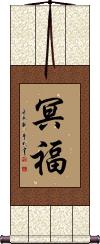
冥福 is an unusual Chinese, Japanese, and Korean term that means afterlife happiness, happiness in the next world, or the happiness of the dead.
Happy Buddha
Buddha of Joyful Light
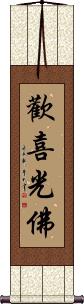
This title is Buddha of Joyful Light.
歡喜光佛 is Amitābha from Sanskrit but pronounced very differently in Chinese and Japanese.
Cry in the Dojo - Laugh on the Battlefield
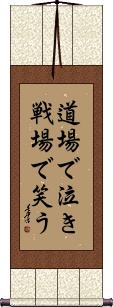
道場で泣き戦場で笑う is a Japanese phrase that means “Cry in the dojo, laugh on the battlefield.”
You'll see this phrase in many dojos as a kind of philosophical joke.
Note: Because this selection contains some special Japanese Hiragana characters, it should be written by a Japanese calligrapher.
See Also: The More We Sweat in Training | the Less We Bleed in Battle
Double Happiness Guest Book
Customize a special Asian guest book for your wedding
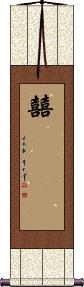
Start customizing a “Double Happiness Guest Book Wall Scroll” Here!
The paper panel length can be whatever you choose from 68cm to 135cm (27” to 53”).
If you don't mention what paper length you want in the special instructions tab (on the next page), we'll make it about 100cm (40”).
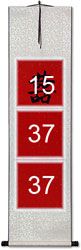
The medium-size scroll with a 33cm x 100cm (13” x 40”) paper panel can usually handle up to 89 signatures. That breaks down to 37 signatures per empty square and 15 signatures around the 囍 character. If you switch to a 135cm paper panel, add another 37 potential signatures.
We can splice two 135cm papers together, but that would be a crazy-long scroll. These are only estimates, your mileage may vary.
With silk panels, this will yield a wall scroll about 155cm (61”) long. That's enough for up to 89 signatures. Of course, that depends on if your guests just sign a brief salutation and name, or more verbose good wishes. Customer feedback is that 126 people can sign the 135cm long paper on a medium-sized scroll. If we go bigger than that, there will be a minor paper seam and an extra charge. Email me with your specifications if you need something special.
Most customers pick the festive red paper with gold flecks and white or ivory silk. Red is a good luck color in Chinese culture, thus the most popular choice. But, you can do any color combination that you want.
There is a long history of Chinese-character-use outside of mainland China. This Double Happiness character is also seen at weddings in Korea, Vietnam, Hong Kong, and Taiwan, as well as in Chinese communities in Thailand, Indonesia, and elsewhere. While Japan borrowed Chinese characters into their language, you won't see 囍 as often at Japanese weddings.
Eternal Happiness
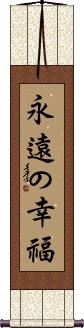
永遠の幸福 means “eternal happiness” in Japanese.
永遠 means eternal, eternity, perpetuity, forever, immortality, and permanence.
の is a possessive article which sort of makes this selection mean “happiness, of the eternal kind.”
幸福 means happiness, though this word can mean truly blessed, joy, happy, welfare, well-being, or fortunate.
Eternal Happiness
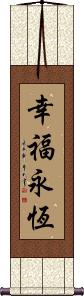
幸福永恆 is a short way to say eternal happiness in Chinese.
Breaking down the parts:
幸福 means happiness, happy, blessed, blessedness, joy, and/or well-being.
永恆 means eternal, everlasting, and/or forever.
Another way to write this is 永恆的幸福. It reverses the word order and adds a possessive article. I prefer the shorter version, which is slightly more natural in Chinese.
Eternal Peace and Happiness

永恆和平與幸福 means “Eternal Peace And Happiness” in Chinese.
The one who retreats 50 paces mocks the one to retreats 100
The pot calls the kettle black
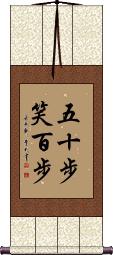
五十步笑百步 is a Chinese proverb that means the one who retreats 50 paces mocks the one who retreats 100 paces.
During the Warring States Period of what is now China (475 - 221 B.C.), the King of Wei was in love with war. He often fought with other kingdoms just for spite or fun.
One day, the King of Wei asked the philosopher Mencius, “I love my people, and all say I do the best for them. I move the people from famine-stricken areas to places of plenty and transport grains from rich areas to the poor. Nobody goes hungry in my kingdom, and I treat my people far better than other kings. But why does the population of my kingdom not increase, and why does the population of other kingdoms not decrease?”
Mencius answered, “Since you love war, I will make this example: When going to war, and the drums beat to start the attack, some soldiers flee for their lives in fear. Some run 100 paces in retreat, and others run 50 steps. Then the ones who retreated 50 paces laugh and taunt those who retreated 100 paces, calling them cowards mortally afraid of death. Do you think this is reasonable?
The King of Wei answered, “Of course not! Those who run 50 paces are just as timid as those who run 100 paces.”
Mencius then said, “You are a king who treats his subjects better than other kings treat their people, but you are so fond of war that your people suffer from great losses in battle. Therefore, your population does not grow. While other kings allow their people to starve to death, you send your people to die in war. Is there any difference?”
This famous conversation led to the six-character proverb shown here. It serves as a warning to avoid hypocrisy. It goes hand-in-hand with the western phrase, “The pot calls the kettle black,” or the Biblical phrase, “Before trying to remove a splinter from your neighbor's eye, first remove the plank from your own eye.”
Funny / Humorous
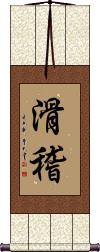
滑稽 is “funny” in Chinese characters and Japanese Kanji.
This can also mean comical, amusing, humorous/humourous, laughable, ridiculous, or joking.
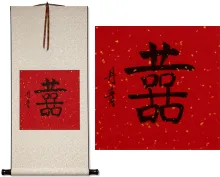
Doing good is the greatest source of happiness
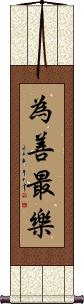
為善最樂 can mean “Doing good is the greatest source of happiness” or “doing good deeds brings the greatest joy.”
The origin is not known but is sometimes used in the context of Buddhism. However, this Chinese proverb or philosophy is a relatively mainstream idea of benevolence.
Hali
(Name - Version 1)
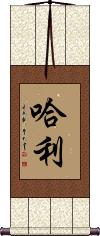
哈利 is the most common transliteration to Mandarin Chinese for the name Hali.
Use this form if you pronounce your name like “Ha-Lee” (This “ha” is like laughing “ha ha”).
Happy / Laughter / Cheerful Bliss
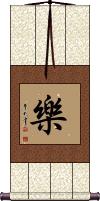
樂 is a single-character form of happiness or bliss that holds the ideas of laughing and having a good time.
This can also be translated as happy, glad, enjoyable, fun, and sometimes, music.
This a really good character if your audience is Chinese.
This is not a word seen alone very often in Korean.
 In Japanese, this character is written like the image shown to the right. If you order this from the Japanese master calligrapher, it will look like this instead of the character shown above.
Note: In Japanese, this has a meaning of comfort, ease, and enjoyment.
See Also: Joyfulness / Happiness
Happiness / Contentment
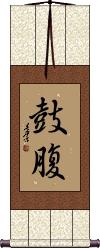
鼓腹 means happiness and contentment in Japanese Kanji.
The first Kanji represents your internal beat or drum.
The second Kanji represents your mind and body.
Together, it suggests that your internal rhythm or beat is regular, soothing, and at the proper tempo.
See Also: Salvation | Pleasure | Safety and Well-Being of the Family
Happiness / Fortune / Lucky
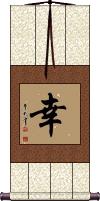
幸 can mean happiness, good fortune, good luck, and in the old days, good harvest or bounty.
Note: From Japanese, this character is sometimes romanized as “sachi,” and is often pronounced “kou” or sometimes “rei” when used in compound words with other Kanji.
Love and Happiness
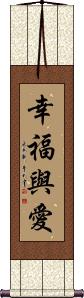
幸福與愛 is “happiness and love” in Chinese.
There is a suggestion of “good fortune” in the version of happiness used here.
Happiness / Contentment
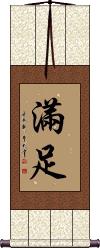
滿足 is the kind of happiness that involves being satisfied and content.
This can also suggest the actions of “to satisfy,” and “to meet the needs of.”
Other single-word definitions include satisfaction, contentment, sufficient, enough, adequate, full, or complete.
 In Japanese, the Kanji for this word is an alternate Chinese form. You can see and select this version at the right (recommended only if your audience is specifically Japanese).
See Also: Salvation | Contentment | Pleasure | Safety and Well-Being of the Family
Happiness / Joy
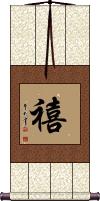
禧 is the type of happiness known in the west as “joy.”
The radical on the right side of this character is often seen alone (with the same meaning - and we do recommend that version because it's more universal).
Double Happiness
(Happy wedding and marriage)
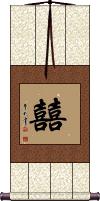
囍 is a common gift for Chinese couples getting married or newly married couples.
As we say in the west, “Two heads are better than one” Well, in the east, two “happinesses” are certainly better than one.
Some will suggest this is a symbol of two happinesses coming together. Others see it as a multiplication of happiness because of the union or marriage.
囍 is not really a character that is pronounced very often - it's almost exclusively used in written form. However, if pressed, most Chinese people will pronounce this “shuang xi” (double happy) although literally there are two “xi” characters combined in this calligraphy (but nobody will say “xi xi”).
 If you select this character, I strongly suggest the festive bright red paper for your calligraphy. Part of my suggestion comes from the fact that red is a good luck color in China, and this will add to the sentiment that you wish to convey with this scroll to the happy couple.
Happiness / Joyful / Joy
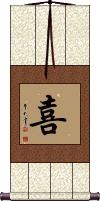
喜 is the Chinese, Japanese Kanji, and Korean Hanja for the kind of happiness known in the west as “joy.”
喜 can also be translated as rejoice, enjoyment, delighted, pleased, or “take pleasure in.” Sometimes it can mean “to be fond of” (in a certain context).
If you write two of these happiness/joy characters side by side, you create another character known in English as “double happiness,” which is a symbol associated with weddings and happy marriages.
There is another version of this character that you will find on our website with an additional radical on the left side (exactly same meaning, just an alternate form). The version of happiness shown here is the commonly written form in China, Japan and South Korea (banned in North Korea).
See Also: Contentment | Happiness | Joy
Happiness
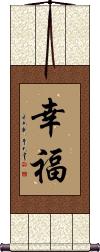
幸福 is a general state of happiness that can also be translated as truly blessed, welfare, well-being, or fortunate.
Happy Laughter
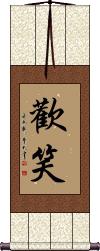
歡笑 translates as “happy laughter.”
The first character means happy or happiness.
The second character means to laugh, laughter or smile.
The Whole Room Rocks With Laughter
The perfect scroll if you love humor or as a gift for the comedian in your life
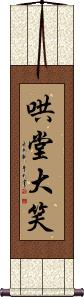
In China, 哄堂大笑 is a proverb that is used in response to a good joke or witty comment.
The story goes that Mr. Feng and Mr. He were both senior officials in the Song Dynasty (about a thousand years ago). One day, Mr. Feng walked into their shared office wearing a new pair of boots. The boots caught the eye of Mr. He who said, “New boots! - how much were they?.” Mr. Feng lifted one of the boots off the ground as if to show it off and responded, “900 coins.”
Astonished, Mr. Feng explained, “900? How can that be? - I paid 1800 coins for my boots!.” Mr. Feng then lifted his other foot off the ground and said, “This boot was also 900 coins.”
It is said that the whole room was shaking from the laughter of all that heard Mr. Feng's joke on Mr. He.
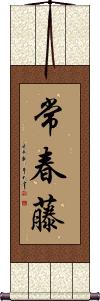
This is a common way to write “ivy” in Chinese.
There are varieties of ivy plant, and other ways to say ivy in Chinese but this version is probably the nicest. It's the one you would use if writing a poem about ivy etc.
If you want the actual meaning, this is, “Always Young Vine,” or “Ever Living Vine.” The literal meaning of the characters is more like, “Always Spring[time] Vine.” But Spring can have other representations in Chinese such as new life, youth, freshness, joyfulness, etc.
Joyful
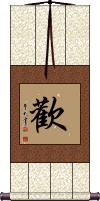
歡 means joyous, happy, delightful, and pleased.
歡 represents external happiness that may have you clapping and cheering.
Please note: The other happiness/joyful which looks like “喜” is more popular.
歡 is the ancient/old version in China and Japan. After WWII in Japan, they started using 歓. Just let us know if you want this modern version instead of the ancient one.
See Also: Happiness
Happy
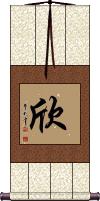
欣 is the type of happiness that you feel on the inside. It is the feeling of being released and delighted as well as being in a state of contentment. 欣 is more the internal happiness that perhaps only shows by the smile on your face. It can also be translated as “to take pleasure in” or “to rejoice.”
Note: 欣 is often used in compound words - especially in Korean Hanja.
As Japanese Kanji, this is so rare, that most Japanese people are not aware of its existence.
See Also: Happiness
Joyfulness / Happiness
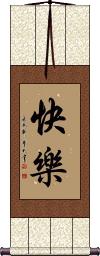
快樂 or joyfulness is an inner sense of peace and happiness.
You appreciate the gifts each day brings. Without joyfulness, when the fun stops, our happiness stops. Joy can carry us through hard times even when we are feeling very sad.
快樂 can also mean pleasure, enjoyment, delight, cheerfulness, or merry. In some ways, this is the essence that makes someone perceived as a charming person.
See Also: Happiness
Laugh / Smile
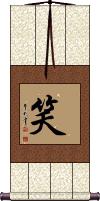
笑 simply means to laugh or smile.
Notes: In some contexts, it can mean “ridicule” in Korean Hanja. 笑 is not often seen alone in Japanese, though it is understood.
Laughing Dragon Kung Fu
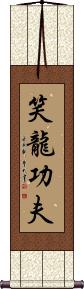
笑龍功夫 is the title for a Martial Arts studio (custom-made at by request of the owner of the studio).
Laughlin

勞克林 is the name Laughlin in Chinese (Mandarin).
Laughlin

ラフリン is the name Laughlin in Japanese Katakana.
Note: Because this title is entirely Japanese Katakana, it should be written by a Japanese calligrapher.
A Life of Happiness and Prosperity
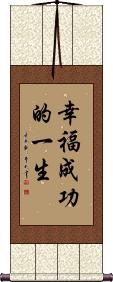
幸福成功的一生 means “A life of happiness and prosperity” or “A life of happiness and success.”
It's a very positive and inspirational wall scroll selection.
See Also: Prosperity
A Life of Happiness and Prosperity
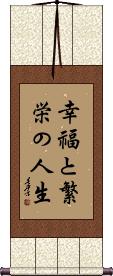
幸福と繁栄の人生 is a Japanese proverb that means “A life of happiness and prosperity” or “A life of happiness and success.”
Note: Because this selection contains some special Japanese Hiragana characters, it should be written by a Japanese calligrapher.
See Also: Prosperity
Life is Fun
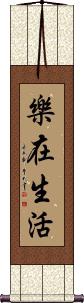
This means “life is fun” in Chinese.
樂 means fun, happy, or in some contexts, joyful music.
在 means at/is.
生活 means life or living.
Live Laugh Love
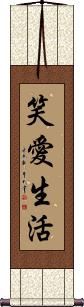
In English, the word order shown in the title is the most natural or popular. In Chinese, the natural order is a little different:
The first character means laugh (sometimes means smile).
The second character means love.
The last two characters mean “live” as in “to be alive” or “pursue life.”
Please note: 笑愛生活 is not a normal phrase in that it does not have a subject, verb, or object. It is a word list. Word lists are not common in Asian languages/grammar (at least not as normal as in English). We only added this entry because so many people requested it.
We put the characters in the order shown above, as it almost makes a single word with the meaning “A life of laughter and love.” It's a made-up word, but it sounds good in Chinese.
We removed the Japanese pronunciation guide from this entry, as the professional Japanese translator deemed it “near nonsense” from a Japanese perspective. Choose this only if your audience is Chinese and you want the fewest-possible characters to express this idea.
In Korean, this would be 소애생활 or “so ae saeng hwar” but I have not confirmed that this makes sense in Korean.
Live Laugh Love
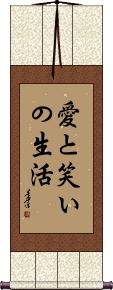
Because a word list of “Live Laugh Love” is not natural in Japanese, this takes the concept and incorporates it into a proper phrase.
愛と笑いの生活 can mean “A life of love and laughter” or “Live life with love and laughter.”
Note: Because this selection contains some special Japanese Hiragana characters, it should be written by a Japanese calligrapher.
Peace, Love, Happiness
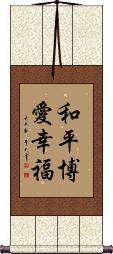
和平博愛幸福 is a word-list that means “peace, love, happiness,” in Chinese.
Word lists like this are not commonly-seen in China. Phrases with subject, verb, and object, or just single words are more natural for calligraphy artwork.
Peace, Love, Happiness
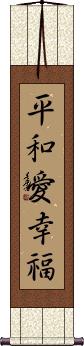
平和, 愛, 幸福 means “peace, love, happiness” in Japanese.
This is a word list, which is not the most natural kind of composition in Japanese (usually there is a subject, object, and verb - or a single word).
Pleasure
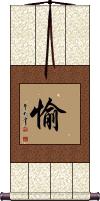
愉 can mean pleasure, well-pleased, contented, and happy.
Note: 愉 is no longer in common use in Japanese.
See Also: Passions / Feelings / Emotions
Prosperity and Happiness
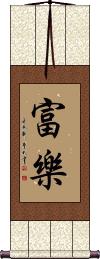
富樂 is the Chinese, Japanese Kanji, and old Korean Hanja for a title meaning prosperity and happiness.
If you have the desire to live in prosperity and happiness, this is for you.
Note: This title is often used in a Buddhist context.
Pursuit of Happiness
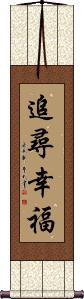
追尋幸福 is the best way to translate the English phrase “pursuit of happiness” into Chinese.
The first two characters mean “to pursue,” “to track down,” or “to search for.”
The last two mean happiness, happy, or being blessed.
See Also: Follow Your Heart
Pursuit of Happiness
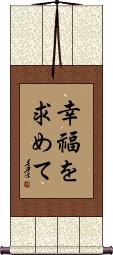
幸福を求めて is “Pursuit of Happiness” or “In Search of Happiness” in Japanese.
Here's how the characters break down:
幸福 (koufuku) happiness; blessedness; joy; well-being.
を (o) particle
求め (motome) to want; to seek; to pursue; to request
て (te) particle
Note: Because this selection contains some special Japanese Hiragana characters, it should be written by a Japanese calligrapher.
See Also: Follow Your Heart
Roar of Laughter / Big Laughs
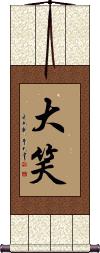
大笑 can mean “roar of laughter,” “loud laughter,” “hearty laugh,” or “cachinnation.”
The first character means big or great, and the second means to laugh or smile.
If you like humor, this is a great wall scroll to hang in your home.
See Also: The Whole Room Rocks With Laughter
School of Happiness
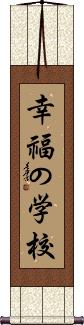
幸福の学校 means “School of Happiness” in Japanese.
This is not a common phrase in Japanese, but it will be understood.
School of Happiness
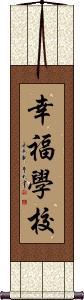
幸福學校 means “School of Happiness” or “Happiness School” in Chinese.
幸福 means happiness, happy, blessed, blessedness, joy, and/or well-being.
學校 means school or college.
Seven Rules of Happiness
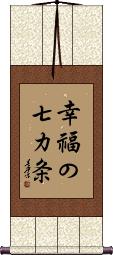
幸福の七カ条 is the title for the 7 rules of happiness in Japanese.
The rules themselves take up many space:
1. 成功や栄誉や勝ち負けを目的に、ことを行ってはいけない。
2. しないではいられないことをし続けなさい。
3. 他人との比較ではない、あくまで自分の楽しさを追及すべし。
4. 好きの力を信じる。
5. 才能と収入は別、努力は人を裏切ると心得よ。
6. 怠け者になりなさい。
7. 目に見えない世界を信じる。
...so this title is probably all you need.
Note: Because this selection contains some special Japanese Katakana characters, it should be written by a Japanese calligrapher.
Shinken Shobu
Death Match
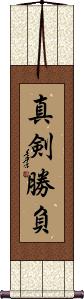
In modern Japanese, 真剣勝負 means to take something very seriously.
The literal and historical meaning is “real sword battle.” In old times, a Samurai apprentice would practice with a wooden practice sword. Once trained and qualified, they would wield a real steel sword made for battle and killing. They were ready for a “death match” or Shinken Shobu.
真剣 is an adjective that has come to mean serious/earnest. The literal translation is “real sword.”
勝負 in the simplest terms, means match, contest, game, or bout. Depending on the context, it could also mean victory or defeat, winning and losing, or the outcome of a battle.
There is a suggestion in Shinken Shobu that you train with serious and real intent, as we should train with the same fervor and dedication as if the battle was real. “Train as we fight.”
See Also: The More We Sweat in Training | the Less We Bleed in Battle | Cry in the Dojo - Laugh on the Battlefield
White Tiger
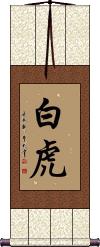
白虎 is the title “White Tiger” in Chinese, Japanese, and old Korean Hanja.
In Chinese folklore, the White Tiger rules or represents the seven mansions (constellations) of the western sky. However, in modern Chinese, a “white tiger” is also slang for hairless female genitalia (be careful about this, as Chinese men might secretly laugh or snicker when they see your white tiger wall scroll).
In Japanese folklore, the White Tiger is a god said to rule over the western heavens. They also know of the Chinese seven mansions of the western heavens. In Japanese, this can also be the given name Byakko.
You must endure a harsh winter to appreciate the warmth of springtime
You must know hardship to appreciate happiness
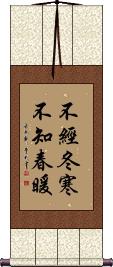
This literally translates as: Without having experienced the cold of winter, one cannot appreciate the warmth of spring.
Figuratively, this means: One cannot truly appreciate happiness without having gone through hardship.
There are many contrasts in life. One simply cannot fully know what joy is without having experienced misery, difficulty, and pain. How could you explain “light” if you did not have “darkness” to compare it to?
Embrace hardship, as it makes the good times seem even better.
This in-stock artwork might be what you are looking for, and ships right away...


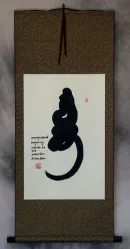
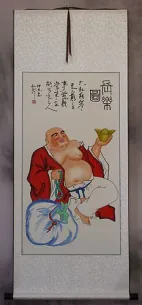
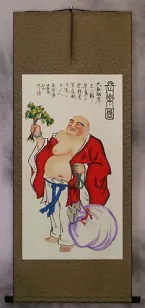
The following table may be helpful for those studying Chinese or Japanese:
| Title | Characters | Romaji (Romanized Japanese) | Various forms of Romanized Chinese | |
| Happiness in the Afterlife | 冥福 | mei fuku / meifuku | míng fú / ming2 fu2 / ming fu / mingfu | |
| Happy Buddha | 歡喜光佛 欢喜光佛 | kan gi kou butsu kangikoubutsu kan gi ko butsu | huān xǐ guāng fó huan1 xi3 guang1 fo2 huan xi guang fo huanxiguangfo | huan hsi kuang fo huanhsikuangfo |
| Cry in the Dojo - Laugh on the Battlefield | 道場で泣き戦場で笑う | doujou de naki senjou de warau dojo de naki senjo de warau | ||
| Double Happiness Guest Book | 囍 喜喜 | xǐ / xi3 / xi | hsi | |
| Eternal Happiness | 永遠の幸福 | ei en no kou fuku eiennokoufuku ei en no ko fuku | ||
| Eternal Happiness | 幸福永恆 幸福永恒 | xìng fú yǒng héng xing4 fu2 yong3 heng2 xing fu yong heng xingfuyongheng | hsing fu yung heng hsingfuyungheng |
|
| Eternal Peace and Happiness | 永恆和平與幸福 永恒和平与幸福 | yǒng héng hé píng yù xìng fú yong3 heng2 he2 ping2 yu4 xing4 fu2 yong heng he ping yu xing fu yonghenghepingyuxingfu | yung heng ho p`ing yü hsing fu yunghenghopingyühsingfu yung heng ho ping yü hsing fu |
|
| The one who retreats 50 paces mocks the one to retreats 100 | 五十步笑百步 | wù shí bù xiào bǎi bù wu4 shi2 bu4 xiao4 bai3 bu4 wu shi bu xiao bai bu wushibuxiaobaibu | wu shih pu hsiao pai pu wushihpuhsiaopaipu |
|
| Funny Humorous | 滑稽 | kokkei / kokei | huá jī / hua2 ji1 / hua ji / huaji | hua chi / huachi |
| Doing good is the greatest source of happiness | 為善最樂 为善最乐 | wéi shàn zuì lè wei2 shan4 zui4 le4 wei shan zui le weishanzuile | wei shan tsui le weishantsuile |
|
| Hali | 哈利 | hā lì / ha1 li4 / ha li / hali | ||
| Happy Laughter Cheerful Bliss | 樂 / 楽 乐 | raku | lè / le4 / le | |
| Happiness Contentment | 鼓腹 | ko fuku / kofuku | ||
| Happiness Fortune Lucky | 幸 | saki / sachi / rei / rē | xìng / xing4 / xing | hsing |
| Love and Happiness | 幸福與愛 幸福与爱 | xìng fú yǔ ài xing4 fu2 yu3 ai4 xing fu yu ai xingfuyuai | hsing fu yü ai hsingfuyüai |
|
| Happiness Contentment | 滿足 / 満足 满足 | man zoku / manzoku | mǎn zú / man3 zu2 / man zu / manzu | man tsu / mantsu |
| Happiness Joy | 禧 | xǐ / xi3 / xi | hsi | |
| Double Happiness | 囍 喜喜 | xǐ / xi3 / xi | hsi | |
| Happiness Joyful Joy | 喜 | ki / yorokobi | xǐ / xi3 / xi | hsi |
| Happiness | 幸福 | koufuku / kofuku | xìng fú / xing4 fu2 / xing fu / xingfu | hsing fu / hsingfu |
| Happy Laughter | 歡笑 欢笑 | huān xiào huan1 xiao4 huan xiao huanxiao | huan hsiao huanhsiao |
|
| The Whole Room Rocks With Laughter | 哄堂大笑 | hōng tāng dà xiào hong1 tang1 da4 xiao4 hong tang da xiao hongtangdaxiao | hung t`ang ta hsiao hungtangtahsiao hung tang ta hsiao |
|
| Ivy | 常春藤 | cháng chūn téng chang2 chun1 teng2 chang chun teng changchunteng | ch`ang ch`un t`eng changchunteng chang chun teng |
|
| Joyful | 歡 欢 / 歓 | kan | huān / huan1 / huan | |
| Happy | 欣 | kin | xīn / xin1 / xin | hsin |
| Joyfulness Happiness | 快樂 快乐 | kai raku / kairaku | kuài lè / kuai4 le4 / kuai le / kuaile | k`uai le / kuaile / kuai le |
| Laugh Smile | 笑 | e / shou / wa e / sho / wa | xiào / xiao4 / xiao | hsiao |
| Laughing Dragon Kung Fu | 笑龍功夫 笑龙功夫 | xiào lóng gōng fu xiao4 long2 gong1 fu xiao long gong fu xiaolonggongfu | hsiao lung kung fu hsiaolungkungfu |
|
| Laughlin | 勞克林 劳克林 | láo kè lín lao2 ke4 lin2 lao ke lin laokelin | lao k`o lin laokolin lao ko lin |
|
| Laughlin | ラフリン | rafurin | ||
| A Life of Happiness and Prosperity | 幸福成功的一生 | xìng fú chéng gōng de yì shēng xing4 fu2 cheng2 gong1 de yi4 sheng1 xing fu cheng gong de yi sheng xingfuchenggongdeyisheng | hsing fu ch`eng kung te i sheng hsingfuchengkungteisheng hsing fu cheng kung te i sheng |
|
| A Life of Happiness and Prosperity | 幸福と繁栄の人生 | kou fuku to ha nei no jin sei koufukutohaneinojinsei ko fuku to ha nei no jin sei | ||
| Life is Fun | 樂在生活 乐在生活 | lè zài shēng huó le4 zai4 sheng1 huo2 le zai sheng huo lezaishenghuo | le tsai sheng huo letsaishenghuo |
|
| Live Laugh Love | 笑愛生活 笑爱生活 | xiào ài shēng huó xiao4 ai4 sheng1 huo2 xiao ai sheng huo xiaoaishenghuo | hsiao ai sheng huo hsiaoaishenghuo |
|
| Live Laugh Love | 愛と笑いの生活 | ai to warai no seikatsu aitowarainoseikatsu | ||
| Peace, Love, Happiness | 和平博愛幸福 和平博爱幸福 | hé píng bó ài xìng fú he2 ping2 bo2 ai4 xing4 fu2 he ping bo ai xing fu hepingboaixingfu | ho p`ing po ai hsing fu hopingpoaihsingfu ho ping po ai hsing fu |
|
| Peace, Love, Happiness | 平和, 愛, 幸福 | heiwa ai koufuku heiwaaikoufuku heiwa ai kofuku | ||
| Pleasure | 愉 | yu | yú / yu2 / yu | yü |
| Prosperity and Happiness | 富樂 富乐 | furaku | fù lè / fu4 le4 / fu le / fule | |
| Pursuit of Happiness | 追尋幸福 追寻幸福 | zhuī xún xìng fú zhui1 xun2 xing4 fu2 zhui xun xing fu zhuixunxingfu | chui hsün hsing fu chuihsünhsingfu |
|
| Pursuit of Happiness | 幸福を求めて | koufuku o motome te koufukuomotomete kofuku o motome te | ||
| Roar of Laughter Big Laughs | 大笑 | taishou / taisho | dà xiào / da4 xiao4 / da xiao / daxiao | ta hsiao / tahsiao |
| School of Happiness | 幸福の學校 幸福の学校 | koufuku no gakkou koufukunogakkou kofuku no gako | ||
| School of Happiness | 幸福學校 幸福学校 | xìng fú xué xiào xing4 fu2 xue2 xiao4 xing fu xue xiao xingfuxuexiao | hsing fu hsüeh hsiao hsingfuhsüehhsiao |
|
| Seven Rules of Happiness | 幸福の七カ條 幸福の七カ条 | kou fuku no nana ka jou koufukunonanakajou ko fuku no nana ka jo | ||
| Shinken Shobu | 真剣勝負 | shinken shoubu shinkenshoubu shinken shobu | ||
| White Tiger | 白虎 | byakko / hakko byako / hako | bái hǔ / bai2 hu3 / bai hu / baihu | pai hu / paihu |
| You must endure a harsh winter to appreciate the warmth of springtime | 不經冬寒不知春暖 不经冬寒不知春暖 | bù jīng dōng hán bù zhī chūn nuǎn bu4 jing1 dong1 han2 bu4 zhi1 chun1 nuan3 bu jing dong han bu zhi chun nuan | pu ching tung han pu chih ch`un nuan pu ching tung han pu chih chun nuan |
|
| In some entries above you will see that characters have different versions above and below a line. In these cases, the characters above the line are Traditional Chinese, while the ones below are Simplified Chinese. | ||||



