Custom Persistence Chinese & Japanese Calligraphy Wall Scroll
We have many options to create artwork with Persistence characters on a wall scroll or portrait.
If you want to create a cool Persistence wall scroll, this is the place. Below you will find a few Asian symbols that express the idea of persistence.
1. Persistence
2. Indomitable / Persistence / Fortitude
3. Nothing is Impossible with Persistence
5. Kenninfubatsu - Indomitable Perseverance
7. Patience / Perseverance / To Endure / Tolerant
8. Perseverance
10. Perseverance
12. Perseverance / Indomitable / Invincible Fortitude
14. Daodejing / Tao Te Ching - Chapter 33
15. Endurance
18. Enthusiasm / Passion for a Cause
19. Undaunted After Repeated Setbacks
20. Strong / Healthy
Persistence
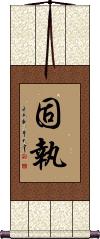
固執 can also mean “opinionated” or “stubborn” in Chinese and Japanese, but in the nicest way possible (still bad).
This just means “stubborn” in Korean (not a good scroll if your audience is Korean, in fact, we don't recommend this word at all). There are better ways to express this idea, such as tenacity/tenacious or perseverance... ...see the links below...
See Also: Tenacious / Tenacity | Perseverance / Indomitable / Invincible Fortitude | Perseverance
Indomitable / Persistence / Fortitude
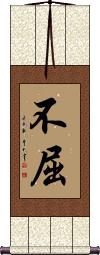
不屈 is the short form of a longer Chinese word and also a word used in Korean and Japanese to express the idea of being indomitable. It literally means “will not bend,” “will not crouch,” “will not yield,” “will not flinch,” or “will not submit.”
Note: Some will translate this as “indomitable spirit”; however, technically, there is no character to suggest the idea of “spirit” in this word.
See Also: Tenacious / Tenacity | Perseverance / Indomitable / Invincible Fortitude | With All the Strength of Your Heart | Carry On | Undaunted
Nothing is Impossible with Persistence
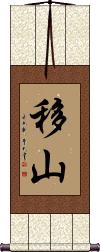
移山 is the Chinese, Japanese Kanji, and old Korean Hanja for “to remove mountains” or “to move a mountain.”
Figuratively, this means you can accomplish the impossible by sheer persistence.
移山 is the short form of a proverb about a man who had much persistence and could move a whole mountain (a bucket of soil at a time).
Perseverance / Fortitude
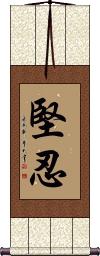
堅忍 means persistent, steadfast, fortitude, and/or perseverance.
The first character means strong, solid, firm, unyielding, or resolute.
The second character means to beat, endure, or tolerate.
Together they speak of the strength from within yourself. Some may also translate this as long-suffering in a more Biblical sense.
堅忍 is a common term in Chinese and Korean Hanja but a little less commonly used in modern Japanese Kanji. For that reason, this selection is best if your audience is Chinese or Korean.

 Note that when writing this as Kanji, Japanese will tend to write the second Kanji a little differently. If you select our Japanese master calligrapher, please expect the form where the little horizontal stroke crosses the vertical stroke. See differences in the images to the right. Technically, they are both the same character, and will be read the same in either language.
Kenninfubatsu - Indomitable Perseverance

堅忍不抜 means indomitable perseverance or invincible fortitude in Japanese Kanji.
Patience / Perseverance
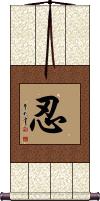
忍 contains the ideas of patience, equanimity, perseverance, forbearance, and endurance. Alone, this single character can be a bit ambiguous or flexible. It can also mean to endure, to bear, to put up with, or to conceal. If you want to simply decide what This means to you within the general meaning but keep it a mystery to others, this is a good choice.
If you want to be more direct, you may want to choose one of our other selections that mean perseverance or patience (you will see this character within those larger words/phrases).
There is a secondary meaning in Japanese since this is the first character of the word ninja.Note that when writing this as Kanji, Japanese will tend to write it in the form shown to the right. If you select our Japanese master calligrapher, please expect this Kanji form (yes, it's just one stroke that is slightly different in location, crossing another stroke in the Japanese Kanji form).
See Also: Perseverance | Patience and Preparation | Tenacious / Tenacity
Patience / Perseverance / To Endure / Tolerant
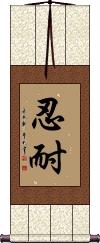
忍耐 is patience, the quiet hope, and trust that things will turn out right.
You wait without complaining. You are tolerant and accepting of difficulties and mistakes. You picture the end in the beginning and persevere to meet your goals.
忍耐 can also mean “to endure,” “restrain oneself,” or “forbearance,” and in some contexts, it can mean “perseverance” or “endurance.”
忍耐 is also used as a tenet of Taekwondo, Tang Soo Do, and other Korean martial arts where it's titled “Endurance” and romanized as “In Neh.”
Note that when writing this as Kanji, Japanese will tend to write the first character in the form shown to the right. If you select our Japanese master calligrapher, please expect this Kanji form (yes,
it’s
just one stroke that is slightly different in location, crossing another stroke in the Japanese Kanji form).
See Also: Worldwide Peace | Peace / Harmony | Perseverance
Perseverance
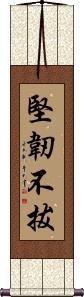
堅韌不拔 is about perseverance, being steadfast and persistent.
堅韌不拔 is a great phrase for you if you commit to your goals and overcome obstacles, no matter how long it takes.
The translation of this proverb literally means “something so persistent or steadfast, that it is not uprootable, movable, or surpassable.”
Other translations include being firm and indomitable or tenacious and unyielding.
See Also: Tenacious / Tenacity | Sincerity and Devotion | Perseverance / Indomitable / Invincible Fortitude
Perseverance / Fortitude
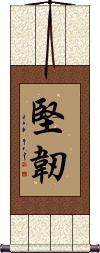
Perseverance
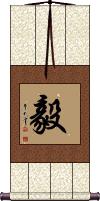
毅 is the simplest way to express perseverance in Chinese and Korean Hanja.
This single-character version leaves a bit of mystery about what kind of perseverance you might want to convey.
In Korean, this is usually associated with “strength of character.”
In Japanese, this character can be pronounced in a dozen different ways (so we have left out the Japanese pronunciation guide that normally appears above). In Japanese, this Kanji would usually be translated as “strong” (perhaps strong-willed).
See Also: Tenacious / Tenacity | Perseverance / Indomitable / Invincible Fortitude | With All the Strength of Your Heart | Carry On | Undaunted
Perseverance / Will-Power
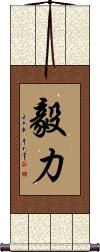
毅力 is a way to express “perseverance” with the idea of “willpower” in Chinese and old Korean Hanja. It can also mean “strong-willed.”
The first character means “strong” and “persistent,” while the second means “strength” and “power.”
Perseverance / Indomitable / Invincible Fortitude

堅忍不抜 means determined, steadfast, unswerving, or unshakable in Japanese.
This is the Japanese version of an old Chinese 4-character perseverance proverb.
This would be understood in Chinese, but it's not commonly written this way in Chinese.
Note that when writing this as Kanji, Japanese calligraphers sometimes write the second Kanji in the form shown to the right. Yes,
it’s
just one stroke that is slightly different in location, crossing another stroke in this alternate Japanese Kanji form. If you have a preference, let us know when you order.
Due to some odd computer coding conventions, these two character forms were combined/merged into the same code point - thus, you will not see Kanji images of more Japanese form as you select options for your scroll.
Perseverance is the Key
Skills cannot be perfected without perseverance in practice
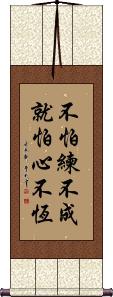
不怕练不成就怕心不恒 literally translates as: Do not worry about not being able to master [a skill]; What [one should] be concerned about is lack of perseverance.
Figuratively, this means: One's skills cannot be perfected without perseverance in practice.
For me, I've learned that you can only get so much from school or studying. You've really got to do “on-the-job training” to perfect your ability and skill.
For martial arts students: You can read about a kick in a book, or someone can tell you about a certain kick but until you practice the kick, there's no way you'll master it.
Daodejing / Tao Te Ching - Chapter 33
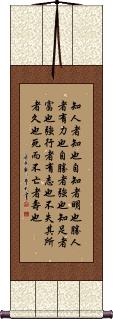
This is referred to as passage or chapter 33 of the Dao De Jing (often Romanized as “Tao Te Ching”).
These are the words of the philosopher Laozi (Lao Tzu).
To know others is wisdom;
To know oneself is acuity/intelligence.
To conquer others is power,
To conquer oneself is strength.
To know contentment is to have wealth.
To act resolutely is to have purpose.
To stay one's ground is to be enduring.
To die and yet not be forgotten is to be long-lived.
To understand others is to be knowledgeable;
To understand yourself is to be wise.
To conquer others is to have strength;
To conquer yourself is to be strong.
To know when you have enough is to be rich.
To go forward with strength is to have ambition.
To not lose your place is to be long-lasting.
To die but not be forgotten -- that's true long life.
He who is content is rich;
He who acts with persistence has will;
He who does not lose his roots will endure;
He who dies physically but preserves the Dao
will enjoy a long after-life.
Notes:
During our research, the Chinese characters shown here are probably the most accurate to the original text of Laozi. These were taken for the most part from the Mawangdui 1973 and Guodan 1993 manuscripts which pre-date other Daodejing texts by about 1000 years.
Grammar was a little different in Laozi’s time. So you should consider this to be the ancient Chinese version. Some have modernized this passage by adding, removing, or swapping articles and changing the grammar (we felt the oldest and most original version would be more desirable). You may find other versions printed in books or online - sometimes these modern texts are simply used to explain to Chinese people what the original text really means.
This language issue can be compared in English by thinking how the King James (known as the Authorized version in Great Britain) Bible from 1611 was written, and comparing it to modern English. Now imagine that the Daodejing was probably written around 403 BCE (2000 years before the King James Version of the Bible). To a Chinese person, the original Daodejing reads like text that is 3 times more detached compared to Shakespeare’s English is to our modern-day speech.
Extended notes:
While on this Biblical text comparison, it should be noted, that just like the Bible, all the original texts of the Daodejing were lost or destroyed long ago. Just as with the scripture used to create the Bible, various manuscripts exist, many with variations or copyist errors. Just as the earliest New Testament scripture (incomplete) is from 170 years after Christ, the earliest Daodejing manuscript (incomplete) is from 100-200 years after the death of Laozi.
The reason that the originals were lost probably has a lot to do with the first Qin Emperor. Upon taking power and unifying China, he ordered the burning and destruction of all books (scrolls/rolls) except those pertaining to Chinese medicine and a few other subjects. The surviving Daodejing manuscripts were either hidden on purpose or simply forgotten about. Some were not unearthed until as late as 1993.
We compared many research by various archeologists and historians before deciding on this as the most accurate and correct version. But one must allow that it may not be perfect, or the actual and original as from the hand of Laozi himself.
Endurance
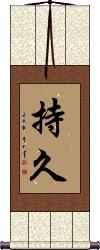
持久 means to endure or lasting.
In some contexts, it can mean “persistent” or “persistence” (especially in Japanese and Korean).
Indomitable / Unyielding
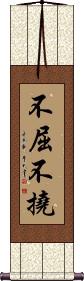
不屈不撓 means “Indomitable” or “Unyielding.”
不屈不撓 is a long word by Chinese standards. At least, it is often translated as a single word into English. It's actually a proverb in Chinese.
If you want to break it down, you can see that the first and third characters are the same. Both mean “not” (they work as a suffix to make a negative or opposite meaning to whatever character follows).
The second character means “bendable.”
The last means “scratched” or “bothered.”
So this really means “Won't be bent, can't be bothered.” I have also seen it written as “Will not crouch, will not submit.” This comes from the fact that the second character can mean “to crouch” and the last can mean “to submit” (as in “to give in” such as “submitting to the rule of someone else”). This may explain better why these four characters mean “indomitable.”
Notes:
Some will translate this as “indomitable spirit”; however, technically, there is no character to suggest the idea of “spirit” in this word.
Other translations include indefatigability, indomitableness, or unremitting tenacity.
The first two characters can be stand-alone words in Chinese.
In Japanese, this is considered two words (with very similar meanings). It's more common to see the word order flipped to 不撓不屈 in Japanese.
The same characters are used in old Korean Hanja. Just like in Japanese, the words are swapped to 不撓不屈 creating a word pronounced “불요불굴” in Korean.
See 不撓不屈
See Also: Tenacious / Tenacity | Perseverance / Indomitable / Invincible Fortitude | With All the Strength of Your Heart | Carry On | Undaunted
Passion for a Cause
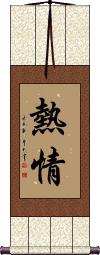
Depending on the context, 熱情 can mean “cordial,” “enthusiastic,” “passionate,” or “passionately.”
This version is sometimes used in Japanese, but the character order is more common in Chinese and Korean Hanja. The meaning in Japanese for this Kanji order is ardor/ardour or zeal but rarely used in modern Japan. I suggest you choose a different version of “passion” if your audience is Japanese.
See Also: Sincerity and Devotion | Tenacious / Tenacity | Commitment | Motivation
Enthusiasm / Passion for a Cause
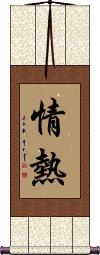
情熱 is the Japanese word that means enthusiasm or “passion for a cause.”
In some contexts, this could mean being extremely fond of something or having a fondness for a cause or person.
Can also be translated as passion, zeal, ardor/ardour, or fervor.
Note: This word (or character order) is not natural in Chinese. However, a typical Chinese person can guess this is a Japanese or Korean word and understand the intended meaning. This selection is best if your audience is Japanese or old-school Korean.
See Also: Sincerity and Devotion | Tenacious / Tenacity | Commitment | Motivation
Undaunted After Repeated Setbacks
Persistence to overcome all challenges
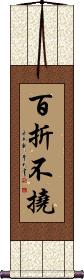
百折不撓 is a Chinese proverb that means “Be undaunted in the face of repeated setbacks.”
More directly translated, it reads, “[Overcome] a hundred setbacks, without flinching.” 百折不撓 is of Chinese origin but is commonly used in Japanese and somewhat in Korean (same characters, different pronunciation).
This proverb comes from a long, and occasionally tragic story of a man that lived sometime around 25-220 AD. His name was Qiao Xuan, and he never stooped to flattery but remained an upright person at all times. He fought to expose the corruption of higher-level government officials at great risk to himself.
Then when he was at a higher level in the Imperial Court, bandits were regularly capturing hostages and demanding ransoms. But when his own son was captured, he was so focused on his duty to the Emperor and the common good that he sent a platoon of soldiers to raid the bandits' hideout, and stop them once and for all even at the risk of his own son's life. While all of the bandits were arrested in the raid, they killed Qiao Xuan's son at first sight of the raiding soldiers.
Near the end of his career, a new Emperor came to power, and Qiao Xuan reported to him that one of his ministers was bullying the people and extorting money from them. The new Emperor refused to listen to Qiao Xuan and even promoted the corrupt Minister. Qiao Xuan was so disgusted that in protest, he resigned from his post as minister (something almost never done) and left for his home village.
His tombstone reads “Bai Zhe Bu Nao” which is now a proverb used in Chinese culture to describe a person of strong will who puts up stubborn resistance against great odds.
My Chinese-English dictionary defines these 4 characters as “keep on fighting despite all setbacks,” “be undaunted by repeated setbacks,” and “be indomitable.”
Our translator says it can mean “never give up” in modern Chinese.
Although the first two characters are translated correctly as “repeated setbacks,” the literal meaning is “100 setbacks” or “a rope that breaks 100 times.” The last two characters can mean “do not yield” or “do not give up.”
Most Chinese, Japanese, and Korean people will not take this absolutely literal meaning but will instead understand it as the title suggests above. If you want a single big word definition, it would be indefatigability, indomitableness, persistence, or unyielding.
See Also: Tenacious / Tenacity | Perseverance / Indomitable / Invincible Fortitude | With All the Strength of Your Heart | Perseverance
Strong / Healthy
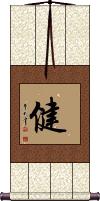
This “strong” character is the more “healthy” version of strong. 健 is the “strong” that is appropriate for an athlete.
Beyond “healthy,” it can also mean strength, persistence, vigorous, or invigorated/invigoration.
Strong / Healthy
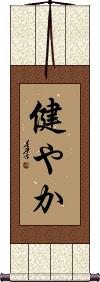
健やか is a verbose way to say strong and healthy in Japanese. 健やか is the “strong” that is appropriate for an athlete.
Beyond “healthy,” it can also mean strength, persistence, vigorous, or invigoration.
Japanese also use the first Kanji to mean the same thing. This version adds two hiragana which serve to emphasize or amplify the word and clarify the meaning.
Note: Because this selection contains some special Japanese Hiragana characters, it should be written by a Japanese calligrapher.
The following table may be helpful for those studying Chinese or Japanese:
| Title | Characters | Romaji (Romanized Japanese) | Various forms of Romanized Chinese | |
| Persistence | 固執 固执 | koshuu / koshu | gù zhí / gu4 zhi2 / gu zhi / guzhi | ku chih / kuchih |
| Indomitable Persistence Fortitude | 不屈 | fukutsu | bù qū / bu4 qu1 / bu qu / buqu | pu ch`ü / puchü / pu chü |
| Nothing is Impossible with Persistence | 移山 | isan | yí shān / yi2 shan1 / yi shan / yishan | i shan / ishan |
| Perseverance Fortitude | 堅忍 坚忍 | ken nin / kennin | jiǎn rěn / jian3 ren3 / jian ren / jianren | chien jen / chienjen |
| Kenninfubatsu - Indomitable Perseverance | 堅忍不抜 | kenninfubatsu | ||
| Patience Perseverance | 忍 | nin | rěn / ren3 / ren | jen |
| Patience Perseverance To Endure Tolerant | 忍耐 | nin tai / nintai | rěn nài / ren3 nai4 / ren nai / rennai | jen nai / jennai |
| Perseverance | 堅韌不拔 坚韧不拔 | jiān rèn bù bá jian1 ren4 bu4 ba2 jian ren bu ba jianrenbuba | chien jen pu pa chienjenpupa |
|
| Perseverance Fortitude | 堅韌 坚韧 | jiān rèn / jian1 ren4 / jian ren / jianren | chien jen / chienjen | |
| Perseverance | 毅 | see note / seenote / se note | yì / yi4 / yi | i |
| Perseverance Will-Power | 毅力 | yì lì / yi4 li4 / yi li / yili | i li / ili | |
| Perseverance Indomitable Invincible Fortitude | 堅忍不抜 / 堅忍不拔 坚忍不拔 | kenninfubatsu | jiān rěn bù bá jian1 ren3 bu4 ba2 jian ren bu ba jianrenbuba | chien jen pu pa chienjenpupa |
| Perseverance is the Key | 不怕練不成就怕心不恆 不怕练不成就怕心不恒 | bú pà liàn bù chéng jiù pà xīn bù héng bu2 pa4 lian4 bu4 cheng2 jiu4 pa4 xin1 bu4 heng2 bu pa lian bu cheng jiu pa xin bu heng | pu p`a lien pu ch`eng chiu p`a hsin pu heng pu pa lien pu cheng chiu pa hsin pu heng |
|
| Daodejing Tao Te Ching - Chapter 33 | 知人者知也自知者明也勝人者有力也自勝者強也知足者富也強行者有志也不失其所者久也死而不亡者壽也 知人者知也自知者明也胜人者有力也自胜者强也知足者富也强行者有志也不失其所者久也死而不亡者寿也 | zhī rén zhě zhī yě zì zhī zhě míng yě shèng rén zhě yǒu lì yě zì shèng zhě qiáng yě zhī zú zhě fù yě qiáng xíng zhě yǒu zhì yě bù zhī qí suǒ zhě jiǔ yě sǐ ér bù wáng zhě shòu yě zhi1 ren2 zhe3 zhi1 ye3 zi4 zhi1 zhe3 ming2 ye3 sheng4 ren2 zhe3 you3 li4 ye3 zi4 sheng4 zhe3 qiang2 ye3 zhi1 zu2 zhe3 fu4 ye3 qiang2 xing2 zhe3 you3 zhi4 ye3 bu4 zhi1 qi2 suo3 zhe3 jiu3 ye3 si3 er2 bu4 wang2 zhe3 shou4 ye3 zhi ren zhe zhi ye zi zhi zhe ming ye sheng ren zhe you li ye zi sheng zhe qiang ye zhi zu zhe fu ye qiang xing zhe you zhi ye bu zhi qi suo zhe jiu ye si er bu wang zhe shou ye | chih jen che chih yeh tzu chih che ming yeh sheng jen che yu li yeh tzu sheng che ch`iang yeh chih tsu che fu yeh ch`iang hsing che yu chih yeh pu chih ch`i so che chiu yeh ssu erh pu wang che shou yeh chih jen che chih yeh tzu chih che ming yeh sheng jen che yu li yeh tzu sheng che chiang yeh chih tsu che fu yeh chiang hsing che yu chih yeh pu chih chi so che chiu yeh ssu erh pu wang che shou yeh |
|
| Endurance | 持久 | ji kyuu / jikyuu / ji kyu | chí jiǔ / chi2 jiu3 / chi jiu / chijiu | ch`ih chiu / chihchiu / chih chiu |
| Indomitable Unyielding | 不屈不撓 不屈不挠 | fu kutsu fu tou fukutsufutou fu kutsu fu to | bù qū bù náo bu4 qu1 bu4 nao2 bu qu bu nao buqubunao | pu ch`ü pu nao puchüpunao pu chü pu nao |
| Passion for a Cause | 熱情 热情 | netsujou / netsujo | rè qíng / re4 qing2 / re qing / reqing | je ch`ing / jeching / je ching |
| Enthusiasm Passion for a Cause | 情熱 情热 | jou netsu / jounetsu / jo netsu | qíng rè / qing2 re4 / qing re / qingre | ch`ing je / chingje / ching je |
| Undaunted After Repeated Setbacks | 百折不撓 百折不挠 | hyaku setsu su tou hyakusetsusutou hyaku setsu su to | bǎi zhé bù náo bai3 zhe2 bu4 nao2 bai zhe bu nao baizhebunao | pai che pu nao paichepunao |
| Strong Healthy | 健 | ken | jiàn / jian4 / jian | chien |
| Strong Healthy | 健やか | sukoyaka | ||
| In some entries above you will see that characters have different versions above and below a line. In these cases, the characters above the line are Traditional Chinese, while the ones below are Simplified Chinese. | ||||



