Approximate Measurements
28cm x 35.6cm ≈ 11" x 14"
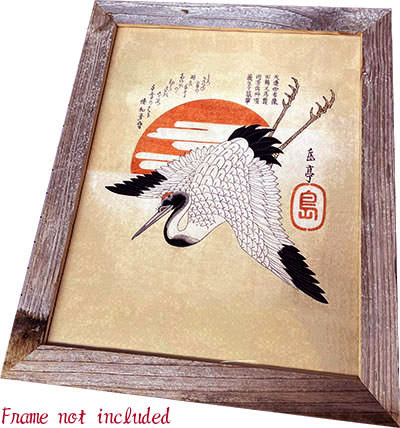
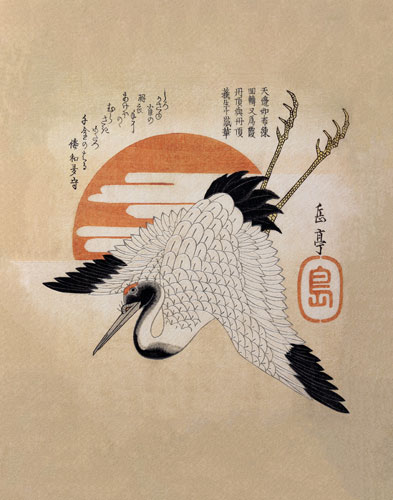
A restored 1835 Japanese masterpiece, beautifully reproduced as a fine art giclée print.
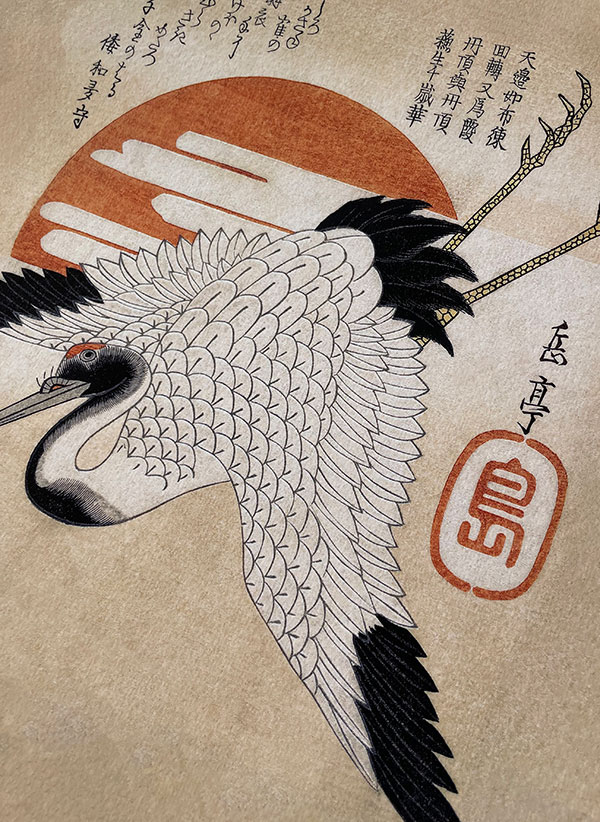
A close-up of this print on museum-quality textured cotton rag paper
A graceful red-crowned crane soars across the glowing disc of the rising sun, yielding a timeless symbol of longevity, beauty, and renewal in Japanese art.
I loved this image when I first saw it on the Metropolitan Museum of Art’s website. This was a woodblock print created by 八島岳亭 (Yashima Gakutei) back in about 1835. All of the prints were created so long ago that they all show a loss of detail, and portions were clipped. I spent many hours working on the restoration of the image. You can now enjoy something much closer to what this would have looked like nearly two centuries ago, for a price you can afford. I also cheated a little, as the original was a little over 8" (20cm) wide. Mine is almost 30% wider, so it makes a better presentation on your wall.
On the right, you will see the artist’s given name, 岳亭, written vertically, in black characters. Below, a red stamp appears to be a circle around a 島 character. But the circle is actually a stylized 八 character (see the breaks at the top and bottom of that oval/circle? Those make it two strokes, hence 八). This is 八島 (Yashima), the artist’s surname portion of his signature for this piece. Upon first glance, some may think it’s just a circle around 島 (Note: 島 means island by itself).
At the top are two poems celebrating the crane, the rising sun, longevity, and the renewal of spring.
The unsigned poem on the right is written in classical Chinese style. It is written in traditional vertical columns, read from top to bottom and proceeding from right to left. Below, I typed it left-to-right to match the orientation of this text:
天邊如布練
回轉又為霞
丹頂與丹頂
蘇生千歲華
This is a kanshi-style Chinese poem, which is Chinese-language poetry composed in the Japanese literary tradition.
It compares the horizon to a band of white silk and evokes the glowing haze or rosy clouds of dawn (霞), while the red crown of the crane visually echoes the red disc of the rising sun. Its final line, 蘇生千歲華, evokes renewed splendor and the crane’s traditional association with a thousand years of life.
A literal translation would be:
At heaven’s edge, like a length of white silk,
Wheeling about, it becomes rosy cloud.
Red crown meets red crown;
Reviving the splendor of a thousand years.
A more poetic English translation:
At the edge of heaven, like a band of white silk,
the crane wheels through the crimson clouds.
Its vermilion crown meets the vermilion sun,
renewing the splendor of a thousand years.
The poem at the upper left is a Japanese kyōka poem signed 倭和夛守 (Yamato Watamori), indicating that it is not by 岳亭 (Gakutei) himself. Here is the text:
しろたへの
鶴の羽衣
あけ方の
むらさきめくる
千金の春
Reading the cursive kuzushiji, the text resolves into the standard 5–7–5–7–7 structure. In modern Japanese orthography, the poem can be transcribed as:
白妙の
鶴の羽衣
明け方の
紫めくる
千金の春
The pronunciation (romaji) is: Shirotae no / tsuru no hagoromo / akegata no / murasaki-mekuru / senkin no haru
The literal translation:
The pure-white
feather robe of the crane,
at break of dawn,
becomes tinged with violet—
spring worth a thousand pieces of gold.
A slightly more poetic translation:
The crane’s robe of pure white feathers,
at the break of dawn
takes on a violet glow—
the priceless beauty
of spring.
The artist is believed to have been born around 1786, the illegitimate son of a samurai named Hirata who served the 徳川幕府 (Tokugawa shogunate). His mother later married into the 八島 (Yashima) family, from which the artist took the surname 八島 (Yashima).
This subject may be described in Japanese as 旭日飛鶴 (Kyokujitsu Hikaku), literally “Rising Sun and Flying Crane.” This is a descriptive title rather than a unique historical title for this particular print, and similar wording is used for other Japanese artworks depicting a crane with the rising sun.
Surviving impressions show varying degrees of fading, wear, loss of detail, and trimming. I spent many hours working on the restoration of the image. You can now enjoy something much closer to what this remarkable print would have looked like nearly two centuries ago, for a price you can afford.