Custom Sincerity Chinese & Japanese Calligraphy Wall Scroll
We have many options to create artwork with Sincerity characters on a wall scroll or portrait.
If you want to create a cool Sincerity wall scroll, this is the place. Below you will find a few Asian symbols that express the idea of Sincerity.
4. Best Love / Most Sincere Love
5. Integrity: Sincere Honest and Faithful
7. Most Sincere Friend / Honest Friend / Real Friend / Best Friend
11. The Five Tenets of Confucius
12. Daodejing / Tao Te Ching - Chapter 81
13. Dedication
14. Determination
15. Devotion / Dedication / Attentive / Focused
17. Religious Devotion / Faith in God / Religious Faith
18. Faith / Trusting in the Unseen
19. Industrious / Hard Working
21. Honesty
23. Integrity
24. Kyojitsu: Falsehood and Truth
25. Loyalty
26. Namu Amida Butsu
28. Enthusiasm / Passion for a Cause
29. Perseverance
33. True Heart
34. True Love
Sincere / True Sincerity
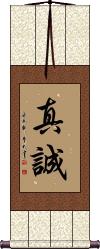
真誠 is the true essence of sincerity.
It takes strength of personality to be truly sincere without overdoing it. Speaking of strength, this is probably the strongest way to convey the idea of sincerity in the Chinese language.
The first character literally means true, real, and genuine. While the second character means sincere and honest.
Sincerity and Devotion
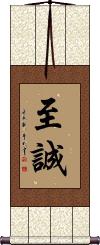
至誠 is the idea that you enter into something with the utmost sincerity and fidelity. Ideas such as devotion, honesty, and “one's true heart” are also contained in this word.
至誠 is a universal word as the Chinese, Japanese Kanji, and Korean Hanja are all identical.
Sincerity and Faithfulness
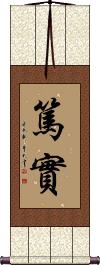
Best Love / Most Sincere Love
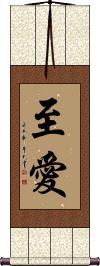
至愛 can mean the best love or most sincere love of your life.
This could be a romantic love such as your love for your spouse or a boyfriend/girlfriend.
It can also apply to the extreme love you have for your children or a parent and maybe a really good friend.
See Also: I Love You
Best Love / Most Sincere Love
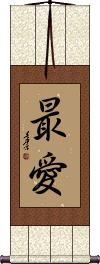
最愛 is a Japanese word that means the best love, beloved, or most sincere love of your life.
This could be a romantic love such as your love for your spouse or a boyfriend/girlfriend.
It can also apply to the extreme love you have for your children or a parent and maybe a really good friend.
See Also: I Love You
Integrity: Sincere Honest and Faithful
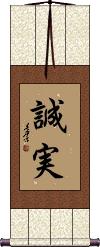
誠実 is the Japanese version of integrity which can also be defined as a combination of “sincere, honest, and faithful.”
Some may also define this as “loyal” or “loyalty.” In some contexts, it can mean “genuine.” Yes, all of this meaning in just one Japanese word!
Perfectly Sincere Mind
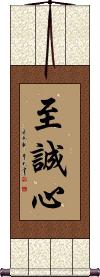
至誠心 is a Buddhist term that means “perfectly sincere mind” or “sincere and devoted heart.”
Most Sincere Friend / Honest Friend / Real Friend / Best Friend
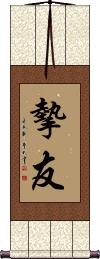
摯友 is one way to say best friend in Chinese.
The first character can mean “honest” or “most sincere.” The second character means “friend” or “friends” (plural forms work differently in Chinese).
See Also: Friendship | Soul Mates
Sincere Heart
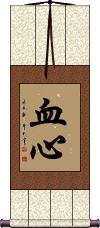
When you take 血心 apart, you find the sum is slightly different than the parts. The first character means blood, and the second means heart. It is important to note that for thousands of years, it was believed that your heart was both your soul and your mind in Asian culture. When you add blood to the heart, it is your whole being - the pure and clean dedication of your whole soul.
Most Chinese dictionaries define this as the sincerity of heart or a MEDICAL TERM!!!
Please think carefully before ordering this selection - it was only added as others have used this for coffee cups and other novelties (though perhaps naively).
Five Reflections / Gosei
ki ryo ku ni ka ku ru na ka ri shi ka? do ryo ku ni u ra mi na ka ri shi ka?
bu sho u ni wa ta ru na ka ri shi ka?
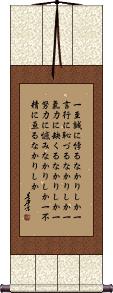
These are the “Five Reflections” of Vice Admiral Hajime Matsushita of the Japanese Imperial Navy.
These days, the Five Reflections are recited or contemplated daily by Japan Maritime Self-Defense Force recruits in training. This long proverb is popularly translated into English this way:
Hast thou not gone against sincerity?
Hast thou not felt ashamed of thy words and deeds?
Hast thou not lacked vigor?
Hast thou not exerted all possible efforts?
Hast thou not become slothful?
Note: Because this selection contains some special Japanese Hiragana characters, it should be written by a Japanese calligrapher.
Believe / Faith / Trust
śraddhā
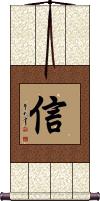
信 can mean to believe, truth, faith, fidelity, sincerity, trust, and confidence in Chinese, old Korean Hanja, and Japanese Kanji.
This single character is often part of other words with similar meanings.
It is one of the five basic tenets of Confucius.
In Chinese, it sometimes has the secondary meaning of a letter (as in the mail) depending on context but it will not be read that way when seen on a wall scroll.
In the Buddhist context, this is śraddhā (faith through hearing or being taught).
See Also: Faith | Trust Your Heart | Confucius
The Five Tenets of Confucius
The Five Cardinal Rules / Virtues of Confucius
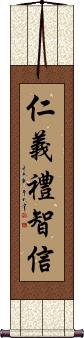
仁義禮智信 are the core of Confucius's philosophy.
Simply stated:
仁 = Benevolence / Charity
義 = Justice / Rectitude
禮 = Courtesy / Politeness / Tact
智 = Wisdom / Knowledge
信 = Fidelity / Trust / Sincerity
Many of these concepts can be found in various religious teachings. It should be clearly understood that Confucianism is not a religion but should instead be considered a moral code for a proper and civilized society.
This title is also labeled “5 Confucian virtues.”
 If you order this from the Japanese calligrapher, expect the middle Kanji to be written in a more simple form (as seen to the right). This can also be romanized as “jin gi rei satoshi shin” in Japanese. Not all Japanese will recognize this as Confucian tenets but they will know all the meanings of the characters.
See Also: Tea | Martial Morality / Martial Arts Ethics / Virtue
Daodejing / Tao Te Ching - Chapter 81
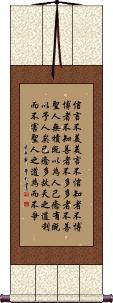
信言不美美言不信知者不博博者不知善者不多多者不善聖人無積既以為人己癒有既以予人矣已癒多故天之道利而不害聖人之道為而不爭 is the Mawangdui version of Daodejing chapter 81.
Credible words are not eloquent;
Eloquent words are not credible.
The wise are not erudite;
The erudite are not wise.
The adept are not all-around;
The all-around are not adept.
The sages do not accumulate things.
Yet the more they have done for others,
The more they have gained themselves;
The more they have given to others,
The more they have gotten themselves.
Thus, the way of tian (heaven) is to benefit without harming;
The way of sages is to do without contending.
Sincere words are not showy;
showy words are not sincere.
Those who know are not “widely learned”;
those “widely learned” do not know.
The good do not have a lot;
Those with a lot are not good.
The Sage accumulates nothing.
Having used what he had for others,
he has even more.
Having given what he had to others,
what he has is even greater.
Therefore, the Way of Heaven is to benefit and not cause any harm,
The Way of Man is to act on behalf of others and not to compete with them.
True words aren't charming,
charming words aren't true.
Good people aren't contentious,
contentious people aren't good.
People who know aren't learned,
learned people don't know.
Wise souls don't hoard;
the more they do for others the more they have,
the more they give the richer they are.
The Way of heaven provides without destroying.
Doing without outdoing
is the Way of the wise.
Dedication
Dedicated to One Thing
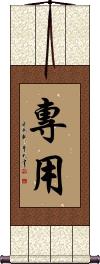
專用 is the dedication you might have to your job or a person.
Trivia: It is the same word used as an adjective in front of the word for “network” to say “dedicated network” in Chinese.
Please note: While this is a word in Korean, the meaning is private or “exclusive use.” So this is best if your audience is Chinese.
See Also: Sincerity and Devotion | Passions / Feelings / Emotions | Tenacious / Tenacity | Commitment
Dedication
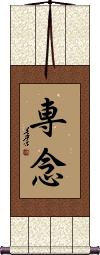
専念 is the Japanese word for dedication.
It means “give undivided attention” or “devote oneself to (something).”
Note: This can be pronounced in Korean, but it's not a commonly used term.
See Also: Sincerity and Devotion | Passions / Feelings / Emotions | Tenacious / Tenacity | Commitment
Determination
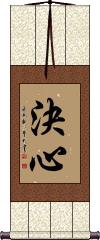
決心 is a Chinese, Japanese, and Korean word that holds the dictionary definition of determination but literally means determined heart.
The first character means to determine or determined.
The second character means heart, mind, or soul, so you can imagine that this form of determination partially means putting your heart into something. It can also be translated as resolve, resolution, or decision (as in a decision made and followed).
See Also: Sincerity and Devotion | Tenacious / Tenacity | Passions / Feelings / Emotions | Dedication | Will-Power / Self
Devotion / Dedication / Attentive / Focused
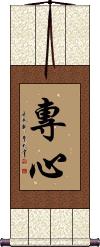
專心 makes a word that means “paying attention with your heart.”
It's often translated as “dedication,” as in “be absorbed in” or “concentrate one's efforts.” It's also used to mean “with the single mind,” “whole-heartedly,” “paying attention,” “undivided attention,” “concentration (-ed),” “engrossed,” “devotionally (listening/watching),” and/or “attentive.”
The first character means “for a particular person, occasion, or purpose,” “focused on one single thing,” “concentrated,” and sometimes, “special.”
The second character means “heart” or “mind” by itself.
My favorite translation, which comes from the Oxford Advanced Chinese/English Dictionary, is, “wholehearted devotion.”
If it seems like the meaning of this word is quite open, you are correct. The context in which the word is used matters a lot. It can mean different things depending on how you use it. This makes it useful as you can decide what this means to you (within some limits). This is always positive in meaning, so even if a Chinese person reads it differently than you, it will still have a good meaning.
 In Japanese, they tend to use a variation of the second character which has one less stroke. If you want your calligraphy written this Japanese form, please click on the Kanji shown to the right instead of the button above. Note: Japanese and Chinese people will recognize either form.
See Also: Faith | Sincerity and Devotion
Devotion / Enthusiasm
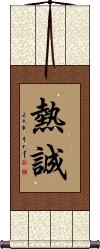
熱誠 is universal in Chinese, Japanese Kanji, and old Korean Hanja.
It can mean earnestness, enthusiasm, ardor, zeal, devotion, spirit, or fervor.
Religious Devotion / Faith in God / Religious Faith
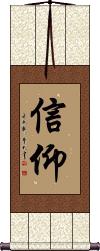
信仰 means firm belief, faith, persuasion, conviction, and sometimes religion or creed in Chinese, Japanese Kanji, and old Korean Hanja.
This clearly fits the religious connotation of the English word “devotion.”
This is often used to refer to a person of faith or a religious person.
This can be directly translated as “firm belief,” “creed,” “conviction,” or simply as “religious,” depending on context.
Some will also use this to mean “trust in God” in Japanese (though the term for God is not actually in this title).
It should be noted that this word is a little strange alone on a wall scroll.
While this can be pronounced in Japanese, it’s not a great selection for a wall scroll if your audience is Japanese.
See Also: Faith | Trust Your Heart | Sincerity and Devotion | Trust in God
Faith / Trusting in the Unseen
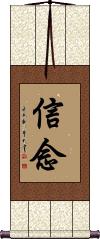
信念 expresses the idea of “having a belief” or “trusting in the unseen.”
信念 could also be translated as beliefs or convictions.
Note: Also considered to be one of the Seven Heavenly Virtues.
See Also: Sincerity and Devotion | Dedication | Trust Your Heart
Industrious / Hard Working
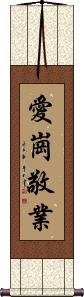
愛崗敬業 is used to refer to someone who puts forth maximum effort and achieves much.
We might call this kind of person a “go-getter” in English.
See Also: Dedication | Tenacious / Tenacity | Sincerity and Devotion
Heaven Rewards Hard Work
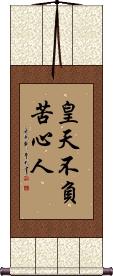
皇天不负苦心人 is an inspirational Chinese proverb that can be translated in a few ways:
Heaven will not disappoint the person who tries.
If you try hard, you're bound to succeed eventually.
Heaven rewards diligent work.
Sincere/heartful effort reaps the grace of Heaven.
Honesty
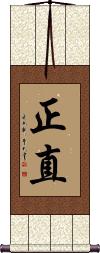
正直 or honesty is being truthful and sincere. It is important because it builds trust. When people are honest, they can be relied on not to lie, cheat or steal. Being honest means that you accept yourself as you are. When you are open and trustworthy, others can believe in you.
正直 is one of the 8 key concepts of Tang Soo Do.
Note: This entry is cross-listed as “integrity” because it also fits that definition.
 Please note that the second Kanji sometimes has an alternate form in Japanese. Let us know if you want the alternate form shown to the right.
See Also: Truth | Trust Your Heart | Integrity
Honesty
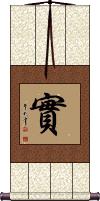
實 means real, true, honest, or solid.
It is one of several ways to express the idea of truth.
Note: In some contexts, this can carry extended meanings of reality, actuality, sincerity, or substance.
See Also: Truth | Trust Your Heart | Justice / Rectitude / Right Decision
Honesty
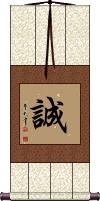
誠 means truth, faith, fidelity, sincerity, trust, and/or confidence.
As a single-character wall scroll, this suggests that you believe “honesty is the best policy,” as your personal philosophy.
This is also a virtue of the Samurai Warrior
See our page with just Code of the Samurai / Bushido here
See Also: Sincerity and Faithfulness | Sincere Heart
Honesty / Fidelity
信 is another character that expresses the idea of honesty.
It can also mean truth, faith, belief in, fidelity, sincerity, trust, and/or confidence.
Some have included this in the list for the Bushido, although “makoto” is probably more common/popular.
Note: In some contexts, this character can mean a letter (mail), news, or envoy. However, alone, it will generally be read with the honesty-meaning.
See our page with just Code of the Samurai / Bushido here
See Also: Two
Integrity
Integrity is living by your highest values. It is being honest and sincere. Integrity helps you to listen to your conscience, do the right thing, and tell the truth. You act with integrity when your words and actions match. Integrity gives you self-respect and a peaceful heart.Please note that the second Kanji sometimes has an alternate form in Japanese. Let us know if you want the alternate form shown to the right.
Note: This entry is cross-listed as “honesty” because it also fits that definition.
Beyond Integrity, this word also means “upright” and “honest” in Chinese. Means “integrity,” “honesty” or “frankness” in Japanese.
See Also: Honor | Honesty | Truth | Trust Your Heart
Kyojitsu: Falsehood and Truth
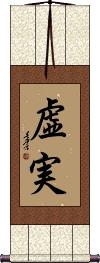
虚実 is a Japanese word that means “falsehood [and] truth” or “fiction [and] fact.”
This concept is used in warfare, gameplay, and martial arts strategies. 虚実 can be a strategy of real and/or deceptive moves. This gets to some Sun Tzu Art of War stuff where in warfare a strategic move is either a real and serious move or it is a deceptive blow.
Let's explore each character in more depth:
虚 was originally written 虛 (there is a very subtle difference in the strokes at the bottom of the character) and means unpreparedness, falsehood, emptiness, void, abstract theory, empty or unoccupied, diffident or timid, false, humble or modest, virtual, or in vain.
In the Buddhist context, 虛 represents the Pali/Sanskrit word “śūnya,” meaning empty, vacant, unreal, unsubstantial, untrue, space, humble, or in vain.
In ancient Eastern/Chinese astronomy, 虛 represents the “Emptiness” constellation (one of the 28 mansions in the sky).
実 was originally 實 in Chinese (they currently write it as 实 in Simplified Chinese) with the meaning, truth, reality, sincerity, honesty, fidelity, and substance.
The Buddhist context is similar, adding real, true, honest, really, solid, definitely, sincere, solid, fixed, full, to fill, fruit, kernel, verily, in fact, the supreme fact, or ultimate reality to the definition.
Loyalty
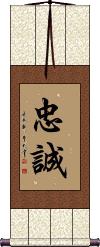
忠誠 is the written form of loyalty that is universal in Chinese, Japanese Kanji, and old Korean Hanja.
Loyalty is staying true to someone. It is standing up for something you believe in without wavering. It is being faithful to your family, country, school, friends, or ideals when the going gets tough and when things are good. With loyalty, you build relationships that last forever.
Notes:
1. There is also a Japanese version that is part of the Bushido Code which may be more desirable depending on whether your intended audience is Japanese or Chinese.
2. This version of loyalty is sometimes translated as devotion, sincerity, fidelity, or allegiance.
See Also: Honor | Trust Your Heart | Integrity | Sincerity and Faithfulness
Namu Amida Butsu
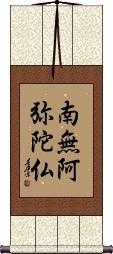
南無阿弥陀仏 is the modern Japanese version of “Namu Amida Butsu” or “The Compassionate Amitabha Buddha.”
Some will translate this as “I sincerely believe in Amitabha; Lord have mercy on me.”
This phrase especially applies to Japanese Pure Land Buddhists.
There is a universal version using ancient characters (with more strokes) for the 4th and last characters. That version is also used in Chinese, Korean, and occasionally Vietnamese.
This is used to pay homage to Amitabha Buddha.
See Also: Bodhisattva | Buddhism | Nirvana
Passion for a Cause
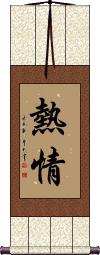
Depending on the context, 熱情 can mean “cordial,” “enthusiastic,” “passionate,” or “passionately.”
This version is sometimes used in Japanese, but the character order is more common in Chinese and Korean Hanja. The meaning in Japanese for this Kanji order is ardor/ardour or zeal but rarely used in modern Japan. I suggest you choose a different version of “passion” if your audience is Japanese.
See Also: Persistence | Sincerity and Devotion | Tenacious / Tenacity | Commitment | Motivation
Enthusiasm / Passion for a Cause
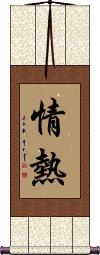
情熱 is the Japanese word that means enthusiasm or “passion for a cause.”
In some contexts, this could mean being extremely fond of something or having a fondness for a cause or person.
Can also be translated as passion, zeal, ardor/ardour, or fervor.
Note: This word (or character order) is not natural in Chinese. However, a typical Chinese person can guess this is a Japanese or Korean word and understand the intended meaning. This selection is best if your audience is Japanese or old-school Korean.
See Also: Persistence | Sincerity and Devotion | Tenacious / Tenacity | Commitment | Motivation
Perseverance
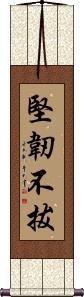
堅韌不拔 is about perseverance, being steadfast and persistent.
堅韌不拔 is a great phrase for you if you commit to your goals and overcome obstacles, no matter how long it takes.
The translation of this proverb literally means “something so persistent or steadfast, that it is not uprootable, movable, or surpassable.”
Other translations include being firm and indomitable or tenacious and unyielding.
See Also: Tenacious / Tenacity | Sincerity and Devotion | Persistence | Perseverance / Indomitable / Invincible Fortitude
Shiken Haramitsu Daikomyo
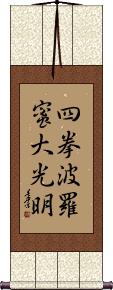
四拳波羅蜜大光明 is “shiken haramitsu daikōmyō,” a famous Japanese Buddhist mantra.
四拳 = shi-ken = four fists (many translate this as “four hearts”).
波羅蜜 = ha-ra-mitsu = A loanword representing pāramitā, or entrance into Nirvana. Awkwardly, it also means jackfruit.
大光明 = dai-kou-myo = big/great light bright (great bright light).
Shiken represents four hearts:
1. The Merciful Heart - Love and caring for all living things.
2. The Sincere Heart - Pursues righteousness, or the right path - sincerely trying to do what is right.
3. The Attuned Heart - Knows that nature and fate have their ways, and thus stay in tune with the universe.
4. The Dedicated Heart - Steadfast on the chosen path to the end.
Shitsujitsu Goken
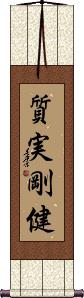
質実剛健 is a Japanese word that can mean “unaffected and sincere, with fortitude and vigor” or “simplicity and fortitude.”
The first two characters, 質実 mean simplicity or the “essence of something.”
The last two, 剛健, mean strength, fortitude, or strong composure.
Tenacious / Tenacity
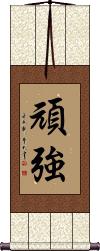
頑強 means “Tenacious,” “Hard to Defeat,” or “Dogged.”
Alone, the first character means mischievous, obstinate, or stubborn. But it loses some of the mischievous meaning when the second character is added.
The second character means strength, force, power, or better.
See Also: Determination | Dedication | Sincerity and Devotion | Never Give Up
True Heart
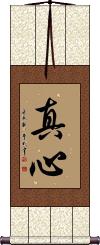
While 真心 literally reads as “true heart” or “genuine heart,” the understood meaning is sincerity, devotion, sincere, or heartfelt. Some will extend the meaning to be like “true love.” It's the idea of doing something or treating someone with genuine feelings.
真心 is valid and has the same meaning in both Chinese characters and Japanese Kanji.
Note: While not too common, this can be the female given name “Mami” in Japanese.
True Love
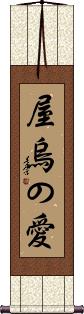
屋烏の愛 is a Japanese way to express true love or deep love.
The phrase literally suggests that this is a love for someone so strong that it can reach a crow perched on that person's roof.
The following table may be helpful for those studying Chinese or Japanese:
| Title | Characters | Romaji (Romanized Japanese) | Various forms of Romanized Chinese | |
| Sincere True Sincerity | 真誠 真诚 | zhēn chéng zhen1 cheng2 zhen cheng zhencheng | chen ch`eng chencheng chen cheng |
|
| Sincerity and Devotion | 至誠 至诚 | shisei | zhì chéng zhi4 cheng2 zhi cheng zhicheng | chih ch`eng chihcheng chih cheng |
| Sincerity and Faithfulness | 篤實 笃实 | dǔ shí / du3 shi2 / du shi / dushi | tu shih / tushih | |
| Best Love Most Sincere Love | 至愛 至爱 | zhì ài / zhi4 ai4 / zhi ai / zhiai | chih ai / chihai | |
| Best Love Most Sincere Love | 最愛 | moai | ||
| Integrity: Sincere Honest and Faithful | 誠實 誠実 | sei jitsu / seijitsu | ||
| Perfectly Sincere Mind | 至誠心 至诚心 | shi jou shin shijoushin shi jo shin | zhì chéng xīn zhi4 cheng2 xin1 zhi cheng xin zhichengxin | chih ch`eng hsin chihchenghsin chih cheng hsin |
| Most Sincere Friend Honest Friend Real Friend Best Friend | 摯友 挚友 | zhì yǒu / zhi4 you3 / zhi you / zhiyou | chih yu / chihyu | |
| Sincere Heart | 血心 | xuě xīn / xue3 xin1 / xue xin / xuexin | hsüeh hsin / hsüehhsin | |
| Five Reflections Gosei | 一至誠に悖るなかりしか一言行に恥づるなかりしか一氣力に缺くるなかりしか一努力に憾みなかりしか一不精に亘るなかりしか | shi se i ni moto ru na ka ri shi ka? gen kou ni ha zu ru na ka ri shi ka? ki ryo ku ni ka ku ru na ka ri shi ka? do ryo ku ni u ra mi na ka ri shi ka? bu sho u ni wa ta ru na ka ri shi ka? shi se i ni moto ru na ka ri shi ka? gen ko ni ha zu ru na ka ri shi ka? ki ryo ku ni ka ku ru na ka ri shi ka? do ryo ku ni u ra mi na ka ri shi ka? bu sho u ni wa ta ru na ka ri shi ka? | ||
| Believe Faith Trust | 信 | shin | xìn / xin4 / xin | hsin |
| The Five Tenets of Confucius | 仁義禮智信 仁义礼智信 | jin gi rei tomo nobu jingireitomonobu | rén yì lǐ zhì xìn ren2 yi4 li3 zhi4 xin4 ren yi li zhi xin renyilizhixin | jen i li chih hsin jenilichihhsin |
| Daodejing Tao Te Ching - Chapter 81 | 信言不美美言不信知者不博博者不知善者不多多者不善聖人無積既以為人己癒有既以予人矣已癒多故天之道利而不害聖人之道為而不爭 信言不美美言不信知者不博博者不知善者不多多者不善圣人无积既以为人己愈有既以予人矣已愈多故天之道利而不害圣人之道为而不争 | |||
| Dedication | 專用 专用 | zhuān yòng zhuan1 yong4 zhuan yong zhuanyong | chuan yung chuanyung |
|
| Dedication | 専唸 専念 | sennen | ||
| Determination | 決心 决心 | kesshin / keshin | jué xīn / jue2 xin1 / jue xin / juexin | chüeh hsin / chüehhsin |
| Devotion Dedication Attentive Focused | 專心 / 専心 / 耑心 专心 | sen shin / senshin | zhuān xīn zhuan1 xin1 zhuan xin zhuanxin | chuan hsin chuanhsin |
| Devotion Enthusiasm | 熱誠 热诚 | nessei / nesei | rè chéng / re4 cheng2 / re cheng / recheng | je ch`eng / jecheng / je cheng |
| Religious Devotion Faith in God Religious Faith | 信仰 | shin kou / shinkou / shin ko | xìn yǎng / xin4 yang3 / xin yang / xinyang | hsin yang / hsinyang |
| Faith Trusting in the Unseen | 信念 | shinnen | xìn niàn / xin4 nian4 / xin nian / xinnian | hsin nien / hsinnien |
| Industrious Hard Working | 愛崗敬業 爱岗敬业 | ài gǎng jìng yè ai4 gang3 jing4 ye4 ai gang jing ye aigangjingye | ai kang ching yeh aikangchingyeh |
|
| Heaven Rewards Hard Work | 皇天不負苦心人 皇天不负苦心人 | huáng tiān bù fù kǔ xīn rén huang2 tian1 bu4 fu4 ku3 xin1 ren2 huang tian bu fu ku xin ren huangtianbufukuxinren | huang t`ien pu fu k`u hsin jen huangtienpufukuhsinjen huang tien pu fu ku hsin jen |
|
| Honesty | 正直 | shoujiki / shojiki | zhèng zhí zheng4 zhi2 zheng zhi zhengzhi | cheng chih chengchih |
| Honesty | 實 实 | shí / shi2 / shi | shih | |
| Honesty | 誠 诚 | makoto | chéng / cheng2 / cheng | ch`eng / cheng |
| Honesty Fidelity | 信 | shin | xìn / xin4 / xin | hsin |
| Integrity | 正直 | shoujiki / shojiki | zhèng zhí zheng4 zhi2 zheng zhi zhengzhi | cheng chih chengchih |
| Kyojitsu: Falsehood and Truth | 虚実 | kyo jitsu / kyojitsu | ||
| Loyalty | 忠誠 忠诚 | chuu sei / chuusei / chu sei | zhōng chéng zhong1 cheng2 zhong cheng zhongcheng | chung ch`eng chungcheng chung cheng |
| Namu Amida Butsu | 南無阿弥陀仏 | namu amida butsu namuamidabutsu | ||
| Passion for a Cause | 熱情 热情 | netsujou / netsujo | rè qíng / re4 qing2 / re qing / reqing | je ch`ing / jeching / je ching |
| Enthusiasm Passion for a Cause | 情熱 情热 | jou netsu / jounetsu / jo netsu | qíng rè / qing2 re4 / qing re / qingre | ch`ing je / chingje / ching je |
| Perseverance | 堅韌不拔 坚韧不拔 | jiān rèn bù bá jian1 ren4 bu4 ba2 jian ren bu ba jianrenbuba | chien jen pu pa chienjenpupa |
|
| Shiken Haramitsu Daikomyo | 四拳波羅蜜大光明 | shi ken ha ra mitsu dai kou myou shi ken ha ra mitsu dai ko myo | ||
| Shitsujitsu Goken | 質実剛健 | shitsu jitsu gou ken shitsujitsugouken shitsu jitsu go ken | ||
| Tenacious Tenacity | 頑強 顽强 | gan kyou / gankyou / gan kyo | wán qiáng wan2 qiang2 wan qiang wanqiang | wan ch`iang wanchiang wan chiang |
| True Heart | 真心 | mago koro / magokoro | zhēn xīn / zhen1 xin1 / zhen xin / zhenxin | chen hsin / chenhsin |
| True Love | 屋烏の愛 | okuunoai / okunoai | ||
| In some entries above you will see that characters have different versions above and below a line. In these cases, the characters above the line are Traditional Chinese, while the ones below are Simplified Chinese. | ||||



