Many custom options


And formats



Baby in Chinese / Japanese
Buy a Baby calligraphy wall scroll here!
Personalize your custom “Baby” project by clicking the button next to your favorite “Baby” title below.
Baby
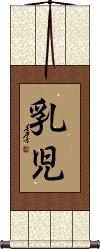
乳児 is a common two-Kanji way to write “baby” in Japanese.
This can also be translated as “infant” or “suckling baby.”
Baby
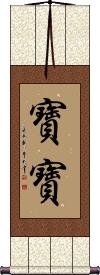
寶寶 is how Chinese people express “baby.”
The word is composed of the same character twice, and therefore literally means “double precious” or “double treasure.”
This would be a nice wall scroll to put either inside or by the door of your baby's room (not on the door, as wall scrolls swing around wildly when hung on doors that open and close a lot).
Baby
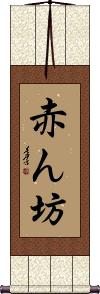
赤ん坊 is one way that Japanese people express “baby.”
Daisy
The yellow flower
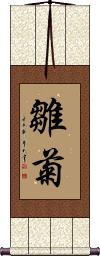
雛菊 is how they write “daisy” in Chinese and Japanese.
This is a good choice if you love daisies, or your name is Daisy. If you translated it directly, this means “chick flower” (as in baby chickens) or “baby chrysanthemum.” Of course, when an Asian person reads this, they just think “daisy.”
If you're into botany, this title represents “Bellis Perennis.”
In Japanese, this can be the female given name, Hinagiku.
No man knows what he owes to his parents until he comes to have children of his own
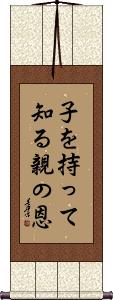
子を持って知る親の恩 literally translates as: Only after you have a baby, you would appreciate your parents (feel the way they do, etc).
This is a bit like the “walk a mile in another man's shoes” saying. it's about you cannot fully understand the plight of others until you experience it yourself. It also shows appreciation for the plight of parents.
This Japanese proverb can also be translated a few more ways:
No man knows what he owes to his parents till he comes to have children of his own.
One knows not what one owes to one's parents till one comes to have children of one's own.
Only after you have a baby, you will appreciate your parents or feel the way they do.
Only after becoming a parent yourself do you realize how much you owe [how indebted you are] to your own parents.
Note: Because this selection contains some special Japanese Hiragana characters, it should be written by a Japanese calligrapher.
Kaili
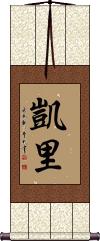
This is a common transliteration to Mandarin Chinese for the name Kaili.
It's also the name of Kaili city in Guizhou province.
I named my first daughter Kaili after visiting Kaili city and finding very friendly people there. I think this is a great English-Chinese baby name, as it is pronounceable in both languages, and the name works as a given name in both languages as well.
Realize Your Ambitions / Embrace Your Ambition
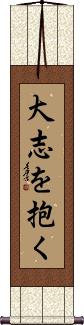
大志を抱く is a Japanese proverb that suggests you should embrace, pursue, and realize your ambitions.
The first part means ambitions or aspirations.
The last part means to embrace or to hold in your arms.
Here's the character breakdown:
大志 (taishi) ambition; aspiration.
を (o) particle
抱く (idaku) to embrace; to hold in the arms (e.g. a baby); to hug; to harbor/harbour; to bear (e.g., a grudge); to entertain (e.g., suspicion); to sleep with; to sit on eggs.
Note: Because this selection contains some special Japanese Hiragana characters, it should be written by a Japanese calligrapher.
This in-stock artwork might be what you are looking for, and ships right away...


Not the results for Baby that you were looking for?
Below are some entries from our dictionary that may match your Baby search:
| Characters If shown, 2nd row is Simp. Chinese |
Pronunciation Romanization |
Simple Dictionary Definition |
乳児 see styles |
nyuuji / nyuji にゅうじ |
More info & calligraphy: Baby |
寶寶 宝宝 see styles |
bǎo bao bao3 bao5 pao pao |
More info & calligraphy: Baby |
メリー see styles |
merii / meri メリー |
More info & calligraphy: Merri |
赤ん坊 see styles |
akanbou(p); akanbo / akanbo(p); akanbo あかんぼう(P); あかんぼ |
More info & calligraphy: Baby |
兒 儿 see styles |
r r5 r ji じ |
non-syllabic diminutive suffix; retroflex final (personal name) Ji baby |
喂 see styles |
wèi wei4 wei |
hey; to feed (an animal, baby, invalid etc) |
娃 see styles |
wá wa2 wa |
baby; doll |
嬔 see styles |
fù fu4 fu |
(archaic) baby rabbit |
嬰 婴 see styles |
yīng ying1 ying enda えんだ |
infant; baby (prefix noun) {music} (See 変・5,嬰ヘ長調) sharp; (personal name) Enda Infant, baby. |
桴 see styles |
fú fu2 fu bachi ばち ikada いかだ |
beam; rafter (1) plectrum; pick; (2) drumstick for Japanese drums (e.g. taiko); (1) (kana only) raft; (2) forearm protector; (3) skewered baby-eel kabayaki |
秧 see styles |
yāng yang1 yang nae なえ |
sapling; seedling; sprout; (esp.) rice seedling; stem; stalk; vine; baby livestock; fry; (dialect) to raise; to cultivate (plants or animals) (out-dated kanji) rice seedlings; (female given name) Nae |
稚 see styles |
zhì zhi4 chih waka わか |
infantile; young (1) youth; (2) child (esp. of the young son of someone of high social standing); (n-pref,n-suf) (3) young; new; baby; child; (female given name) Waka |
筏 see styles |
fá fa2 fa ikada いかだ |
raft (of logs) (1) (kana only) raft; (2) forearm protector; (3) skewered baby-eel kabayaki; (surname) Ikada A raft. |
缶 see styles |
fǒu fou3 fou hotogi ほとぎ |
pottery (1) fat-bodied, small-mouthed earthenware jar for carrying water; (2) water vessel used for a baby's first bath; (surname) Hotogi |
襁 see styles |
qiǎng qiang3 ch`iang chiang mutsuki むつき |
cloth for carrying baby on back (female given name) Mutsuki |
乳歯 see styles |
nyuushi / nyushi にゅうし |
baby tooth; milk tooth; first set of teeth |
乳燕 see styles |
rǔ yàn ru3 yan4 ju yen |
baby swallow |
乳牙 see styles |
rǔ yá ru3 ya2 ju ya |
(dentistry) deciduous tooth; baby tooth; milk tooth |
乳齒 乳齿 see styles |
rǔ chǐ ru3 chi3 ju ch`ih ju chih |
deciduous tooth; milk tooth; baby tooth |
二寶 二宝 see styles |
èr bǎo er4 bao3 erh pao nihō |
second child; second baby two jewels |
仔雞 仔鸡 see styles |
zǐ jī zi3 ji1 tzu chi |
chick; baby chicken |
催生 see styles |
cuī shēng cui1 sheng1 ts`ui sheng tsui sheng |
to pressure a younger relative to hurry up and have a baby; (obstetrics) to induce labor; to expedite childbirth; (fig.) to be a driving force in bringing something into existence |
分娩 see styles |
fēn miǎn fen1 mian3 fen mien bunben ぶんべん |
to give birth to a baby; (of animals) to give birth to young (n,vs,adj-no) delivery; confinement; childbirth |
初湯 see styles |
hatsuyu はつゆ |
(1) first bath of the year; (2) first bath in one's life (i.e. for a baby) |
北鼻 see styles |
běi bí bei3 bi2 pei pi |
baby (loanword) |
卸貨 卸货 see styles |
xiè huò xie4 huo4 hsieh huo |
to unload cargo; (fig.) to give birth to a baby |
吐乳 see styles |
tonyuu / tonyu とにゅう |
(n,vs,vt,vi) (baby) vomiting up milk |
呱々 see styles |
koko ここ |
cry of a baby at its birth |
呱呱 see styles |
guā guā gua1 gua1 kua kua koko ここ |
(onom.) sound made by frogs, ducks etc cry of a baby at its birth |
喃語 see styles |
nango なんご |
(noun/participle) (1) lover's whispers; sweet nothings; whispered intimacies; (2) babbling (of a baby); babble |
Click here for more Baby results from our dictionary
The following table may be helpful for those studying Chinese or Japanese:
| Title | Characters | Romaji (Romanized Japanese) | Various forms of Romanized Chinese | |
| Baby | 乳児 | nyuu ji / nyuuji / nyu ji | ||
| Baby | 寶寶 宝宝 | bǎo bao / bao3 bao / bao bao / baobao | pao pao / paopao | |
| Baby | 赤ん坊 | akan bou / akanbou / akan bo | ||
| Daisy | 雛菊 雏菊 | hinagiku | chú jú / chu2 ju2 / chu ju / chuju | ch`u chü / chuchü / chu chü |
| No man knows what he owes to his parents until he comes to have children of his own | 子を持って知る親の恩 | ko wo motte shiru oya no on kowomotteshiruoyanoon | ||
| Kaili | 凱里 凯里 | kǎi lǐ / kai3 li3 / kai li / kaili | k`ai li / kaili / kai li | |
| Realize Your Ambitions Embrace Your Ambition | 大志を抱く | taishi wo Idaku taishiwoIdaku | ||
| In some entries above you will see that characters have different versions above and below a line. In these cases, the characters above the line are Traditional Chinese, while the ones below are Simplified Chinese. | ||||

Successful Chinese Character and Japanese Kanji calligraphy searches within the last few hours...



