Many custom options...


And formats...



Free Will in Chinese / Japanese...
Buy a Free Will calligraphy wall scroll here!
Personalize your custom “Free Will” project by clicking the button next to your favorite “Free Will” title below...
Free Will
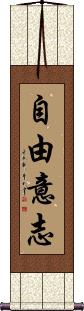
自由意志 is a concept that has existed for thousands of years that humans can understand right and wrong, then make a decision one way or the other (thus affecting their fate).
Sources such as Confucius, Buddhist scriptures, the Qur'an, and the Bible all address this idea.
As for the characters shown here, the first two mean free, freedom, or liberty. The last two mean “will.”
Can be romanized from Japanese as jiyū-ishi, jiyuu-ishi, and sometimes jiyuu-ishii.
It's 자유의지 or jayuu-yiji in Korean and zìyóu yìzhì in Chinese.
See Also: Freedom | Strong Willed | Fate
Live Free or Die
Give me liberty or give me death
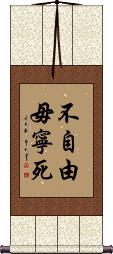
不自由毋寧死 means “Give me liberty or give me death” in Chinese.
This is also the best way to say, “Live free or die.”
The characters break down this way:
不 = Not; none; without.
自由 = Freedom; liberty; freewill; self-determination.
毋寧 = Rather; would rather; rather be.
死 = Dead; death.
This will go nicely next to your “Don't tread on me” flag. This phrase is known well enough in China that it's listed in a few dictionaries. Though I doubt you will find too many Chinese citizens willing to yell this on the steps of the capital in Beijing.
See Also: Death Before Dishonor
Freedom / Liberty
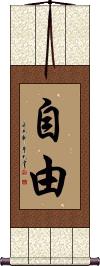
自由 is a common word to express the idea of freedom in both Chinese and Japanese.
This word is the essence of “being free” but also acts as the suffix to create words like freestyle swimming, free trade, civil liberties, free will, freedom fighter, religious freedom, and liberal.
Smooth Sailing
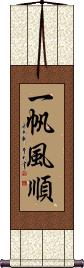
一帆風順 is just what you think it means. It suggests that you are on a trouble-free voyage through life, or literally on a sailing ship or sailboat. It is often used in China as a wish for good luck on a voyage or as you set out on a new quest or career in your life. Some may use this in place of “bon voyage.”
The literal meaning is “Once you raise your sail, you will get the wind you need, and it will take you where you want to go.” Another way to translate it is “Your sail and the wind follow your will.”
This is a great gift for a mariner, sailor, adventurer, or someone starting a new career.
Note: Can be understood in Korean Hanja but is rarely used.
See Also: Bon Voyage | Adventure | Travel
2. Right Resolve / Right Thought / Right Intention / Perfect Resolve
Samyak Samkalpa / Samma Sankappa
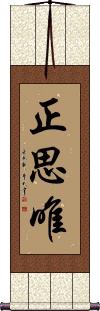
正思唯 is one of the Noble Eightfold Paths of Buddhism. Right Thought, along with the Right View, constitute the path to Wisdom.
In Buddhism, Right Thought, in simple terms, means to free yourself from having ill will towards anyone or anything. It also suggests that you remain harmless to other living creatures.
This can also be defined as “Resolve in favor of renunciation, goodwill, and non-harming of sentient beings.”
 There is an ancient/alternate version of the third character for this selection. You can see that alternation third character to the right. If you want your selection to use that older character, just click on the character to the right, instead of the button above.
Note: This term is exclusively used by devout Buddhists. It is not a common term, and is remains an unknown concept to most Japanese and Chinese people.
See Also: Buddhism | Enlightenment | Noble Eightfold Path
Tolerance
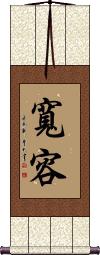
Being tolerant is accepting differences. You don't expect others to think, look, speak or act just like you. You are free of prejudice, knowing that all people have feelings, needs, hopes, and dreams. Tolerance is also accepting things you wish were different with patience and flexibility.
寬容 can also be translated as magnanimity, generosity, or leniency.
Note: There is a tiny deviation in the first character when written in Japanese. If you choose our Japanese master calligrapher, the little dot on the lower right of the first character will be omitted. With or without the dot, this can be read in Chinese, Japanese, and old Korean.
See Also: Patience
Safety and Well-Being of the Family
Kanai Anzen
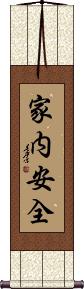
家內安全 is the Japanese way of saying “Family First.”
It's a Japanese proverb about the safety and well-being of your family and/or peace and prosperity in the household.
Some Japanese will hang an amulet in their home with these Kanji. The purpose is to keep your family safe from harm.
According to Shinto followers, hanging this in your home is seen as an invocation to God to always keep family members free from harm.
We were looking for a way to say “family first” in Japanese when this proverb came up in the conversation and research. While it doesn't say “family first,” it shows that the safety and well-being of your family is your first or most important priority. So, this proverb is the most natural way to express the idea that you put your family first.
See Also: Peace and Prosperity
This in-stock artwork might be what you are looking for, and ships right away...

Gallery Price: $61.00
Your Price: $33.88

Gallery Price: $61.00
Your Price: $33.88

Gallery Price: $61.00
Your Price: $33.88

Gallery Price: $61.00
Your Price: $33.88

Gallery Price: $36.00
Starting at: $20.00

Gallery Price: $322.00
Your Price: $178.88
Gallery Price: $108.00
Your Price: $59.88

Gallery Price: $65.00
Your Price: $36.00
Gallery Price: $108.00
Your Price: $59.88
Gallery Price: $108.00
Your Price: $59.88
Gallery Price: $90.00
Your Price: $49.88
Not the results for free will that you were looking for?
Below are some entries from our dictionary that may match your free will search...
| Characters If shown, 2nd row is Simp. Chinese |
Pronunciation Romanization |
Simple Dictionary Definition |
三昧 see styles |
sān mèi san1 mei4 san mei sanmai さんまい |
More info & calligraphy: Samadhi(1) (さんまい only) {Buddh} samadhi (state of intense concentration achieved through meditation) (san:); (suffix noun) (2) (usu. ざんまい) being immersed in; being absorbed in; indulging in; doing to one's heart's content; (suffix noun) (3) (usu. ざんまい) prone to; apt to; (given name) Sanmai (三昧地) Samādhi, "putting together, composing the mind, intent contemplation, perfect absorption, union of the meditator with the object of meditation." (M. W.) Also 三摩地 (三摩提, 三摩帝, 三摩底). Interpreted by 定 or 正定, the mind fixed and undisturbed; by 正受 correct sensation of the object contemplated; by 調直定 ordering and fixing the mind; by 正心行處 the condition when the motions of the mind are steadied and harmonized with the object; by 息慮凝心 the cessation of distraction and the fixation of the mind; by 等持 the mind held in equilibrium; by 奢摩他, i.e. 止息 to stay the breathing. It is described as concentration of the mind (upon an object). The aim is 解脫, mukti, deliverance from all the trammels of life, the bondage of the passions and reincarnations. It may pass from abstraction to ecstasy, or rapture, or trance. Dhyāna 定 represents a simpler form of contemplation; samāpatti 三摩鉢底 a stage further advanced; and samādhi the highest stage of the Buddhist equivalent for Yoga, though Yoga is considered by some as a Buddhist development differing from samādhi. The 翻譯名義 says: 思專 when the mind has been concentrated, then 志一不分 the will is undivided; when 想寂 active thought has been put to rest, then 氣虛神朗 the material becomes etherealized and the spirit liberated, on which 智 knowledge, or the power to know, has free course, and there is no mystery into which it cannot probe. Cf. 智度論 5, 20, 23, 28; 止觀 2; 大乘義章 2, 9, 1 3, 20, etc. There are numerous kinds and degrees of samādhi. |
無心 无心 see styles |
wú xīn wu2 xin1 wu hsin mushin むしん |
More info & calligraphy: No Mind / Mushin(n,adj-no,adj-na) (1) innocence; (noun - becomes adjective with の) (2) {Buddh} (See 有心・2) mind free of obstructive thoughts; detachment; no-mind; (adj-no,n) (3) insentient; (noun, transitive verb) (4) pestering (someone for money, etc.); asking; begging; request Mindless, without thought, will, or purpose; the real immaterial mind free from illusion; unconsciousness, or effortless action. |
自由意志 see styles |
zì yóu yì zhì zi4 you2 yi4 zhi4 tzu yu i chih jiyuuishi / jiyuishi じゆういし |
More info & calligraphy: Free Willfree will |
自在 see styles |
zì zai zi4 zai5 tzu tsai shizai しざい |
comfortable; at ease (n,adj-na,adj-no) (1) being able to do as one pleases; doing at will; (2) (abbreviation) (See 自在鉤) pothook; (surname) Shizai Īśvara , 伊濕伐邏; can, king, master, sovereign, independent, royal; intp. as free from resistance; also, the mind free from delusion; in the Avataṃsaka Sūtra it translates vasitā. There are several groups of this independence, or sovereignty— 2, 4, 5, 8, and 10, e. g. the 2 are that a bodhisattva has sovereign knowledge and sovereign power; the others are categories of a bodhisattva's sovereign powers. For the eight powers v. 八大自在我. |
進む see styles |
susumu すすむ |
(v5m,vi) (1) to advance; to go forward; (v5m,vi) (2) to precede; to go ahead (of); (v5m,vi) (3) to make progress; to improve; (v5m,vi) (4) to deepen; to heighten; (v5m,vi) (5) to be fast (of a clock); to be ahead; (v5m,vi) (6) (See 進んで) to do of one's own free will |
好んで see styles |
kononde このんで |
(adverb) (See 好む) by (from) choice; by (for) preference; of one's own accord; of one's (own) free will; on purpose; deliberately; intentionally |
進んで see styles |
susunde すすんで |
(adverb) voluntarily; willingly; of one's own free will |
円満退職 see styles |
enmantaishoku えんまんたいしょく |
(noun/participle) amicable resignation (retirement); resigning (retiring) from one's job of one's free will |
已離欲者 已离欲者 see styles |
yǐ lí yù zhě yi3 li2 yu4 zhe3 i li yü che i riyoku sha |
Those who have abandoned the desire-realm; divided into two classes, 異生 ordinary people who have left desire, but will be born into the six gati; 聖者 the saints, who will not be reborn into the desire-realm; e. g. non-Buddhists and Buddhists. |
自分勝手 see styles |
jibungatte じぶんがって jibunkatte じぶんかって |
(noun or adjectival noun) (yoji) selfishness; egotism; egoism; (being) self-centered; without consulting; (doing) as one pleases; one's own free will |
逍遙自在 逍遥自在 see styles |
xiāo yáo zì zai xiao1 yao2 zi4 zai5 hsiao yao tzu tsai shōyō jizai |
free and at leisure (idiom); unfettered; outside the reach of the law (of criminal); at large To go anywhere at will, to roam where one will. |
意志の自由 see styles |
ishinojiyuu / ishinojiyu いしのじゆう |
(exp,n) (See 自由意志) freedom of will; free will |
自ら進んで see styles |
mizukarasusunde みずからすすんで |
(exp,adv) by choice; of one's own free will; on one's own initiative; off one's own bat |
自分かって see styles |
jibunkatte じぶんかって |
(noun or adjectival noun) (yoji) selfishness; egotism; egoism; (being) self-centered; without consulting; (doing) as one pleases; one's own free will |
自由意志論 see styles |
jiyuuishiron / jiyuishiron じゆういしろん |
{phil} doctrine of free will; libertarianism |
Variations: |
jibunkatte; jibungatte(自分勝手) じぶんかって; じぶんがって(自分勝手) |
(noun or adjectival noun) (yoji) selfishness; egotism; egoism; (being) self-centered; without consulting; (doing) as one pleases; one's own free will |
Variations: |
jibunkatte; jibungatte じぶんかって; じぶんがって |
(noun or adjectival noun) (yoji) selfishness; egotism; egoism; (being) self-centered; without consulting; (doing) as one pleases; one's own free will |
The following table may be helpful for those studying Chinese or Japanese...
| Title | Characters | Romaji (Romanized Japanese) | Various forms of Romanized Chinese | |
| Free Will | 自由意志 | jiyuu ishi / jiyuuishi / jiyu ishi | zì yóu yì zhì zi4 you2 yi4 zhi4 zi you yi zhi ziyouyizhi | tzu yu i chih tzuyuichih |
| Live Free or Die | 不自由毋寧死 不自由毋宁死 | bú zì yóu wú nìng sǐ bu2 zi4 you2 wu2 ning4 si3 bu zi you wu ning si buziyouwuningsi | pu tzu yu wu ning ssu putzuyuwuningssu |
|
| Freedom Liberty | 自由 | jiyuu / jiyu | zì yóu / zi4 you2 / zi you / ziyou | tzu yu / tzuyu |
| Smooth Sailing | 一帆風順 一帆风顺 | yī fán fēng shùn yi1 fan2 feng1 shun4 yi fan feng shun yifanfengshun | i fan feng shun ifanfengshun |
|
| 2. Right Resolve Right Thought Right Intention Perfect Resolve | 正思唯 | sei shi yui seishiyui | zhèng sī wéi zheng4 si1 wei2 zheng si wei zhengsiwei | cheng ssu wei chengssuwei |
| Tolerance | 寬容 宽容 | kanyou / kanyo | kuān róng kuan1 rong2 kuan rong kuanrong | k`uan jung kuanjung kuan jung |
| Safety and Well-Being of the Family | 家內安全 家内安全 | ka nai an zen kanaianzen | ||
| In some entries above you will see that characters have different versions above and below a line. In these cases, the characters above the line are Traditional Chinese, while the ones below are Simplified Chinese. | ||||

Successful Chinese Character and Japanese Kanji calligraphy searches within the last few hours...



