Many custom options...


And formats...



Mix in Chinese / Japanese...
Buy a Mix calligraphy wall scroll here!
Personalize your custom “Mix” project by clicking the button next to your favorite “Mix” title below...

米克斯 is the name Mix in Chinese (Mandarin).

ミックス is the name Mix in Japanese Katakana.
Note: Because this title is entirely Japanese Katakana, it should be written by a Japanese calligrapher.
Four Elements
Buddhist Term
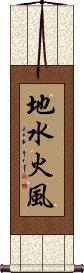
地水火風 is a Buddhist term that means “earth, water, fire, wind.”
This is often just referred to as “the four elements.” There is a more common title (the five elements) that adds wood to the mix. These four elements are used in some sects of Japanese Buddhism (not so much in Chinese).
Harmony / Balance
Cho Wa
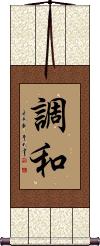
調和 is one of the several ways to express harmony in Chinese and Japanese.
Note: The first character means harmony but also suggests a musical meaning. It can also describe warriors marching in perfect cadence (in step) or to regulate something.
The second character carries the meaning of harmony and peace by itself.
Together, these characters create a word that can be defined as harmonious, to mediate, to reconcile, to compromise; mediation, temper, to mix, blend, blended, season, seasoning (getting the flavors of the food in balance), to placate, or be in harmonious proportion.
The meaning varies depending on the context. However, when hanging as a wall scroll, this will refer to the person (you) being balanced and in harmony while rational and under control simultaneously.
Daodejing / Tao Te Ching - Excerpt
Excerpt from Chapter 67
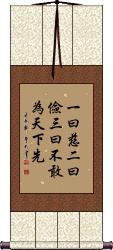
一曰慈二曰儉三曰不敢為天下先 is an excerpt from the 67th Chapter of Lao Tzu's (Lao Zi's) Te-Tao Ching (Dao De Jing).
This is the part where the three treasures are discussed. In English, we'd say these three treasures are compassion, frugality, and humility. Some may translate these as love, moderation, and lack of arrogance. I have also seen them translated as benevolence, modesty, and “Not presuming to be at the forefront in the world.” You can mix them up the way you want, as translation is not really a science but rather an art.
I should also explain that the first two treasures are single-character ideas, yet the third treasure was written out in six characters (there are also some auxiliary characters to number the treasures).
If Lao Tzu's words are important to you, then a wall scroll with this passage might make a great addition to your home.
Qi Gong / Chi Kung
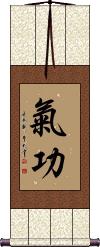
氣功 or Qigong is the title of a technique that is somewhere between medical practice, meditation, and in some cases, religion.
The definition is blurred depending on which school of Qigong you are following. In some cases, it is even incorporated with martial arts.
Some people (even Chinese people) mix this title with Tai Chi (Tai Qi) exercises.
Lately, in China, people will claim to practice Tai Chi rather than Qigong because the Qigong title was recently used as a cover for an illegal pseudo-religious movement in China with the initials F.G. or F.D. (I can not write those names here for fear of our website being banned in China).
You can learn those names and more here: Further info about Qigong
If you are wondering why I wrote “Qi Gong” and “Chi Kung” as the title of this calligraphy entry, I should teach you a little about the various ways in which Chinese can be Romanized. One form writes this as “Chi Kung” or “Chikung” (Taiwan). In the mainland and elsewhere, it is Romanized as “Qi Gong” or “Qigong.” The pronunciation is the same in Taiwan, mainland, and Singapore Mandarin. Neither Romanization is exactly like English. If you want to know how to say this with English rules, it would be something like “Chee Gong” (but the “gong” has a vowel sound like the “O” in “go”).
Romanization is a really confusing topic and has caused many Chinese words to be mispronounced in the west. One example is “Kung Pao Chicken,” which should actually be more like “Gong Bao” with the “O” sounding like “oh” for both characters. Neither the Romanization system in Taiwan nor the Mainland is perfect, in my opinion, and leads to many misunderstandings.
In modern Japan, you may see this written as 気功, but the original 氣功 is still recognized. If you need the Japanese version, please contact me.
These search terms might be related to Mix:
Merge / Unify
Unite / Unity
You Are Who You Hang Out With
Not the results for Mix that you were looking for?
Below are some entries from our dictionary that may match your Mix search...
| Characters If shown, 2nd row is Simp. Chinese |
Pronunciation Romanization |
Simple Dictionary Definition |
和 see styles |
huò huo4 huo wataru わたる |
More info & calligraphy: Peace / Harmony(1) (mathematics term) sum; (2) harmony; peace; (n,n-pref,adj-no) (3) Japan; Japanese-style; (noun or adjectival noun) (kana only) soft; fragile; weak; poorly built; insubstantial; (adj-nari) (archaism) tranquil; calm; quiet; peaceful; calm (at sea); lull; (given name) Wataru Harmony, peace; to blend, mix; with, unite with; respond, rhyme. |
調和 调和 see styles |
tiáo hé tiao2 he2 t`iao ho tiao ho chouwa / chowa ちょうわ |
More info & calligraphy: Harmony / Balance(n,vs,vi,adj-no) harmony; accord; reconciliation; agreement; (personal name) Chōwa to adjust |
ミックス see styles |
mikkusu ミックス |
More info & calligraphy: Mix |
打成一片 see styles |
dǎ chéng yī piàn da3 cheng2 yi1 pian4 ta ch`eng i p`ien ta cheng i pien tajouippen / tajoippen たじょういっぺん |
More info & calligraphy: Merge / Unify(yoji) {Buddh} (See 座禅・ざぜん) intensive zazen meditation on a subject; knocking all into one To knock all into one, bring things together, or into order. |
亂 乱 see styles |
luàn luan4 luan ran |
in confusion or disorder; in a confused state of mind; disorder; upheaval; riot; illicit sexual relations; to throw into disorder; to mix up; indiscriminate; random; arbitrary Disturb, perturb, confusion, disorder, rebellion. |
拌 see styles |
bàn ban4 pan |
to mix; to mix in; to toss (a salad) |
搰 see styles |
hú hu2 hu |
to dig; to mix |
攪 搅 see styles |
jiǎo jiao3 chiao |
to disturb; to annoy; to mix; to stir |
沖 冲 see styles |
chōng chong1 ch`ung chung fukashi ふかし |
(of water) to dash against; to mix with water; to infuse; to rinse; to flush; to develop (a film); to rise in the air; to clash; to collide with open sea; (surname) Fukashi empty |
混 see styles |
hùn hun4 hun kon こん |
to mix; to mingle; muddled; to drift along; to muddle along; to pass for; to get along with sb; thoughtless; reckless (unc) (on electronic traffic signs; abbr. of 混雑) (traffic) congestion; heavy traffic; (given name) Kon Turbid, intermingled, confused, chaotic. |
糅 see styles |
róu rou2 jou |
mix |
糝 糁 see styles |
sǎn san3 san |
to mix (of powders) |
羼 see styles |
chàn chan4 ch`an chan san |
to mix; to blend; to dilute; to adulterate Crowding sheep, confusion; translit. kṣan, ṣan. |
配 see styles |
pèi pei4 p`ei pei hai |
to join; to fit; to mate; to mix; to match; to deserve; to make up (a prescription); to allocate to distribute |
錯 错 see styles |
cuò cuo4 ts`o tso saku こすり |
mistake; wrong; bad; interlocking; complex; to grind; to polish; to alternate; to stagger; to miss; to let slip; to evade; to inlay with gold or silver rubbing; scrubbing; scraping to mix |
雜 杂 see styles |
zá za2 tsa zō |
mixed; miscellaneous; various; to mix Mixed, variegated, heterogeneous, hybrid, confused, disordered. |
交結 交结 see styles |
jiāo jié jiao1 jie2 chiao chieh |
to associate with; to mix with; to connect |
交融 see styles |
jiāo róng jiao1 rong2 chiao jung |
to blend; to mix |
付焼 see styles |
tsukeyaki つけやき |
(food term) dish broiled in a mix of soy sauce, mirin, etc.; broiling with soy sauce, mirin, etc. |
劐弄 see styles |
huō leng huo1 leng5 huo leng |
(dialect) to mix; to stir; to make trouble |
加入 see styles |
jiā rù jia1 ru4 chia ju kanyuu / kanyu かにゅう |
to become a member; to join; to mix into; to participate in; to add in (n,vs,vi) joining (a club, organization, etc.); becoming a member; entry; admission; subscription; affiliation; signing (e.g. a treaty); taking out (insurance) |
加進 加进 see styles |
jiā jìn jia1 jin4 chia chin kashin かしん |
to add; to mix in; to incorporate (surname) Kashin |
參雜 参杂 see styles |
cān zá can1 za2 ts`an tsa tsan tsa |
to mix |
合す see styles |
gassu がっす |
(Godan verb with "su" ending) (See 合する) to join together; to sum up; to combine; to unite; to mix; to agree with |
周旋 see styles |
zhōu xuán zhou1 xuan2 chou hsüan shuusen / shusen しゅうせん |
to mix with others; to socialize; to deal with; to contend (noun/participle) (1) (acting as an) intermediate; mediation; (noun/participle) (2) employment office (Edo period) go around |
夾雜 夹杂 see styles |
jiā zá jia1 za2 chia tsa |
to mix together (disparate substances); to mingle; a mix; to be tangled up with |
客土 see styles |
kyakudo; kakudo きゃくど; かくど |
(n,vs,vi) (1) {agric} introducing foreign topsoil to one's land (to improve soil quality); foreign topsoil brought to mix with the soil present; (2) (form) (faraway) destination; foreign land; distant land |
廝混 厮混 see styles |
sī hùn si1 hun4 ssu hun |
(derog.) to hang out (with sb); to mix (things) together |
廣普 广普 see styles |
guǎng pǔ guang3 pu3 kuang p`u kuang pu kōfu |
Guangdong pidgin (a mix of Standard Mandarin and Cantonese) widely and universally |
拌和 see styles |
bàn huò ban4 huo4 pan huo |
to mix and stir; to blend |
Click here for more Mix results from our dictionary
The following table may be helpful for those studying Chinese or Japanese...
| Title | Characters | Romaji (Romanized Japanese) | Various forms of Romanized Chinese | |
| Mix | 米克斯 | mǐ kè sī mi3 ke4 si1 mi ke si mikesi | mi k`o ssu mikossu mi ko ssu |
|
| Mix | ミックス | mikkusu / mikusu | ||
| Four Elements | 地水火風 地水火风 | chisuikafuu chisuikafu | dì shuǐ huǒ fēng di4 shui3 huo3 feng1 di shui huo feng dishuihuofeng | ti shui huo feng tishuihuofeng |
| Harmony Balance | 調和 调和 | chou wa / chouwa / cho wa | tiáo hé / tiao2 he2 / tiao he / tiaohe | t`iao ho / tiaoho / tiao ho |
| Daodejing Tao Te Ching - Excerpt | 一曰慈二曰儉三曰不敢為天下先 一曰慈二曰俭三曰不敢为天下先 | yī yuē cí èr yuē jiǎn sān yuē bù gǎn wéi tiān xià xiān yi1 yue1 ci2 er4 yue1 jian3 san1 yue1 bu4 gan3 wei2 tian1 xia4 xian1 yi yue ci er yue jian san yue bu gan wei tian xia xian | i yüeh tz`u erh yüeh chien san yüeh pu kan wei t`ien hsia hsien i yüeh tzu erh yüeh chien san yüeh pu kan wei tien hsia hsien |
|
| Qi Gong Chi Kung | 氣功 气功 | ki kou / kikou / ki ko | qì gōng / qi4 gong1 / qi gong / qigong | ch`i kung / chikung / chi kung |
| In some entries above you will see that characters have different versions above and below a line. In these cases, the characters above the line are Traditional Chinese, while the ones below are Simplified Chinese. | ||||

Successful Chinese Character and Japanese Kanji calligraphy searches within the last few hours...



