Many custom options...


And formats...



Not what you want?
Try other similar-meaning words, fewer words, or just one word.
2024 Student Exchange Program in Chinese / Japanese...
Buy a 2024 Student Exchange Program calligraphy wall scroll here!
Personalize your custom “2024 Student Exchange Program” project by clicking the button next to your favorite “2024 Student Exchange Program” title below...
Switched to secondary search mode due to lack of results using primary.
These secondary results may not be very accurate. Try a different but similar meaning word or phrase for better results. Or...
Look up 2024 Student Exchange Program in my Japanese Kanji & Chinese Character Dictionary(My dictionary is a different system then the calligraphy search you just tried)
If you want a special phrase, word, title, name, or proverb, feel free to contact me, and I will translate your custom calligraphy idea for you.
1. Wood Dragon
3. Birth / Life
4. Confucius: Universal Education
6. Daodejing / Tao Te Ching - Chapter 27
7. Drain the pond to get all the fish
8. Guanxi
9. Islam
10. Kyousei / Kyōsei
11. Love and Respect
12. Meibukan
13. New Life
14. There is No Royal Road to Learning
15. The Sea of Knowledge Has No Limits
16. River of Literacy, Sea of Learning
17. Ronin / Masterless Samurai
19. Student
20. Uchi-Deshi
21. It is better to be a warrior in a garden than a gardener in a war
Wood Dragon
The Year of the Wood Dragon
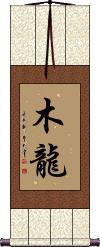
木龍 is Wood Dragon in Chinese.
In the Chinese zodiac and sexagenary (60-year) cycle, this combination occurs in years that include 1904, 1964, 2024, and 2084.
In the sexagenary cycle, this year is represented by 甲辰.
See Also: Dragon
Always with a Book in Hand
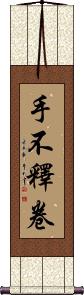
手不釋卷 is a Chinese proverb that literally means “always with a book in hand.”
It's a proverb said of a hardworking scholar or student.
This may refer to a student or scholar who is diligent and hardworking. It's a great gift for a student or scholar who loves books.
Birth / Life
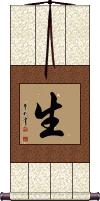
生 is a Chinese word that means “to be born” and “to give birth.”
Also, it's often used to refer to life itself, and sometimes “to grow.”
生 is used in a lot of compound words such as “yi sheng,” which means “doctor” (literally “healer of life”), “sheng ri” which means “birthday” (literally “birth-day”), and “xue sheng” which means student (literally “studying life” or “learner [about] life”). Few Chinese people will think of the literal meaning when this uses words like doctor and student - but it is interesting to note.
生 has the same root meaning in Korean Hanja and Japanese. However, in Japanese, there are many possible pronunciations, and this can be used to mean “raw” or “unprocessed” (as in draft beer). Therefore, not be the best if your audience is Japanese.
See Also: Vitality
Confucius: Universal Education
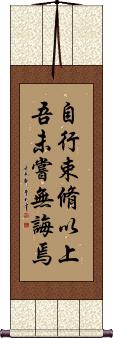
自行束脩以上吾未尝无诲焉 means, for anyone who brings even the smallest token of appreciation, I have yet to refuse instruction.
Another way to put it is: If a student (or potential student) shows just an ounce of interest, desire, or appreciation for the opportunity to learn, a teacher should offer a pound of knowledge.
This quote is from the Analects of Confucius.
This was written over 2500 years ago. The composition is in ancient Chinese grammar and phrasing. A modern Chinese person would need a background in Chinese literature to understand this without the aid of a reference.
Daito-Ryu Aiki-jujutsu
School of Japanese Martial Arts
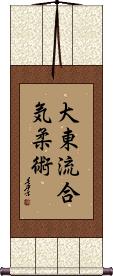
大東流合気柔術 is Daitō-Ryū Aiki-jūjutsu, a Japanese martial art established by Takeda Sōkaku.
The most famous student of Daitō-Ryū Aiki-jūjutsu is Morihei Ueshiba who later founded the school or branch of martial arts known as Aikido.
Note: 大東流合気柔術 can also be romanized as Daito-ryu Aiki-Jujutsu, Daitou-Ryuu Aiki-Juujutsu or Daito-Ryu Aiki-Jujitsu.
Daodejing / Tao Te Ching - Chapter 27
The Mastery of Effortless Skill

Chapter 27 of the Daodejing reveals a profound truth about mastery: the highest skill leaves no trace, requires no force, and appears almost invisible.
善行無轍跡,
善言無瑕謫,
善數不用籌策,
善閉無關鍵而不可開,
善結無繩約而不可解。
是以聖人常善救人,
故無棄人;
常善救物,
故無棄物。
是謂襲明。
故善人者,不善人之師;
不善人者,善人之資。
不貴其師,不愛其資,
雖智大迷,
是謂要妙。
The sage moves through life with such natural harmony that nothing seems imposed; doors need no locks, knots require no rope, and actions leave no mark behind.
This is the essence of wúwéi (effortless action), where true ability arises from deep alignment with the Tao rather than deliberate effort.
At its heart, this chapter teaches compassion without exception. The sage “abandons no one and nothing,” recognizing value in all people and all things. Even those who seem flawed or unrefined are not rejected, but understood as part of a greater whole with each person both a student and a teacher in the unfolding of life.
Laozi reminds us that wisdom is not about perfection or control, but about subtle awareness. The truly skilled individual does not rely on tools, rules, or rigid structures; instead, they embody an intuitive understanding that makes their actions naturally complete.
In this way, excellence becomes quiet, effortless, and beyond imitation.
This teaching also reflects a deeper philosophical insight: Opposites are interdependent. The “good” person learns from the “not good,” and the “not good” provides the material for growth. To reject either is to misunderstand the balance of existence itself.
As calligraphy, Daodejing Chapter 27 serves as a reminder to cultivate inner mastery rather than outward display. It is a meditation on refinement, humility, and the quiet power of skill perfected through harmony with the natural order.
Note: The Chinese text used here is based on the early Mawangdui silk manuscript tradition (2nd century BCE). The Guodian manuscripts do NOT preserve Chapter 27 in full form.
Drain the pond to get all the fish
Kill the goose that lays the golden eggs
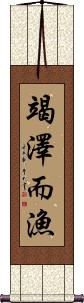
In 632 BC, Duke Wen of the Kingdom of Jin was about to lead an army against the forces of the Kingdom of Chu.
The Duke asked one of his advisers, Jiu Fan, how they could win the impending battle, as they were drastically outnumbered.
Jiu Fan said, “All is fair in war,” and suggested a plan of dishonorable tactics (cheating).
The Duke was unsure of this advice, so he asked another adviser, Yong Ji, who replied, “If you catch fish by draining the pond, you can certainly get all the fish. But there will be no fish the following year. You can cheat this one time in battle, but such tactics can only be used once, as the enemy will be wise in future encounters.”
The Duke heard the words of his wiser adviser but cheated to gain victory in the battle. However, he rewarded Yong Ji more than Jiu Fan at the victory celebration, stating that while Jiu Fan's advice gained one victory, the wise words of Yong Ji would last forever.
This Chinese idiom/proverb is still used, over 2600 years later to remind people not to burn bridges, cheat, or dishonor themselves in exchange for a short-term gain while sacrificing the future.
竭澤而漁 is very similar to the meaning of the English phrase, “Kill the goose that lays the golden eggs.”
Guanxi
The Chinese Concept of Relationship and Exchange of Favors
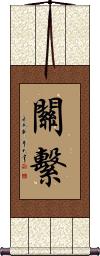
The dictionary definition is:
Relations/relationship, to concern, to affect, to have to do with, or connection.
But there's more to it...
In China, the relationship that you have with certain people can open doors for you. Having guanxi with someone also means they would never defraud you but are honor-bound to treat you fairly (of course, this goes both ways). Sometimes it is suggested that guanxi is the exchange of favors. 關繫 / 関繫 / 關係 is more about having a relationship that allows you to ask for and expect favors without shame.
There is no concept in western culture that exactly matches guanxi, but perhaps having a social or professional network is similar.
Note that there are some variations common within Chinese, Japanese Kanji, and Korean Hanja for this word... Japanese tend to use a Chinese alternate form as shown to the right for
the first character.
 There's also another alternate form of that first character (currently used as the official Simplified form in mainland China) which looks like the character shown to the right. It's basically the central radical of the alternate version shown above but without the “door radical” around it. In more free-flowing calligraphy styles, this version would be the likely choice for a calligrapher.
 In Modern Japanese, they use the character shown to the right.
They also tend to use this same form in Korean Hanja (I've only checked this word in my Korean dictionary, but it has not been confirmed by a translator's review).
 If that was not confusing enough, there is another alternate form of that second character. See right.
An Asian calligrapher of any nationality may use these forms at their discretion. However, They would tend to stick to the most common form used in their respective languages.
If you have any preference on any of these issues, please give us a special note with your order, and we'll make sure it's done the way you want.
Islam
(phonetic version)
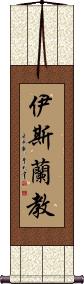
伊斯蘭教 both means and sounds like “Islam” in Mandarin Chinese.
The first three characters sound like the word “Islam,” and the last character means “religion” or “teaching.” It's the most general term for “Islam” in China. The highest concentration of Muslims in China is Xinjiang (the vast region in northwest China that was called The East Turkistan Republic until 1949 and is sometimes called Chinese Turkistan, Uyghuristan). Here you will find Uygurs, Kazakhs, Kyrgyz, and others that are descendants of Turkmen (possibly mixed with Persians and Arabs). Many of their ancestors were traders who traveled the silk road to buy and sell spices and silk and exchange other goods from the Orient and the Middle East.
I spent some time in Xinjiang and got to know this community. They are strong people who can endure much. They are friendly and love to have a good time. I was a stranger but was treated by villagers (near China's border with Afghanistan) as if I was a good friend.
However, I have heard that it's best not to cross them, as in this land, the law is the blade, and everything is “eye for an eye.” The Chinese government has little control in Xinjiang, with almost no police officers except in the capital of Urumqi (so it's a 60-hour roundtrip train ride to seek the aid of law enforcement in most cases).
While few seem devout, there are at least small mosques in every village. And you will never see a man or woman outside without a head covering.
It should be noted that these people are all citizens of China, but they are officially of the Caucasian race. A visit to Xinjiang will change your idea of what it means to be Chinese.
Kyousei / Kyōsei
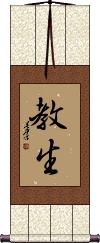
教生 is a Japanese name that can be romanized as Norio, Kyousei, or Atsuo.
These Kanji are sometimes an abbreviation for “student teacher.”
Love and Respect
Love each other and show mutual respect
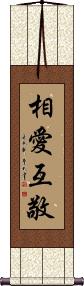
相愛互敬 is a nice way to say “Love and Respect” in Chinese.
This proverb is about the mutual exchange of love and respect within a good relationship.
The first two characters create a word that means “to love each other” or “mutual love.”
The third character means mutual, interlocking, or in some contexts, “to dovetail” (as in how joints are made in fine furniture).
The last character means “to respect,” “to venerate,” “to salute,” “reverence,” or simply “respect.”
Love and Respect
Love and respect each other
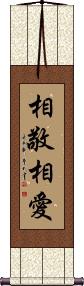
相敬相愛 is an old Chinese proverb that suggests love and respect go together and are to be exchanged between people (especially couples).
The first two characters mean “exchanging respect” or “mutual respect.”
The last two characters create a word that means “to love each other” or “mutual love.”
You'll notice that the first and third characters are the same. So you can read this literally as something like “Exchange respect, exchange love” or “Mutual respect, mutual love.” In English, we'd probably just say, “Mutual love and respect.” Grammar differs in every language - So while the literal translation might sound a bit awkward in English, this phrase is very natural in Chinese.
Meibukan
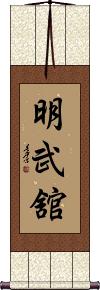
Meibukan (明武舘) is a branch of Gōjū-ryū karate. It was created by Meitoku Yagi, a student of Goju-ryu's founder, Chojun Miyagi. Meibukan means "House of the pure-minded warrior."
New Life
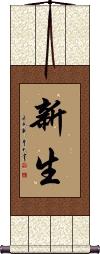
新生 literally means “new life” or “new birth” in Chinese, Japanese Kanji, and old Korean Hanja.
Depending on the context, this word can also mean newborn, new student, rebirth, new birth, or nascent.
In Japanese, this can be the given name Wakaki.
Note: This is not the most common word selection for a calligraphy wall scroll. But if you’re a westerner, you can bend the rules a bit.
There is No Royal Road to Learning
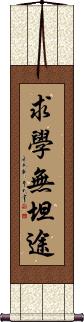
求學無坦途 is a Chinese proverb that translates as “There is no royal road to learning.”
This suggests that the path of learning can never be smooth, there will be difficulties and troubles along the way.
See Also: Learning is Eternal
The Sea of Knowledge Has No Limits
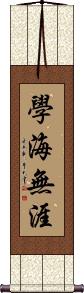
學海無涯 is a Chinese proverb that reads, “sea of learning, no horizon.”
Colloquially, it means there are no limits to what one still has left to learn.
This would be the Chinese equivalent to the quote from Hippocrates, “ars longa, vita brevis,” meaning “it takes a long time to acquire and perfect one's expertise.”
See Also: Learning is Eternal
River of Literacy, Sea of Learning
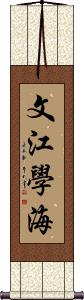
文江學海 is a Chinese proverb that reads, “river of literacy, a sea of learning”
This suggests that there is a lot to learn in the world, with an eternal amount of reading and things to study.
文江學海 is one way to translate the quote from Hippocrates, “ars longa, vita brevis,” meaning “it takes a long time to acquire and perfect one's expertise.”
See Also: Learning is Eternal
Ronin / Masterless Samurai
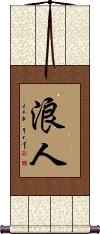
The 浪人 or Ronin have no master - The most famous are the 47 ronin created after their Lord committed suicide. This term was not a positive title for the Samurai of ancient Japan. However, in recent years, movies and video games have glorified the term Ronin.
In Chinese, this term has the original meaning of a hobo, vagabond, or ruffian.
In Korean Hanja, these characters would be read as adventurer, wanderer, someone without a steady job, or someone who is wasting away time.
In modern Japan, this term is used as a nickname for a high school student who has failed a college entry exam (and is trying again).
In Chinese and Korean, the Japanese definition of “Masterless Samurai” is known because of the historical context. Even in Japanese, the literal translation is closer to the Chinese and Korean definitions shown above.
This will make a fine wall scroll if you are a fan of the Ronin or see yourself as a Ronin of sorts. However, please think twice before getting a Ronin tattoo!
Shorinji Kempo / Kenpo
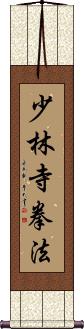
少林寺拳法 is a specific type of martial art in Japan that claims origins in the Kung Fu practiced in the original Shaolin Monastery of China.
The first three characters mean “Shaolin Monastery,” and you might notice the Japanese is pronounced in a very similar way. The reason is, many words were “borrowed” from the original Chinese when Japan did not have a written language and simply absorbed Chinese characters into their language around the 5th century. When a Japanese word did not exist, the Chinese pronunciation was often absorbed as well as the written form.
The last two characters mean “fist law” or “method of the fist.” It has long been argued as to whether the Japanese for these characters should be Romanized as “kempo” or “kenpo.” The official method should be “kenpou” but it's common to drop the “u” that comes after the “o.”
I imagine if you are looking for this title, you already know what it means, so the above is simply extra information that a student of Shorinji Kempo might want to know.
Student
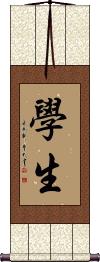
學生 is how to write “student” in Chinese, pre-WWII Japanese Kanji, and old Korean Hanja.
If you are a “student of life,” this might be an interesting wall scroll to hang in your reading room.
The first character means “study” or “learning.”
The second character means “life” or “birth.” Don't read too much into that second character unless you decide that this means “the birth of studies” or “the life of learning.” Everyone in China, Japan (and those who can read Hanja in Korea) will just read this word with the meaning of “student.”
If you put the character for “little” in front of this word, it becomes “elementary school student.” Prefixed with “middle,” it becomes “middle school student.” Prefixed with “big,” it becomes “university student” (though when these two characters for student are seen alone, it often suggests “university student”). The term “high school student” is written differently.
 There is a very common simplified version of the first character for this word. You will see this form in modern Japan and mainland China, Singapore, and other places. If you want this simplified version, please click on the character shown to the right instead of the "select and customize" button above.
Uchi-Deshi

内弟子 is a Japanese term for a live-in student, pupil, or apprentice.
In the context of martial arts, it is an apprentice who trains under and assists a sensei on a full-time basis.
It is better to be a warrior in a garden than a gardener in a war
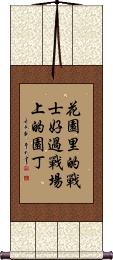
花園里的戰士好過戰場上的園丁 is the Chinese for the phrase, “It is better to be a warrior in a garden than a gardener in a war.”
This proverb is purported to come from the following exchange:
A student approaches his samurai master and says,
“Teacher, you instruct me how to fight, yet you preach to me about peace. How do I reconcile the two?”
The samurai responds,
“Because it is better to be a warrior in a garden than a gardener in a war.”
This in-stock artwork might be what you are looking for, and ships right away...


The following table may be helpful for those studying Chinese or Japanese...
| Title | Characters | Romaji (Romanized Japanese) | Various forms of Romanized Chinese | |
| Wood Dragon | 木龍 木龙 | mù lóng / mu4 long2 / mu long / mulong | mu lung / mulung | |
| Always with a Book in Hand | 手不釋卷 手不释卷 | shǒu bù shì juàn shou3 bu4 shi4 juan4 shou bu shi juan shoubushijuan | shou pu shih chüan shoupushihchüan |
|
| Birth Life | 生 | shou / iku / sho / iku | shēng / sheng1 / sheng | |
| Confucius: Universal Education | 自行束脩以上吾未嘗無誨焉 (note 嘗 = 嚐) 自行束脩以上吾未尝无诲焉 | zì xíng shù xiū yǐ shàng wú wèi cháng wú huì yān zi4 xing2 shu4 xiu1 yi3 shang4 wu2 wei4 chang2 wu2 hui4 yan1 zi xing shu xiu yi shang wu wei chang wu hui yan | tzu hsing shu hsiu i shang wu wei ch`ang wu hui yen tzu hsing shu hsiu i shang wu wei chang wu hui yen |
|
| Daito-Ryu Aiki-jujutsu | 大東流合氣柔術 大東流合気柔術 | dai tou ryuu ai ki ju jutsu daitouryuuaikijujutsu dai to ryu ai ki ju jutsu | ||
| Daodejing Tao Te Ching - Chapter 27 | 善行無轍跡善言無瑕謫善數不用籌策善閉無關鍵而不可開善結無繩約而不可解是以聖人常善救人故無棄人常善救物故無棄物是謂襲明故善人者不善人之師不善人者善人之資不貴其師不愛其資雖智大迷是謂要妙 善行无辙迹善言无瑕谪善数不用筹策善闭无关键而不可开善结无绳约而不可解是以圣人常善救人故无弃人常善救物故无弃物是谓袭明故善人者不善人之师不善人者善人之资不贵其师不爱其资虽智大迷是谓要妙 | shàn xíng wú zhé jì shàn yán wú xiá zhé shàn shù bù yòng chóu cè shàn bì wú guān jiàn ér bù kě kāi shàn jié wú shéng yuē ér bù kě jiě shì yǐ shèng rén cháng shàn jiù rén gù wú qì rén cháng shàn jiù wù gù wú qì wù shì wèi xí míng gù shàn rén zhě bù shàn rén zhī shī bù shàn rén zhě shàn rén zhī zī bù guì qí shī bù ài qí zī suī zhì dà mí shì wèi yào miào shan4 xing2 wu2 zhe2 ji4 shan4 yan2 wu2 xia2 zhe2 shan4 shu4 bu4 yong4 chou2 ce4 shan4 bi4 wu2 guan1 jian4 er2 bu4 ke3 kai1 shan4 jie2 wu2 sheng2 yue1 er2 bu4 ke3 jie3 shi4 yi3 sheng4 ren2 chang2 shan4 jiu4 ren2 gu4 wu2 qi4 ren2 chang2 shan4 jiu4 wu4 gu4 wu2 qi4 wu4 shi4 wei4 xi2 ming2 gu4 shan4 ren2 zhe3 bu4 shan4 ren2 zhi1 shi1 bu4 shan4 ren2 zhe3 shan4 ren2 zhi1 zi1 bu4 gui4 qi2 shi1 bu4 ai4 qi2 zi1 sui1 zhi4 da4 mi2 shi4 wei4 yao4 miao4 shan xing wu zhe ji shan yan wu xia zhe shan shu bu yong chou ce shan bi wu guan jian er bu ke kai shan jie wu sheng yue er bu ke jie shi yi sheng ren chang shan jiu ren gu wu qi ren chang shan jiu wu gu wu qi wu shi wei xi ming gu shan ren zhe bu shan ren zhi shi bu shan ren zhe shan ren zhi zi bu gui qi shi bu ai qi zi sui zhi da mi shi wei yao miao | shan hsing wu che chi shan yen wu hsia che shan shu pu yung ch`ou ts`e shan pi wu kuan chien erh pu k`o k`ai shan chieh wu sheng yüeh erh pu k`o chieh shih i sheng jen ch`ang shan chiu jen ku wu ch`i jen ch`ang shan chiu wu ku wu ch`i wu shih wei hsi ming ku shan jen che pu shan jen chih shih pu shan jen che shan jen chih tzu pu kuei ch`i shih pu ai ch`i tzu sui chih ta mi shih wei yao miao shan hsing wu che chi shan yen wu hsia che shan shu pu yung chou tse shan pi wu kuan chien erh pu ko kai shan chieh wu sheng yüeh erh pu ko chieh shih i sheng jen chang shan chiu jen ku wu chi jen chang shan chiu wu ku wu chi wu shih wei hsi ming ku shan jen che pu shan jen chih shih pu shan jen che shan jen chih tzu pu kuei chi shih pu ai chi tzu sui chih ta mi shih wei yao miao |
|
| Drain the pond to get all the fish | 竭澤而漁 竭泽而渔 | jié zé ér yú jie2 ze2 er2 yu2 jie ze er yu jiezeeryu | chieh tse erh yü chiehtseerhyü |
|
| Guanxi | 關繫 / 関繫 / 關係 关系 / 関係 | kankei | guān xì / guan1 xi4 / guan xi / guanxi | kuan hsi / kuanhsi |
| Islam | 伊斯蘭教 伊斯兰教 | yī sī lán jiào yi1 si1 lan2 jiao4 yi si lan jiao yisilanjiao | i ssu lan chiao issulanchiao |
|
| Kyousei Kyōsei | 教生 | norio / kyousei norio / kyosei | ||
| Love and Respect | 相愛互敬 相爱互敬 | xiāng ài hù jìng xiang1 ai4 hu4 jing4 xiang ai hu jing xiangaihujing | hsiang ai hu ching hsiangaihuching |
|
| Love and Respect | 相敬相愛 相亲相爱 | xiāng jìng xiāng ài xiang1 jing4 xiang1 ai4 xiang jing xiang ai xiangjingxiangai | hsiang ching hsiang ai hsiangchinghsiangai |
|
| Meibukan | 明武舘 | mei bu kan / meibukan | ||
| New Life | 新生 | waka ki / wakaki | xīn shēng xin1 sheng1 xin sheng xinsheng | hsin sheng hsinsheng |
| There is No Royal Road to Learning | 求學無坦途 求学无坦途 | qiú xué wú tǎn tú qiu2 xue2 wu2 tan3 tu2 qiu xue wu tan tu qiuxuewutantu | ch`iu hsüeh wu t`an t`u chiuhsüehwutantu chiu hsüeh wu tan tu |
|
| The Sea of Knowledge Has No Limits | 學海無涯 学海无涯 | xué hǎi wú yá xue2 hai3 wu2 ya2 xue hai wu ya xuehaiwuya | hsüeh hai wu ya hsüehhaiwuya |
|
| River of Literacy, Sea of Learning | 文江學海 文江学海 | wén jiāng xué hǎi wen2 jiang1 xue2 hai3 wen jiang xue hai wenjiangxuehai | wen chiang hsüeh hai wenchianghsüehhai |
|
| Ronin Masterless Samurai | 浪人 | rou nin / rounin / ro nin | làng rén / lang4 ren2 / lang ren / langren | lang jen / langjen |
| Shorinji Kempo Kenpo | 少林寺拳法 | shourinji kenpou shourinjikenpou shorinji kenpo | shào lín sì quán fǎ shao4 lin2 si4 quan2 fa3 shao lin si quan fa shaolinsiquanfa | shao lin ssu ch`üan fa shaolinssuchüanfa shao lin ssu chüan fa |
| Student | 學生 学生 | gakusei | xué shēng xue2 sheng1 xue sheng xuesheng | hsüeh sheng hsüehsheng |
| Uchi-Deshi | 内弟子 | uchideshi | ||
| It is better to be a warrior in a garden than a gardener in a war | 花園里的戰士好過戰場上的園丁 花园里的战士好过战场上的园丁 | huā yuán lǐ de zhàn shì hǎo guò zhàn chǎng shàng de yuán dīng huā yuán lǐ de zhàn shì hǎo guò zhàn chǎng shàng de yuán dīng ài wēng huā yuán lǐ de zhàn shì hǎo guò zhàn chǎng shàng de yuán dīng hua1 yuan2 li3 de zhan4 shi4 hao3 guo4 zhan4 chang3 shang4 de yuan2 ding1 hua1 yuan2 li3 de zhan4 shi4 hao3 guo4 zhan4 chang3 shang4 de yuan2 ding1 ai4 weng1 hua1 yuan2 li3 de zhan4 shi4 hao3 guo4 zhan4 chang3 shang4 de yuan2 ding1 hua yuan li de zhan shi hao guo zhan chang shang de yuan ding hua yuan li de zhan shi hao guo zhan chang shang de yuan ding ai weng hua yuan li de zhan shi hao guo zhan chang shang de yuan ding | hua yüan li te chan shih hao kuo chan ch`ang shang te yüan ting hua yüan li te chan shih hao kuo chan ch`ang shang te yüan ting ai weng hua yüan li te chan shih hao kuo chan ch`ang shang te yüan ting hua yüan li te chan shih hao kuo chan chang shang te yüan ting hua yüan li te chan shih hao kuo chan chang shang te yüan ting ai weng hua yüan li te chan shih hao kuo chan chang shang te yüan ting |
|
| In some entries above you will see that characters have different versions above and below a line. In these cases, the characters above the line are Traditional Chinese, while the ones below are Simplified Chinese. | ||||

Successful Chinese Character and Japanese Kanji calligraphy searches within the last few hours...



