Many custom options


And formats



The Name Cien in Chinese / Japanese
Buy a Cien calligraphy wall scroll here!
Personalize your custom “Cien” project by clicking the button next to your favorite “Cien” title below.
Cien
qián
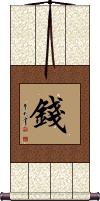
錢 is the name Cien in Chinese (Mandarin).
Cien
shien

シエン is the name Cien in Japanese Katakana.
Note: Because this title is entirely Japanese Katakana, it should be written by a Japanese calligrapher.
Not the results for cien that you were looking for?
Below are some entries from our dictionary that may match your cien search:
| Characters If shown, 2nd row is Simp. Chinese |
Pronunciation Romanization |
Simple Dictionary Definition |
法相 see styles |
fǎ xiàng fa3 xiang4 fa hsiang hossou / hosso ほっそう |
(1) {Buddh} (See 法性) dharmalaksana (dharma characteristics, the specific characteristics of all manifest phenomena); (2) (abbreviation) (See 法相宗) Hosso sect of Buddhism The aspects of characteristics of things-all things are of monad nature but differ in form. A name of the 法相宗 Faxiang or Dharmalakṣaṇa sect (Jap. Hossō), called also 慈恩宗 Cien sect from the Tang temple, in which lived 窺基 Kuiji, known also as 慈恩. It "aims at discovering the ultimate entity of cosmic existence n contemplation, through investigation into the specific characteristics (the marks or criteria) of all existence, and through the realization of the fundamental nature of the soul in mystic illumination". "An inexhaustible number" of "seeds" are "stored up in the Ālaya-soul; they manifest themselves in innumerable varieties of existence, both physical and mental". "Though there are infinite varieties. . . they all participate in the prime nature of the ālaya." Anesaki. The Faxiang School is one of the "eight schools", and was established in China on the return of Xuanzang, consequent on his translation of the Yogācārya works. Its aim is to understand the principle underlying the 萬法性相 or nature and characteristics of all things. Its foundation works are the 解深密經, the 唯識論, and the 瑜伽論. It is one of the Mahāyāna realistic schools, opposed by the idealistic schools, e.g. the 三論 school; yet it was a "combination of realism and idealism, and its religion a profoundly mystic one". Anesaki. |
玄奘 see styles |
xuán zàng xuan2 zang4 hsüan tsang genjou / genjo げんじょう |
Xuanzang (602-664), Tang dynasty Buddhist monk and translator who traveled to India 629-645 (given name) Genjō; (person) Xuanzang (602-664) Xuanzang, whose name is written variously e. g. Hsüan Chuang, Hiüen-tsang, Hiouen Tsang, Yüan Tsang, Yüen Chwang; the famous pilgrim to India, whose surname was 陳 Chen and personal name 禕 Wei; a native of Henan, A. D. 600-664 (Giles). It is said that he entered a monastery at 13 years of age and in 618 with his elder brother, who had preceded him in becoming a monk, went to Chang-an 長安, the capital, where in 622 he was fully ordained. Finding that China possessed only half of the Buddhist classics, he took his staff, bound his feet, and on foot braved the perils of the deserts and mountains of Central Asia. The date of his setting out is uncertain (629 or 627), but the year of his arrival in India is given as 633: after visiting and studying in many parts of India, he returned home, reaching the capital in 645, was received with honour and presented his collection of 657 works, 'besides many images and pictures, and one hundred and fifty relics, 'to the Court. Taizong, the emperor, gave him the 弘福寺 Hongfu monastery in which to work. He presented the manuscript of his famous 大唐西域記 Record of Western Countries in 646 and completed it as it now stands by 648. The emperor Gaozong called him to Court in 653 and gave him the 慈恩寺 Cien monastery in which to work, a monastery which ever after was associated with him; in 657 he removed him to the 玉華宮 Yuhua Gong and made that palace a monastery. He translated seventy-five works in 1335 juan. In India he received the titles of 摩訶耶那提婆 Mahāyānadeva and 木叉提婆 Mokṣadeva; he was also known as 三藏法師 Tripiṭaka teacher of Dharma. He died in 664, in his 65th year. |
四部經 四部经 see styles |
sì bù jīng si4 bu4 jing1 ssu pu ching shibu kyō |
The four sutras of the Pure Land sect, according to 慈恩 Cien, i. e. the 無量壽經; 觀無量壽經; 阿彌陀經, and 鼓音壽處陀羅尼經. |
慈恩傳 慈恩传 see styles |
cí ēn zhuàn ci2 en1 zhuan4 tz`u en chuan tzu en chuan Jion den |
Biography of Cien |
五種唯識 五种唯识 see styles |
wǔ zhǒng wéi shì wu3 zhong3 wei2 shi4 wu chung wei shih goshu yuishiki |
The five kinds of weishi, or idealistic representation in the sutras and śāstras as summed up by Cien 慈恩 of the 法相宗 Dharmalakṣana school: (1) 境唯識 wisdom or insight in objective conditions; (2) 教唯識 in interpretation; (3) 理唯識 in principles; (4) 行唯識 in meditation and practice; (5) 果唯識 in the fruits or results of Buddhahood. The first four are objective, the fifth subject. |
慈恩大師 慈恩大师 see styles |
cí ēn dà shī ci2 en1 da4 shi1 tz`u en ta shih tzu en ta shih Jion Daishi |
the great master Cien |
六部大乘經 六部大乘经 see styles |
liù bù dà shèng jīng liu4 bu4 da4 sheng4 jing1 liu pu ta sheng ching rokubu daijō kyō |
The six works chosen by Cien 慈恩 as authoritative in the 法相宗 Dharmalakṣana school, i. e. 大方廣佛華嚴經 of which there are three translations; 解深密經4 tr.; 如來出現功德莊嚴經 untranslated; 阿毘達磨經 untranslated; 楞伽經 3 tr.; 厚嚴經 (also called 大乘密嚴經). |
大慈恩三藏 see styles |
dà cí ēn sān zàng da4 ci2 en1 san1 zang4 ta tz`u en san tsang ta tzu en san tsang Dai Jion sanzō |
"Tripitaka of the Ta Cien T'zu En Si" is one of Xuanzang's 玄奘 titles. |
The following table may be helpful for those studying Chinese or Japanese:
| Title | Characters | Romaji (Romanized Japanese) | Various forms of Romanized Chinese | |
| Cien | 錢 钱 | qián / qian2 / qian | ch`ien / chien | |
| Cien | シエン | shien | ||
| In some entries above you will see that characters have different versions above and below a line. In these cases, the characters above the line are Traditional Chinese, while the ones below are Simplified Chinese. | ||||

Successful Chinese Character and Japanese Kanji calligraphy searches within the last few hours...
A Journey of 1000 Miles Feels Like OneAalyanAaniyahAaronAasaAbdulrehmanAbigailAblachimAbubakarAcceptanceAdamAdraAdrienneAgnesAhmedAimanAkariAkashAkashanshuAkitaAlaiaAlanAlenaAlesiaAlessiaAlijahAlinAlinaAlirezaAlisonAlphieAlviAmberAmerAndreaAngelAngelaAngelieAngusAnikAnjaliAnjuAnkitAnnabelleAntonAntoniaArielArielleArifArinaArleeArnoldArshadArt of WarAshaAshrafAzamBayleighBe Like WaterBest FriendsBethBhumikaBillieBishalBlancaBless This HouseBlessings on This HomeBlissBody and MindBraydenBrielleBrooklynBuddhaCamilleCaroleCherryCienClairCleoCommitmentConnieContentmentCooperDakotaDanaDanielaDarronDawoodDebbieDennyDewiDimasDionDivine FavorDoodDorotaDrewEarth Fire Water AirEliasElijahEmonEngage With ConfidenceErrolEternalExpensiveFabioFannyFinnFireFisherFive PreceptsFive Reflections GoseiForgivenessFreedomFriendshipGabrielGailGanbatteGenerational PoemGinoGloriaGo-Dan - 5th Degree Black BeltGodzillaGolden DragonGolden Metal TigerGregGustavHalaHamzaHannya ShingyoHarrietHasanHazelHeathHeavenHeineHelenHelenaHernandezHilaryHillaryHitoriHome is Where the Heart IsHoseaHouseHuynhInfinityInfinity and BeyondIrisIsabellaJaceJaceyonJadaJadeJamalJanetJannaJayceJennaJensenJessaJessyJesusJoachimJohannaJohn 3:16JosieJulietteJustinKaiyaKamilKandiceKaneKarate-DoKarmenKawasakiKaylaKeeleyKellyKikiKimberlyKiraKobeKodyKrystalKyllaLauraLeiaLevonLife Goes OnLileeLindsayLonnieLoraLorenaLorenzoLouisaLourdesLuciano



